 Guide On Map
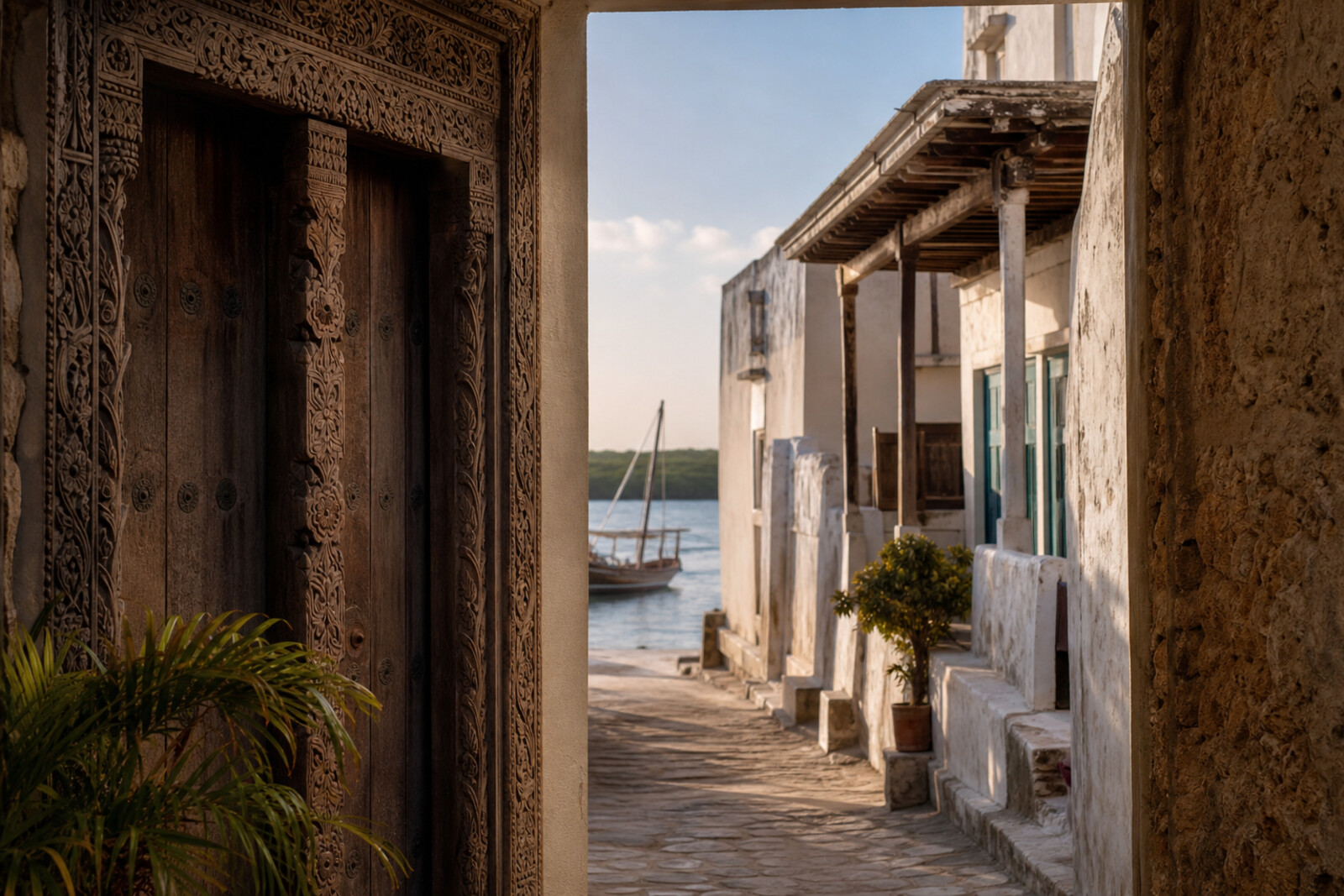
Lamu Old Town: Harbor, Houses, and Carved Doors
From Lamu Main Jetty through Mkomani and Langoni to the southern waterfront
Guide On Map on your phone
Open the walk like a regular app
It takes about 10 seconds to install. No app store needed.
The whole path
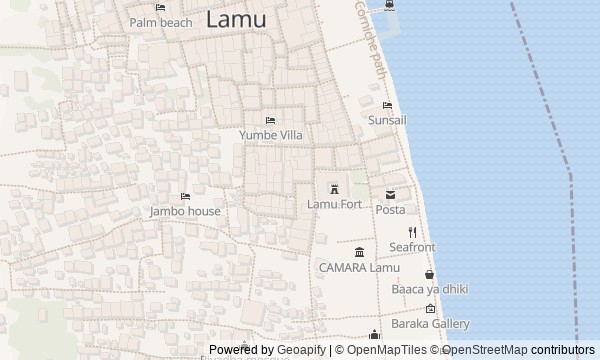
Route map
About the walk
You will begin at Lamu Main Jetty, where boats are ordinary city transport, not part of the maritime scenery. From here, the route follows the water, slips into the lanes of Mkomani and Langoni, crosses the market, and returns to Lamu Channel.
In the museums, you will not be looking at collections in the abstract, but at how the city works. First come the things its residents chose to keep in Lamu. Then comes a house where every room marks a new boundary of who may enter. Outside, add market stalls, the carved door of a working shop, a fort, 2 rooms from a former post office, and a school beside a mosque.
The stories turn on small clashes. Why did an empty dhow nearly lead to weapons being drawn? Why did one master leave his name where other carvers stayed silent? By the end, you will be able to read Lamu Old Town through its thresholds, room layouts, and the mangrove beams overhead.
Why this order
The jetty is the necessary beginning: only from the water does it become clear why the city's streets converge on the harbor. Just beyond it, Lamu Museum gathers objects from maritime and domestic Lamu, while Swahili House Museum shows how those same things were arranged inside a real floor plan. From enclosed family rooms, the route moves out to the market—a public place of exchange moved from the former waterfront square. Next comes the door of a working shop: after the market, you can see how trade entered directly into the home, and how a master marked the threshold. From a private entrance, the route shifts to the gates of Lamu Fort, where the defense of one city became an expansion of the sultan's power. Nearby, the small German Post Office in Lamu continues the theme of control through letters and sea routes. Riyadha Mosque and Islamic Centre offers a local answer to the struggle for connections and access—a school for people once excluded from education. The final stretch to the southern waterfront returns the route to the water and reveals the material basis of the houses: dhows brought the mangrove beams that roofed the narrow rooms of Lamu Old Town.
Those who want to understand how a Swahili city works through objects and floor plans Lovers of specific human episodes rather than a survey of dates Those ready to enter several small museums
Those looking for a walk to Shela Beach Those who care more about panoramic views than doors, rooms, and documents Those who do not want to hear about slavery and colonial rivalry
Before you go
Choose sturdy closed shoes and bring water: part of the route runs through uneven lanes, and old buildings have steps and thresholds. Save the route in advance, but check object names and signs—in dense development, the right entrance is not always obvious. It is best to check access to the small museums before setting out; a closed door does not mean you may look for a way in through a courtyard or service area. For Riyadha Mosque and Islamic Centre, wear clothing that covers your shoulders and knees. At the market, shops, and jetty, remember that these are workplaces, not scenery: do not block the way, delay loading, or photograph people without asking permission.
When to go
Start in the morning to walk the narrow streets before the midday heat and take your time over museum interiors, if they are open. At the jetty and market, give yourself time to get used to the movement of people and cargo, but do not stand in passageways. Approach Riyadha Mosque and Islamic Centre outside communal prayer; if a service or class is underway, continue the route without waiting to enter. Leave the southern channel for daylight, when the hulls of the boats, the opposite shore, and the strip of mangroves are clearer.
Backup plan
If a museum is closed, do not skip the stop: outside Lamu Museum, its closeness to the harbor and the scale of the former residence matter; at Swahili House Museum, the enclosed facade and the threshold itself; at Lamu Fort, the weight of its walls and its position by the former harbor; at German Post Office in Lamu, the institution's unobtrusive size. Do not try to enter behind staff or through neighboring properties. Without permission, listen to and view Riyadha Mosque and Islamic Centre only from outside. The jetty, market, Kijumwa Door (1897), and southern waterfront can all be observed from public space and keep the route coherent even if every interior is unavailable.
Route conditions
Surface. Paved — 292 m (data covers 19% of the route)
Facilities. Drinking water — 1
Elevation. Ascent — 20 m; descent — 15 m
OpenStreetMap extract of July 3, 2026: database data, not a check on the ground. Data © OpenStreetMap contributors, ODbL licence
Walk plan
Open in maps ↗- 1
Lamu Main Jetty
Here the island town's dependence on boats and a sheltered harbor will become clear. - 2
Lamu Museum
The former official residence shows how historical objects were collected and preserved on the island itself. - 3
Swahili House Museum
The layout will explain how a family separated business meetings, everyday life, and its most private rites. - 4
Lamu Central Market
This stop will connect present-day trade with the former shoreline and the cleared town square. - 5
Kijumwa Door (1897)
The master's signature turns an ordinary entrance into a rare record of a carver's authorship. - 6
Lamu Fort
The fort will show how a request for protection changed Lamu’s position along the whole coast. - 7
German Post Office Museum
Two museum rooms recall a brief attempt to govern a mainland protectorate through Lamu harbor. - 8
Riyadha Mosque and Islamic Centre
Here the route moves from the town's elite to the students who had previously been denied religious education. - 9
Southern Waterfront: Dhows, the Channel, and Mangrove Beams
The finale connects maritime trade with the beams that still determine the width of rooms in Lamu Old Town.
Route features
Everything you need stays in the browser
Progress, saves and your trip plan are stored on this device.
Add Guide On Map to your home screen so the walk opens outside the browser.
How we handle sources, maps and corrections: our editorial standards