 Guide On Map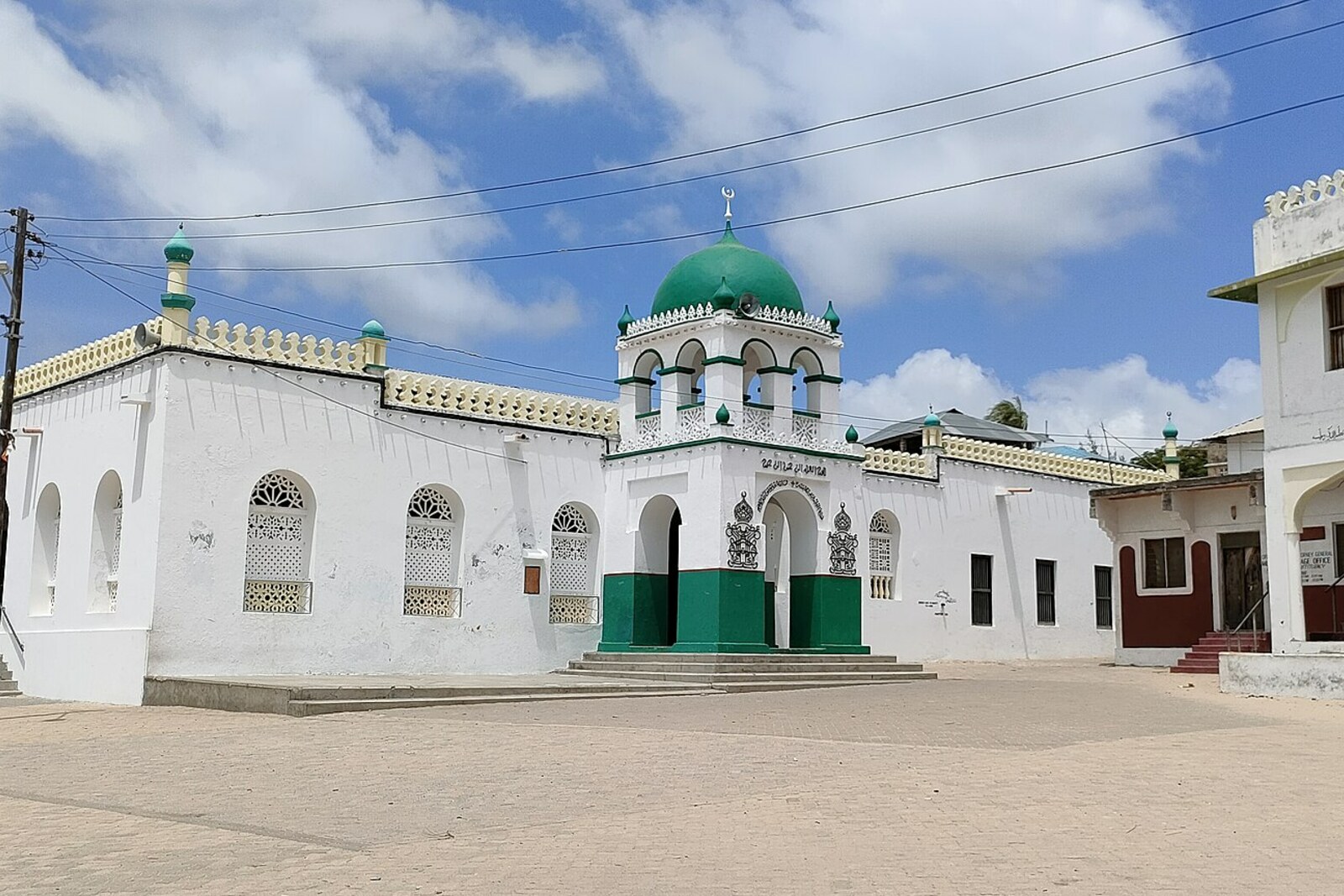
Look around first
What to notice
- The mosque facade
- Arched openings
- The inner courtyard
- Library cabinets with manuscripts
The story of the place
The arched openings in the facade lead into the courtyard of the Riyadha Mosque and Islamic Centre. The land beneath it was permanently set aside as a waqf for a religious purpose. Here, a prayer hall, school, and library operate under one roof, and classes are based on books and a fixed curriculum. The library cabinets hold manuscript copies of works by Ali bin Muhammad al-Habshi.
When the religious scholar Salih bin Alawi Jamal al-Layl arrived in Lamu in the eighteen eighties, he was offered a place to live in Mkomani, the stone-built part of town where prominent families lived. Salih bin Alawi Jamal al-Layl was a sayyid, meaning he was considered a descendant of the Prophet Muhammad, and he belonged to a circle for whom scholarship was both a profession and the basis of social standing. But he wanted to teach those whom local instructors did not admit to classes.
So Salih bin Alawi Jamal al-Layl chose Langoni, an outlying district where enslaved people, freed slaves, and workers from coconut plantations settled. He lived in a small mud-walled hut and began teaching there. Because of his closeness to coconut gatherers, he was nicknamed the “sharif of the coconut climbers.” The nickname precisely captured his commitment: a man of honored lineage linked his name to a group that the town's elite considered inferior. Salih bin Alawi Jamal al-Layl's students included Oromo, Giriama people, Pokomo, and others from beyond the old stone town. Many had previously been enslaved. He admitted them to the same religious texts and prayers studied by freeborn families. Former masters and former slaves found themselves in one community.
The students filled the hut, and Salih bin Alawi Jamal al-Layl needed a permanent place for classes. He was supported by Sayyid Mansab bin Abdurrahman, Lamu's senior scholar, whose opinion people sought in disputes over faith and language. In nineteen oh three, Sayyid Mansab bin Abdurrahman placed part of his land in a waqf: property permanently set aside for a religious or charitable cause. The Riyadha Mosque and Islamic Centre was built on that land.
The name referred to Al-Riyad School—“The Garden”—in the Yemeni city of Sayun. It was headed by the scholar Ali bin Muhammad al-Habshi, whose methods Salih bin Alawi Jamal al-Layl brought to Lamu. Instead of instruction available only through a personal connection with a teacher, classes based on books and a fixed curriculum were introduced here. The mosque became at once a prayer hall, school, and library.
Sayyid Mansab bin Abdurrahman's support did not mean agreement on everything. In nineteen oh nine, Ali bin Muhammad al-Habshi composed a new mawlid, a poetic account of the Prophet's birth, titled Simt al-Durar. Salih bin Alawi Jamal al-Layl performed it at the Riyadha Mosque and Islamic Centre with rhythmic accompaniment. Conservative townspeople complained to Sayyid Mansab bin Abdurrahman about music in the mosque, and he came to stop the innovation. Salih bin Alawi Jamal al-Layl reminded him that similar accompaniment had already been used by the revered Hadhramaut teacher Abu Bakr bin Salim. Sayyid Mansab bin Abdurrahman accepted the argument and announced to the town that the performance was permitted.
After Salih bin Alawi Jamal al-Layl's death, his sons continued the classes. The Riyadha Mosque and Islamic Centre admits children from the Lamu Archipelago and students of Islamic law, interpretation of the Qur'an, the Arabic language, and the Sufi tradition. The mosque library holds manuscript copies of works by Ali bin Muhammad al-Habshi, including Simt al-Durar. On the days of the annual Mawlid, the courtyard again fills with participants in the celebration that began with the performance Sayyid Mansab bin Abdurrahman came here to forbid.
Useful on site
Active mosque and Islamic centre; no public visitor arrangements have been published. This stop is intended to be viewed from the street.
Checked: date not specified. Check the official source before visiting.Cover your shoulders and knees, do not enter during prayer or classes without permission, and do not photograph worshippers.