 Guide On Map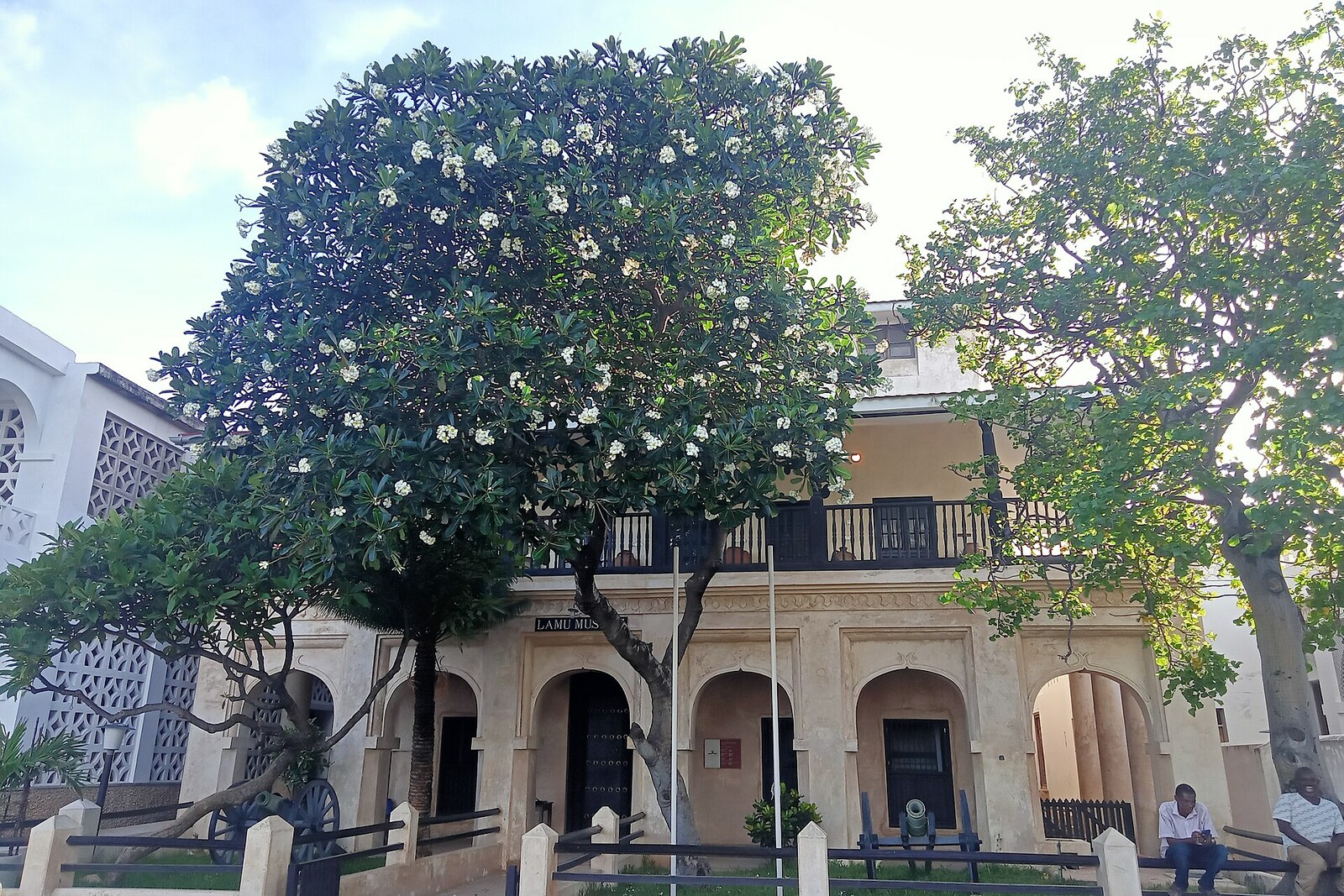
Look around first
What to notice
- Stone arcade
- Wooden veranda
- Inner courtyard
- Carved door with brass studs
The story of the place
Behind the carved wooden door with brass studs is a museum housed in Lamu’s former administrative offices. Instead of offices, manuscripts, household utensils, fishing gear, jewelry, and equipment for building dhows, collected across the islands of the Lamu Archipelago, are kept here. Many of these objects once belonged to families in Lamu and neighboring settlements, so the display cases hold not an abstract collection of antiquities but familiar island domestic life.
The two-story house, with a stone arcade, a wooden veranda, and an inner courtyard, was completed in eighteen ninety-two. It was commissioned by Abdallah bin Hamed bin Said al-Busaidi, a close associate of the Sultan of Zanzibar. When Abdallah moved to Mombasa, the house passed to a prominent family, and then the Imperial British East Africa Company occupied it. Later, the district commissioner—the chief administrator of Lamu—was housed here. Even after Kenya declared independence, the commissioner remained in this house until nineteen sixty-eight.
Two years later, the Kenyan historian James de Vere Allen arrived here. Previously, he had earned his living by teaching, but in Lamu he received the salary of a staff curator at the National Museums of Kenya. Allen sought funding to establish a coastal museum in the former residence. No ready-made collection awaited him: old doors, furniture, manuscripts, and household utensils still belonged to families in Lamu and neighboring settlements. Allen bought historical objects, and, according to the recollections of a contemporary, paid their owners good money.
The local ethnologist Omar Bwana worked on the same team. He recalled how staff traveled throughout the region and selected objects that could tell the story of indigenous communities: Swahili, Pokomo, Orma, Boni, and Sanye. They collected clothing, jewelry, amulets, musical instruments, items used to build dhows, and finds from abandoned settlements in the Lamu Archipelago. The objects were arranged in the rooms so that a resident of Lamu could show a child a familiar item and explain how it was used.
Allen headed the museum from nineteen seventy-one to nineteen seventy-three. He then resigned, making way for the first African curator. Omar Bwana remained in museum work, later headed museums on the Kenyan coast, and helped prepare the law that protected old Swahili houses, carved doors, and objects from removal and destruction.
The district commissioner’s rooms are now occupied by displays and storage areas. The museum objects include carved doors, manuscripts, fishing gear, and a ceremonial ivory siwa from Pate Island. The entrance has retained its carved wooden door with brass studs, and behind it remains the collection for which Allen sought funding, Bwana traveled through the archipelago, and families in Lamu parted with their belongings.
Useful on site
Daily 08:30–17:30, including public holidays; rates and hours are effective from 7 May 2026.
Checked: date not specified. Check the official source before visiting.View the collections only when the official entrance is open; when it is closed, limit yourself to the building from the street side.