 Guide On Map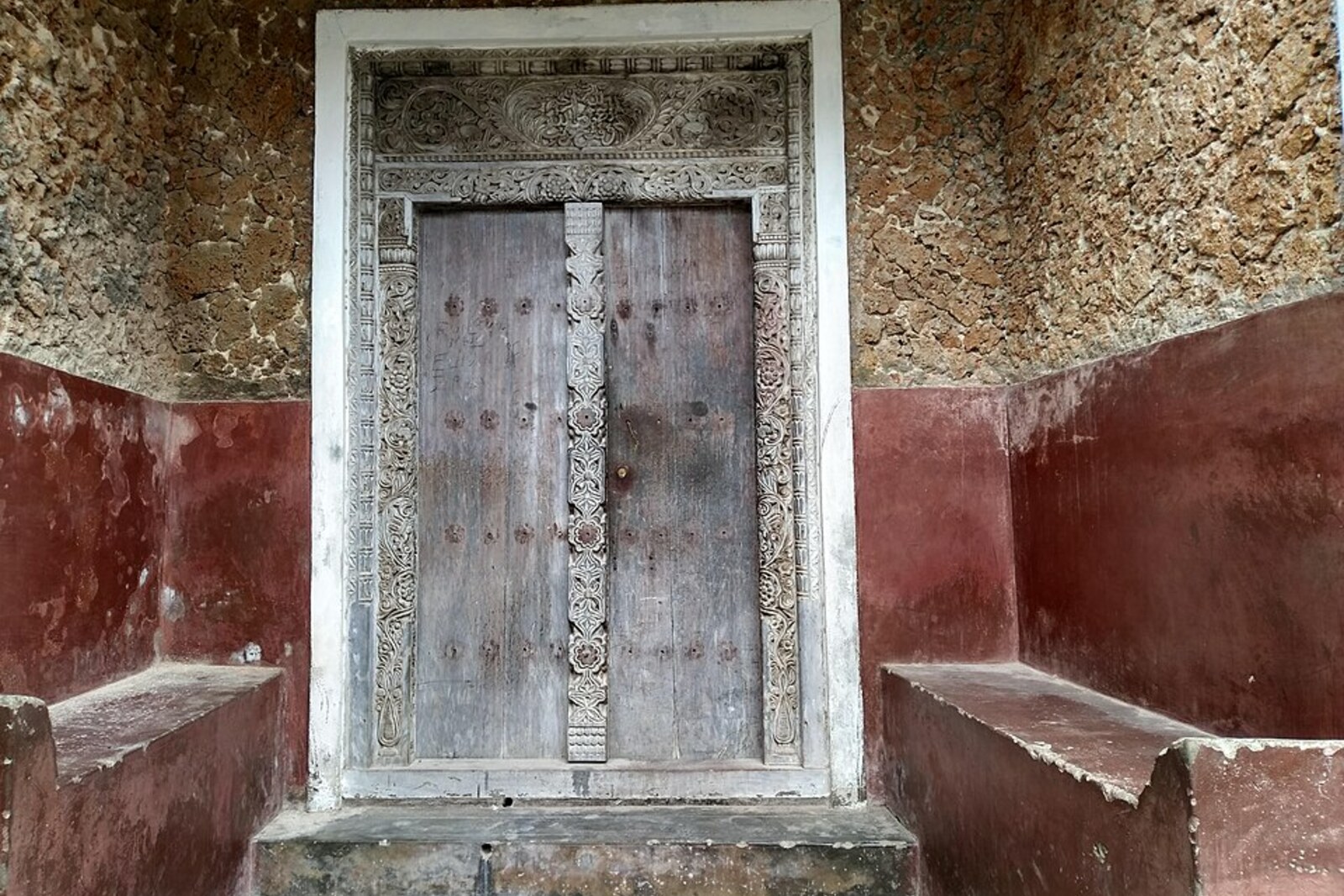
Look around first
What to notice
- Vegetal ornament
- Inscription on the upper crossbar
- Central upright
- Hand, fingers, and snake
The story of the place
Kijumwa is the name of the master who carved this entrance. In May eighteen ninety-seven, Muhammadu Kijumwa was commissioned to make a door for a shop and residence on Lamu's main street, a little south of the market. The door is still used as the entrance to commercial premises.
Kijumwa was a poet, musician, and calligrapher. He learned woodcarving without a teacher, through trial and error. He was invited to the sultan's court in Zanzibar as a musician; there he saw the work of Indian carvers. When he returned to Lamu, he transferred their curling stems, leaves, fruits, and flowers into wood, but began cutting the ornament at different depths. This work required up to ten kinds of tools. By the time of this commission, his style was already recognizable.
At the center of the upper crossbar, Kijumwa left a date in the Muslim calendar: the seventh of Dhu al-Hijjah, thirteen fourteen. Beside it, he carved the basmala—the words “In the name of God, the Most Gracious, the Most Merciful.” On Swahili doors, such an inscription served as a prayer for the protection of the home, property, and people passing through the threshold.
Most carvers did not leave their names on doors. Skill was considered a gift from God, and the maker was expected to stand aside before the sacred text. Kijumwa did otherwise. On the central upright beneath the basmala, he carved a twisting snake, a hand hooked around its coil, and fingers raised upward. Right there he placed the words “Fundi Kijumwa”—“master Kijumwa.” The hand points toward the sacred inscription above it. Among the surviving doors of the Swahili Coast, researchers know of no other signature like this on a central upright.
Kijumwa achieved what masters usually gave up: his authorship outlived the client. Later carvers adopted the deeply carved vegetal ornament, and this manner was called the Kijumwa style. At the original location remain the shop owner's prayer, the date of manufacture, and the name carved by the master himself.
Useful on site
The door is visible from the public street; the shop is not guaranteed to be open. The exact geotag is approximate; the verbal landmark is more reliable.
Checked: date not specified. Check the official source before visiting.This is an active entrance to a shop and home: view it from the street, do not touch the carving, and do not block the threshold.