 Guide On Map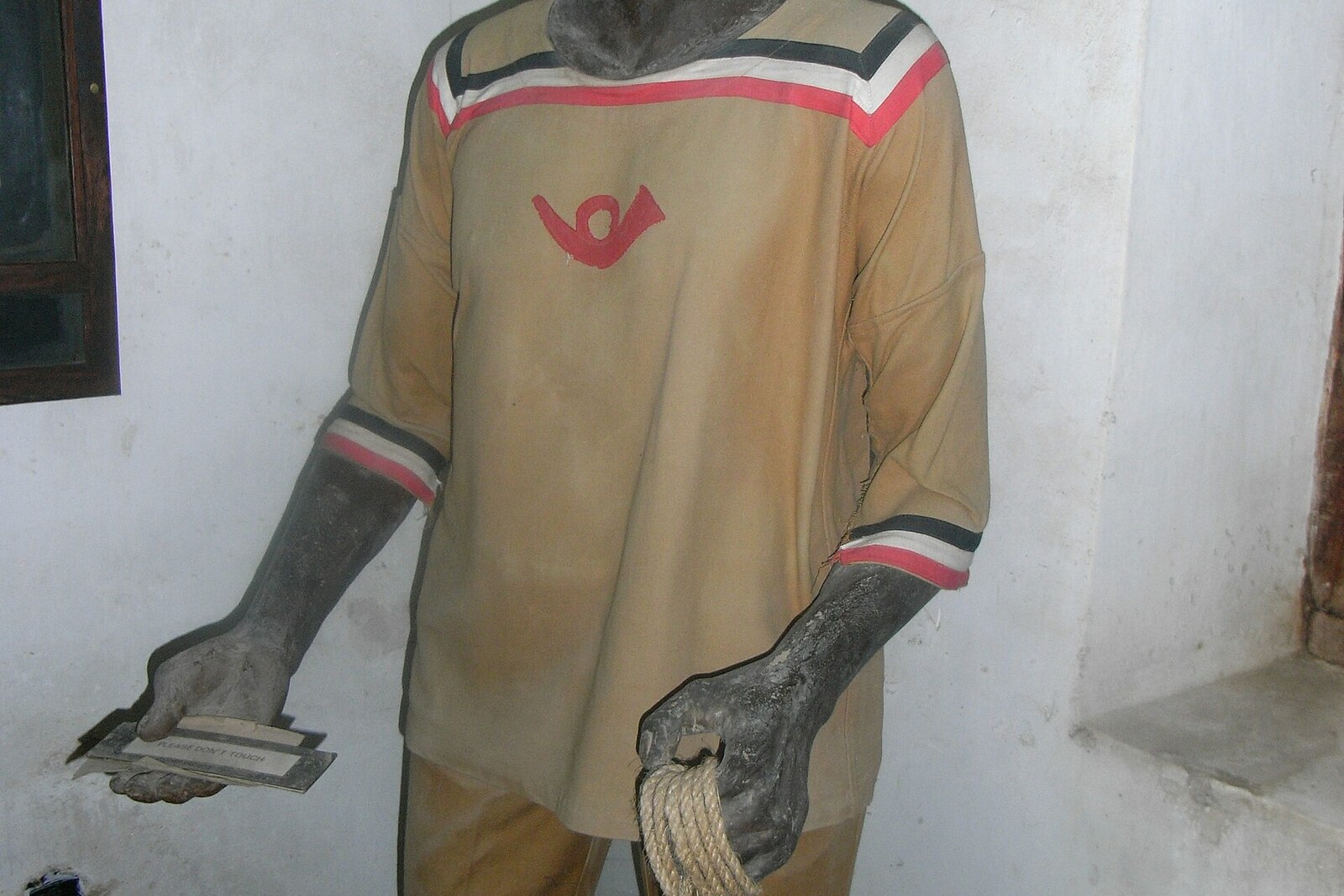
Look around first
What to notice
- Postal uniform
- Envelopes with circular postmarks
- Maps
- Historic photographs
The story of the place
In the former building of the German Witu Company, the museum occupies two small rooms. Display cases hold envelopes with circular postal markings, maps, and old photographs, while a uniform with a red horn hangs nearby. The office was run part-time by a company employee, and local staff sold stamps and processed registered mail. The National Museums of Kenya later acquired the building, restored it with support from the German embassy, and opened a museum here.
When a steamer delivered a sack of letters to Lamu, there was no mail service here yet. According to contemporary reports, Indian customs officers, hampered by the language barrier, emptied the correspondence onto the floor, and recipients searched for their own envelopes. Outgoing letters were placed in a wooden box with two compartments: one for Aden and Europe, the other for Mombasa and Zanzibar.
This system was especially inconvenient for Clemens Denhardt, a German explorer and entrepreneur. Together with his brother Gustav, he made an agreement with the ruler of Witu—a Swahili sultanate on the mainland south of Lamu—and secured a German protectorate over the territory. The brothers intended to trade there and establish plantations. Their contracts, reports, and orders passed through Lamu harbor: Witu had no other reliable access to sea routes. The island itself was not German territory.
After complaints from Denhardt and other German subjects, Imperial German Post agreed to open an official office here. On November twenty-second, eighteen eighty-eight, two rooms were set aside for it in the building of the German Witu Company. This is now the German Post Office Museum.
No professional postal officials were sent from Germany. The office was run part-time by Kurt Töppen, an employee of the Denhardt brothers' company; Carl Weiss later replaced him. Local staff sold German stamps, processed registered mail, and applied a circular postmark bearing the name Lamu and the words “East Africa.” They wore ochre shirts with a red postal horn and black, white, and red trim. Correspondence on which the company's deals and the administration of the Witu protectorate depended passed through these two rooms.
In eighteen ninety, the German government relinquished the protectorate over Witu under an agreement with Great Britain. By then, the Imperial British East Africa Company had already opened its own post office in Lamu. On March thirty-first, eighteen ninety-one, Carl Weiss closed the German office.
Of the original stock of two hundred fifty numbered registration labels for registered letters, the last was used on the eve of the closure. On the final day, collectors asked to have several more items canceled for them, and staff wrote the registration markings in red ink by hand.
In nineteen ninety-three, the National Museums of Kenya acquired the former post office building, restored it with support from the German embassy, and opened a museum here. Photographs, maps, postal uniforms, and envelopes with circular postmarks now occupy the building where the German Post Office in Lamu managed to operate for two years and four months.
Useful on site
Daily 08:30–17:30, including public holidays; rates and hours are valid as of 7 May 2026.
Checked: date not specified. Check the official source before visiting.The small exhibition may be unavailable regardless of the other museums; view the interior only through the official entrance.