 Guide On Map
Mogador: port, walls, and medina
From Bab el-Marsa through the kasbah and markets to Bayt Dakira
Guide On Map on your phone
Open the walk like a regular app
It takes about 10 seconds to install. No app store needed.
The whole path
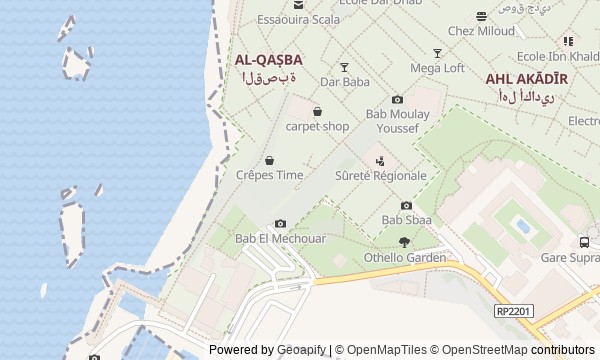
Route map
About the walk
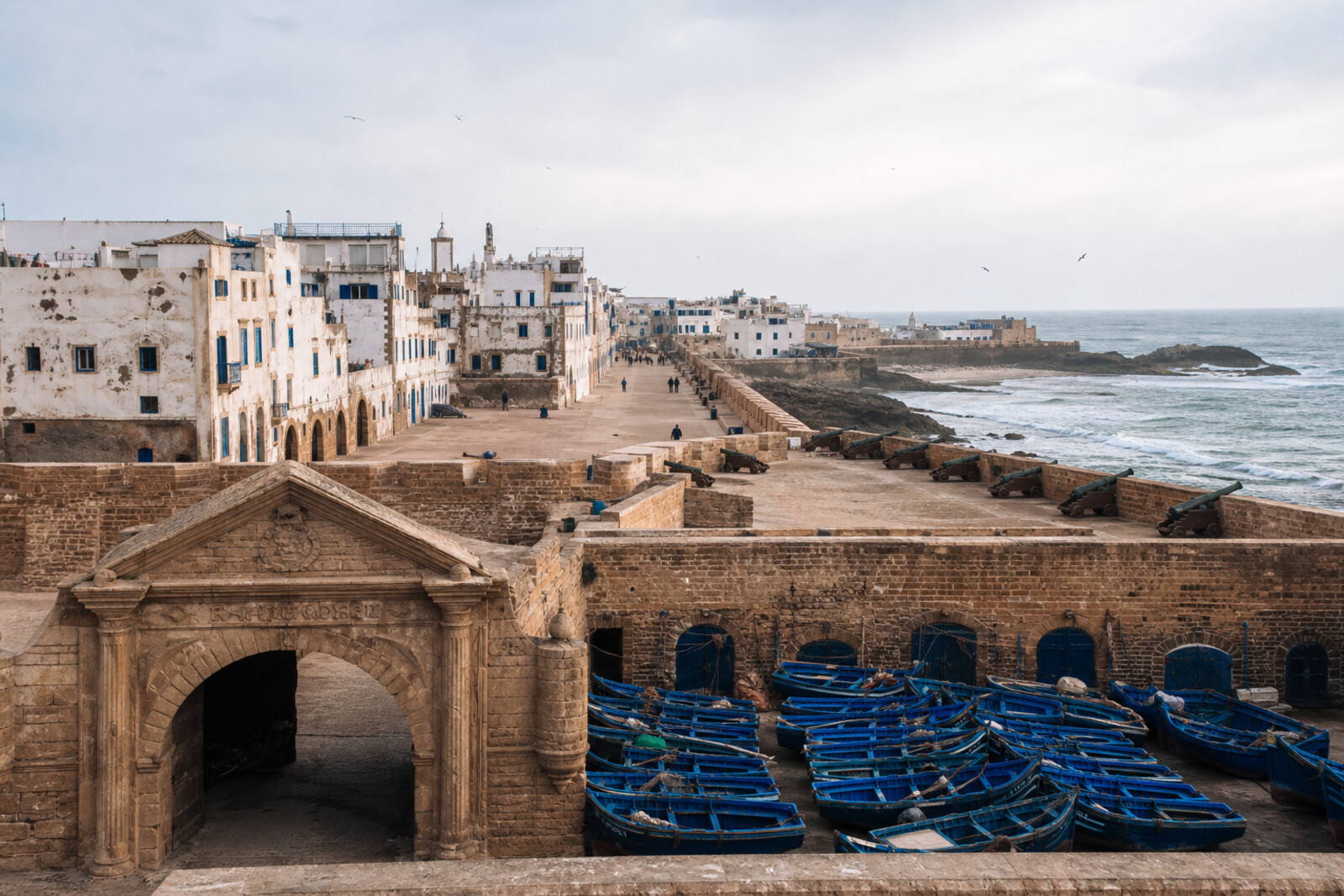
You will begin at the harbor gate, walk between the battery and the harbor, then step out onto the square left behind when the sultan's palace disappeared. From the kasbah, the route leads to the city museum, the sea wall, and casemates with thuya workshops. Then the straight trading streets bring you to Souk Jdid and the old Jewish quarter.
You will read Mogador as a port built for accounting and trade: from a boat carrying cargo to the market and a merchant's home. A general overview of the medina will stay to one side. You will learn why a film crew needed the fish market, where a wooden replica of a fortress vanished, and why furnishings for a family synagogue were ordered from across the sea.
The story rests on documents, objects, and human decisions, separating what is established from what remains disputed. By the end, the gates, square, straight streets, and arched windows will let you trace the path of old Mogador—from a customs bundle to a family prayer hall.
Why this order
The route begins where a ship's cargo passed beneath cannons and through customs at the same time. From the gate, you will descend to the harbor: beside the boats, it becomes clear what remained after the large merchant ships left. The way back through Bab el-Marsa leads to Moulay Hassan Square—its open space appeared after the palace that governed the port was gone. Next comes the museum: after a lost building, you will see objects its keeper had to search for across the city. From the museum collection, the route turns to the surviving part of the old operation, the sea battery. Descending beneath its platform continues the story of that same structure from below, where thuya craftsmen took over the artillery stores. From the workshops, you will head to Souk Jdid: craft appears within a layout created to distribute goods. The final stretch leads from the trading rows to the Mellah and Bayt Dakira, because the port system did not end at the market, but in the homes of the families and communities who lived by it.
Those who want to understand how the medina works, not only see its fortress walls Fans of maritime, trade, and urban history Those interested in human decisions and the lives of objects
Those looking mainly for a beach walk Those who want a quick overview without detailed stories Those who do not want to enter museums, fortifications, and craft spaces
Before you go
Wear shoes with sturdy soles: the waterfront can be slippery, and the walls and old quarters have steps and uneven stone. Bring wind and sun protection—the weather feels stronger on the open fortifications than inside the medina. The harbor is still a working place: keep to open passages, give way to fishers, carts, and cargo, and do not touch nets or boats. Access to the museum, fortifications, and Bayt Dakira can change, so check on the day of your walk; the full main story can be followed from exterior stops. No separate booking is needed for the route's streets, while guided visits and special access to interiors must be arranged independently.
When to go
Allow about 3 hours 30 minutes. It is best to start in the morning, while the harbor's working life is visible and it is easier to pause along the open walls and at the market without getting in the way of the main flow.
Backup plan
If the port fortifications are inaccessible, view Bab el-Marsa from the city and sea sides, then continue to the quays: the purpose of the entrance is clear from its position even without climbing to the battery. If the museum is closed, replace it with a look at the facade and a conversation about the building's changing functions; the collection details will remain part of the audio rather than an interior visit. If Sqala de la Ville cannot be entered, listen from the outer line of the walls without going into closed sections. If Bayt Dakira is closed, finish the route outside the building and on the streets of the Mellah. In dense crowds or when a passage is blocked, do not try to push through a working or fenced-off area—move on to the next stop along accessible city streets.
Route conditions
Surface. Paved — 1 km (data covers 36% of the route)
Stairs. Flights: 1, 6 m in total
Access. Wheelchair — no; stroller — limited (stairs)
Facilities. Toilets — 5; drinking water — 3
Elevation. Ascent — 17 m; descent — 8 m
OpenStreetMap extract of July 2, 2026: database data, not a check on the ground. Data © OpenStreetMap contributors, ODbL licence
Walk plan
Open in maps ↗- 1
Bab el-Marsa and Sqala du Port
This is where the port order began, with customs duty and artillery protection converging at the same gate. - 2
Fishing Harbor
The working port becomes the setting for a story about filming that had to continue without money or costumes. - 3
Moulay Hassan Square and the trace of the menzeh
The open space makes it possible to reconstruct the boundaries of the vanished sultan's palace. - 4
Sidi Mohammed ben Abdallah Museum
The collection will show how one curator searched for objects and information about still-living craft traditions. - 5
Sqala de la Ville
The work of craftsmen from a trading enterprise that did not survive its own debts has been preserved here. - 6
Casemates and Workshops of Moroccan Thuya
The fate of one apprentice connects the former artillery stores with the craft that continues here. - 7
Souk Jdid
At this intersection, the layout of the city, created for the trade moved here, becomes clear. - 8
The Old Jewish Quarter and Bayt Dakira
The final stop will connect the history of the trading port with the memory of a family and a departed community.
Route features
Everything you need stays in the browser
Progress, saves and your trip plan are stored on this device.
Add Guide On Map to your home screen so the walk opens outside the browser.
How we handle sources, maps and corrections: our editorial standards