 Guide On Map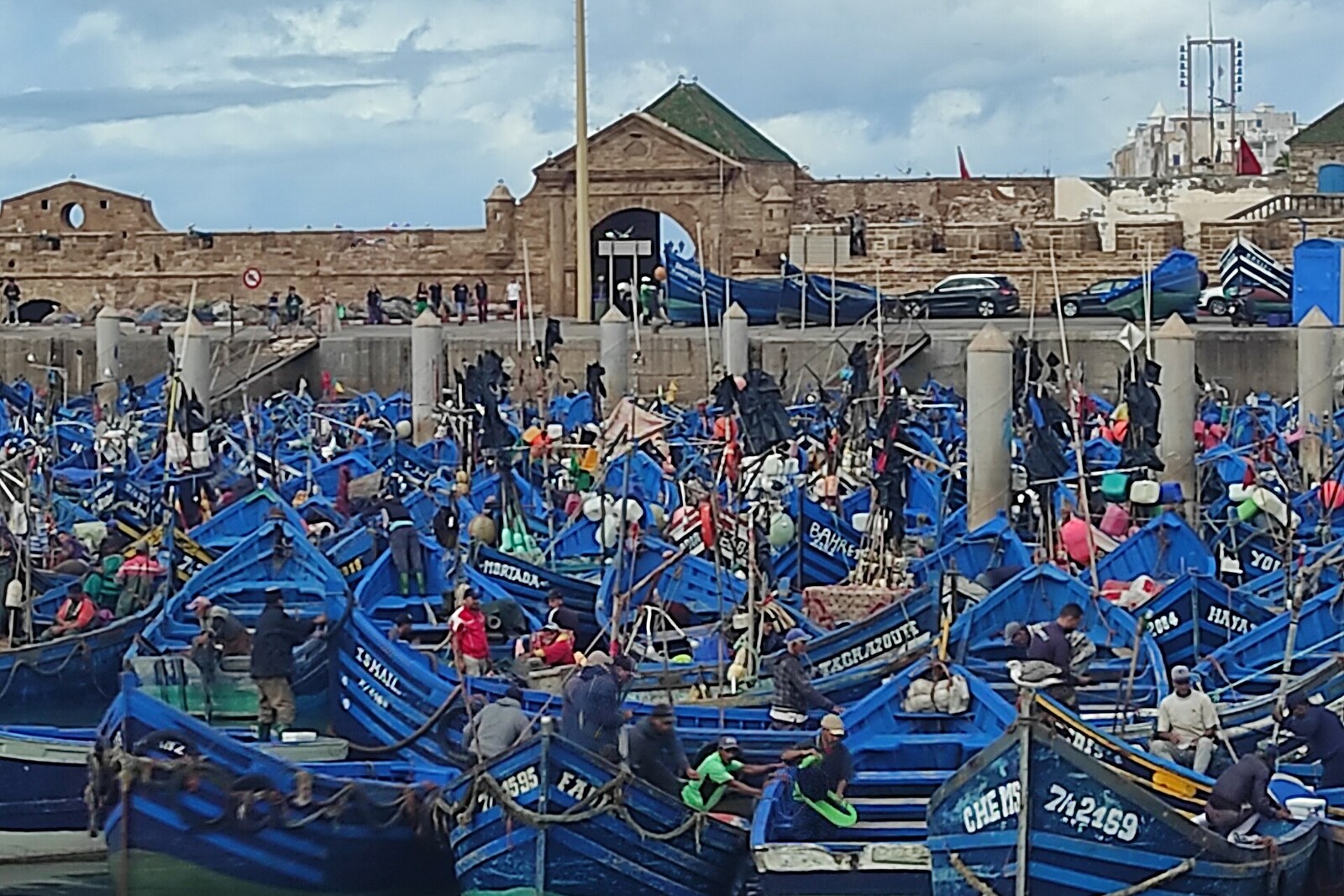
Look around first
What to notice
- Wooden fishing boats
- Crates for the catch
- Fish hall
- Port shipyard
The story of the place
The harbor's cramped layout came to fishermen from the era of sailing merchant ships. In the twentieth century, new cargo vessels needed deep berths, and shipowners began choosing Casablanca and Agadir. Fishermen continued to use the sheltered but shallow basin. The northern trade winds bring nutrient-rich cold water up near the coast; schools of sardines follow the plankton toward Essaouira. The catch is transferred into crates and carried to auction in the fish hall, while wooden hulls are built and repaired right here at the port shipyard.
In nineteen forty-nine, director and lead actor Orson Welles came to Mogador to film Othello. The port fortifications were to stand in for Cyprus, where Shakespeare's tragedy is set. Welles sought complete creative independence and paid for it with his own earnings: money he received for roles in other films went into making his own.
Almost immediately, the Italian producer who had undertaken to finance the film went bankrupt. The costumes, which had not yet been paid for, were not sent to Morocco. The actors and a large film crew were already in town; Welles had enough money to last roughly a week or two. He hired local Jewish tailors and showed them reproductions of paintings by Vittore Carpaccio so that they could sew Venetian clothing. The tailors needed ten days, but the director could not keep an idle crew for that long.
So Welles changed the scene of Roderigo's murder. It had been conceived as taking place in the street, among people in historical costumes. The director moved the action to a Turkish bath: there, men could appear bare-chested, with towels on their heads. The bath was filmed at Mogador's fish market. The camera framed the actors from the waist up, the hall was filled with smoke, and the market hall became, on screen, a cramped maze with a chase and a murder. Later, Welles said that craftsmen hammered the armor for other scenes out of sardine tins.
The tailors did finish the costumes, but the money ran out again. Welles would disband the crew, leave to act in films, bring back another fee, and resume work. Othello was put together over three years from episodes filmed in Morocco and Italy, sometimes thousands of kilometers apart. In nineteen fifty-two, the film was presented at Cannes as a Moroccan film. It received the festival's top prize, sharing it with another film.
There was never a Turkish bath in the harbor, and Welles did not name the exact fish-market hall in his memoirs. A reliable trace remains in the film itself: behind the smoke and towels is hidden the place where the catch was sold, and beneath the soldiers' armor are flattened sardine tins.
Useful on site
Access to the public part is free; working areas may be closed off without a schedule.
Checked: date not specified. Check the official source before visiting.Stand clear of unloading and repairs, yield to people at work, and ask permission before photographing fishers at close range.