 Guide On Map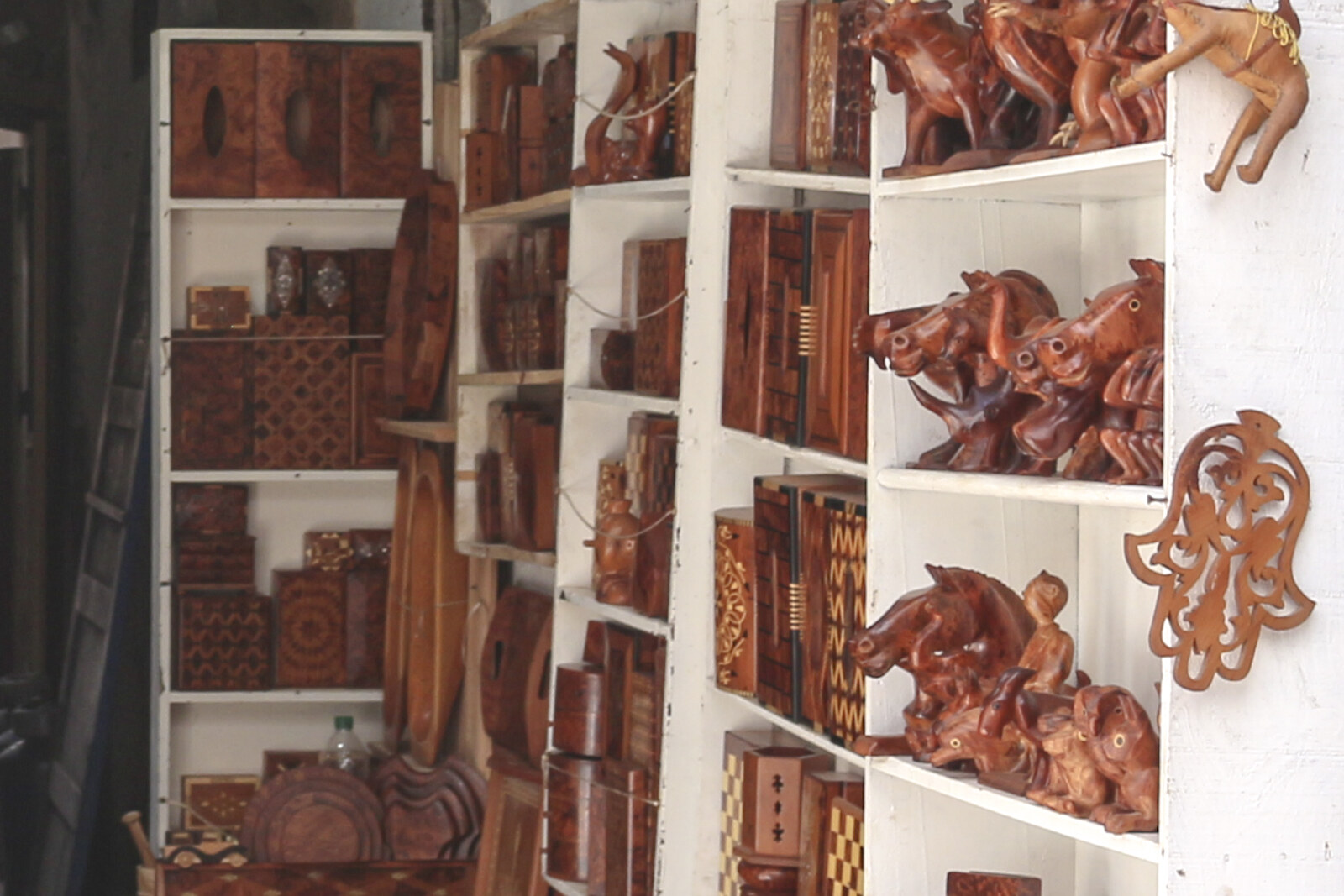
Look around first
What to notice
- Vaulted casemates
- Workbenches
- Thuya objects
- Inlaid patterns
The story of the place
The Sqala's stone vaulted rooms stand beside one another, one after another; workshops and shops are now open inside them. Iron rings were once left in front of the entrances: horses were tied to them while cannons were pulled up the sloping ascent to the upper platform. Under these same vaults, thuya is sawn, pale wood and mother-of-pearl are inserted into carved recesses, and boxes and small tables are sold right here.
One of these vaulted rooms was the workshop of Tahar Mana, a maâlem—that is, a master craftsman already entrusted with his own journeyman and apprentice. Artillerymen once stored gunpowder and artillery equipment here for the battery above.
Tahar did not choose his craft himself. In nineteen nineteen, he was about ten years old; his father had already died, and his mother was dying of diphtheria. Before her death, she asked a relative who was his guardian to find the boy manual work through which he could support himself. Tahar was given as an apprentice to one of Mogador's first marquetry craftsmen. One day, the first master smashed a jug over his head because he was late, and the boy moved to another master. There he learned to make walnut tea sets and inlaid gunstocks for the sultan's court and the city's consuls.
In the nineteen thirties, Pasha Ben-Maalem brought Tahar an old walnut sugar case. According to the pasha, the object had belonged to the former sultan Moulay Abdelaziz. The commission was to reproduce it in thuya wood. This was the name for the wood of the arar, especially prized in the burls at its roots: after polishing, it revealed a dense pattern of tangled fibers. The master carved recesses into the base and inserted pale lemonwood, mother-of-pearl, or other contrasting materials into them. Before this, patterns were often burned in to produce black lines, and the finished object was rubbed with walnut oil.
Commissions from Mogador's French residents allowed Tahar to move from small cases to elaborate tables. The owner of a bazaar named Bungal commissioned him to make a miniature of Sqala de la Ville itself in thuya wood. The young master reproduced the battery beneath which he later worked. The model was displayed in the window of the city tourist bureau, where it remained until the nineteen seventies. It was then found in the municipal park, broken into pieces.
By the end of the nineteen thirties, Tahar had received the title of maâlem. His craft card from the early nineteen fifties lists a workshop of twenty-four square meters, four workbenches, several planes, saws, and clamps; beside this is a note: not enough tools. With this workshop, he supported his children and the children of his older half-brother.
Tahar worked in one of the former artillery stores. In his recollections, iron rings were still left in front of such rooms: horses that pulled cannons up the ramp to the upper platform were tied to them. The wooden copy of the Sqala has not survived. What has survived is the row of stone casemates—inside them, thuya objects are now cut, inlaid, and sold.
Useful on site
Each workshop keeps its own hours; the outer row of casemates is accessible from the street.
Checked: date not specified. Check the official source before visiting.Do not handle objects or tools without an invitation. Ask first before photographing the craftsmen or their work; no purchase is needed to complete this stop.