 Guide On Map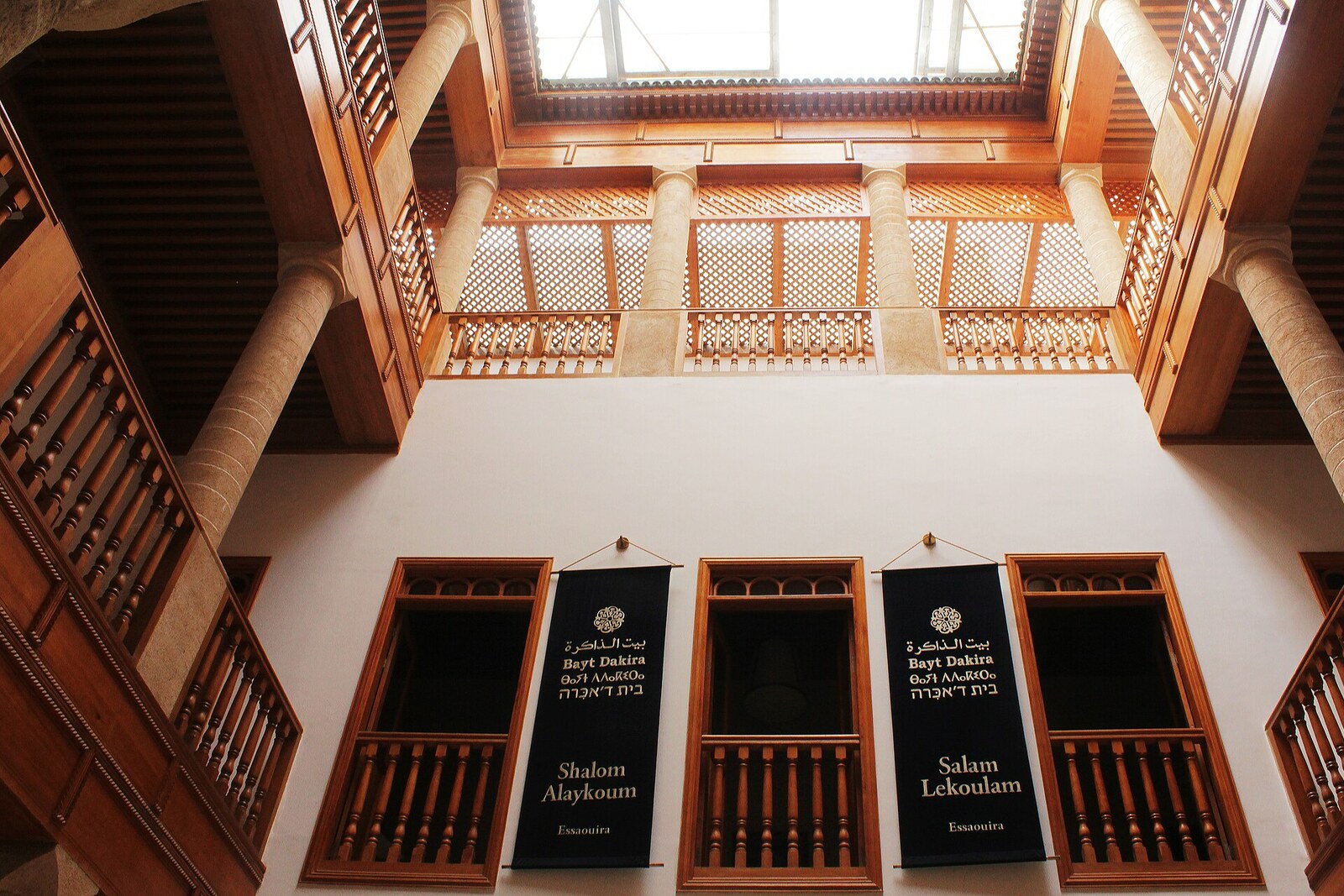
Look around first
What to notice
- Tall arched windows
- Women's gallery
- Carved walnut cabinet for the Torah
- Memorial lamps
The story of the place
Bayt Dakira occupies the former mansion of Jewish merchants in the Kasbah, where families connected with port trade lived. The ground floor brought in income from shops; one floor above was a high prayer hall with a women's gallery, while the upper rooms were occupied by the community court, which considered merchants' disputes and family conflicts. The large windows ending in arches remain a feature of the prayer hall. Farther north began the Mellah, where craftsmen, small traders, and peddlers settled; when it became crowded, property owners added floors to their houses.
Mima Attia set out from Mogador for England to find craftsmen and furniture for the synagogue she had decided to name after her husband. Simon Attia, a prosperous local merchant, traveled extensively on business. He never returned from one of those journeys. For a long time, the family did not know what had happened to him; later, it emerged that Simon had died in Liberia. His body was transported by sea to London and buried there.
Mima wanted to leave his name in the city where their home and business were located. In eighteen ninety-two, she began fitting out a synagogue in the family mansion. In England, she commissioned a carved cabinet of solid walnut for Torah scrolls, wooden furnishings, and silver lamps. The house of prayer was called Slat Attia—the Attia synagogue.
The building brought together almost the whole life of a wealthy Jewish family of Mogador. Shops operated on the ground floor. Above were a high prayer hall, large arched windows, and a women's gallery. The Jewish court met in the upper rooms: commercial disputes and family cases were heard there. A merchant could keep accounts below, pray one floor higher, and seek a resolution to a dispute under religious law in the same building.
The Attia mansion stood in the Kasbah, where wealthy Jewish merchants connected with port trade lived. Most Jewish craftsmen, small traders, and peddlers were settled farther north, in the Mellah—the quarter set aside for them. By eighteen ninety, more than six thousand people were crowded into one hundred fifty-six houses there. Over several decades, the population doubled, the quarter's boundaries changed little, and property owners added new floors.
Moisey Lugasi, a Mogador native and businessman who had grown up in England, returned to the city and decided to seek an expansion of the Mellah. He organized its residents, helped submit a petition to city officials, accompanied by the sacrifice of a bull and a sheep, and sent a delegation to Marrakesh. The sultan sent an engineer to draw up a plan for new houses. However, Lugasi encountered resistance from wealthy property owners and community leaders. He created a separate branch of the London-based Anglo-Jewish Association for Mellah residents, then, under pressure, agreed to merge it with the branch of Kasbah merchants and stepped down from his post. The expansion project was never carried out. The narrow plots and multi-story houses of the old Mellah remained a consequence of that failure.
In the twentieth century, Jewish families left Essaouira, worshippers became fewer and fewer, and Slat Attia closed. From the nineteen nineties onward, the carved wood and memorial lamps were still preserved in the building, but there was no longer a permanent congregation here.
In two thousand fifteen, Association Essaouira-Mogador, founded by city native and royal adviser André Azoulay, began the restoration. Four years later, the former mansion was transformed into Bayt Dakira—“House of Memory.” Now, around the restored synagogue, there are family documents, photographs, ritual objects, and a research center devoted to the history of Moroccan Jews and their relations with Muslims.
Simon Attia is buried in London. In Essaouira, his name remains on the prayer hall commissioned by Mima and on the carved walnut cabinet for the Torah inside today's Bayt Dakira.
Useful on site
Official regular hours and fee have not been confirmed as of 24.06.2026; check at the entrance. Saturday access restrictions are possible; confidence is low.
Checked: date not specified. Check the official source before visiting.Check whether entry is possible and observe the rules of the active cultural space. If it is closed, finish the account outside without disturbing neighboring homes.