 Guide On Map
Central Cusco: from Plaza de Armas to Hatun Rumiyoc
From the main square through Calle Loreto and Coricancha to the Twelve-Angled Stone
Guide On Map on your phone
Open the walk like a regular app
It takes about 10 seconds to install. No app store needed.
The whole path
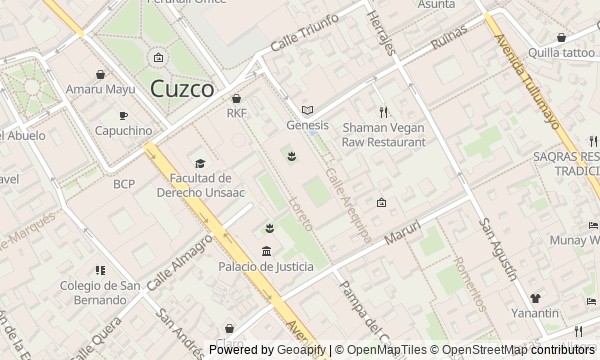
Route map
About the walk
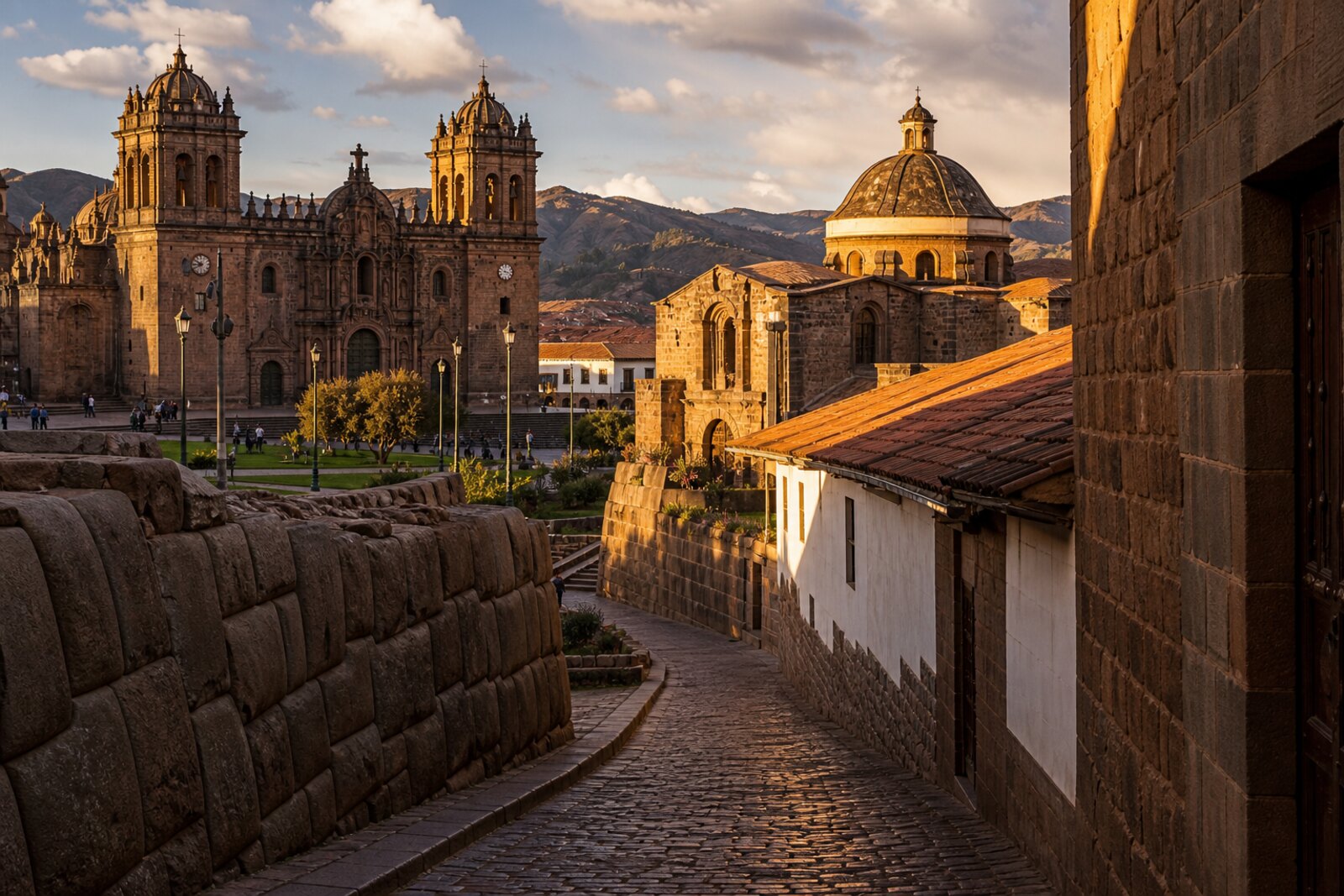
You will walk through central Cusco from Plaza de Armas to Coricancha, then return to a palace wall on Hatun Rumiyoc. The route begins among cathedral façades and Jesuit towers. Then you will enter the narrow corridor of Calle Loreto, where long Inca walls hold the street on both sides. At Church and Convent of Santo Domingo, you will see a church and convent set over the stone chambers of the Temple of the Sun. The finale is a single block in a palace wall. The story will be calm and precise: chronicle will be separated from church tradition, and ceremonial façades from human decisions. Why did a procession need a notary? Why did clergy serve in a church whose construction they had tried to stop? How did a workman's hammer end up beside the famous stone at night? After this walk, you will read central Cusco from the bottom up: Inca masonry, colonial additions, and today's traces that can no longer be erased.
Why this order
Plaza de Armas establishes the scale: here, an Inca ceremonial space became a colonial square of public power. The Cusco Cathedral Complex stands on its northeast side and shows how the conquerors secured their claim to the city through church tradition. Across from it, the Church of the Society of Jesus continues the story through a dispute within the colonial church itself—the neighboring façades make the rivalry visible. Calle Loreto begins right beside the Church of the Society of Jesus: the narrow passage between Inca walls replaces the struggle between churches with the story of a man who had to prove his status in public. Along Calle Loreto and Pampa del Castillo, the route reaches the former Intipampa, where the question of recognition gives way to an earlier one—who owned the land itself. On the same square, Coricancha shows what happened to the principal sanctuary and its furnishings after the conquest. The route then returns to the upper part of the center and the palace wall of Inca Roca: after the temple, the story turns to a change in the ruling line and the separate residences of its heirs. Walking along this wall leads to the Twelve-Angled Stone, where the distant history of the palace meets damage that occurred in 2025.
Those who want to understand the Inca and colonial layers of the center Those interested in human decisions, documents, and consequences Those who prefer a calm historical narrative without ceremonial rhetoric
Those looking for an overview of all of Cusco's major sights Those who want a walk only about Inca stone masonry Those who do not want to hear about violence, seizure, and loss
Before you go
Wear shoes with reliable grip: stone slabs and cobblestones can be slippery after rain. At the square and near the Twelve-Angled Stone, you often have to wait for a clear view, so do not plan the walk on too tight a schedule. All key comparisons are visible from the street; treat visits to Cusco Cathedral, the Church of the Society of Jesus, Coricancha, and the Museum of Religious Art as a separate plan, and check their current entry conditions in advance. On narrow sections, stay close to the edge of the passage, do not block movement, and do not lean against historic masonry.
When to go
Walk the route in daylight: it is easier to make out the shape of the blocks, the boundary between different masonry, and façade details. The main time is needed not for the distance, but for stops and waiting for an unobstructed view. If you add interiors, do not try to fit them in between audio sections while walking—set aside separate time for visits.
Backup plan
If Plaza de Armas is crowded, listen to the beginning from the edge of the square, where you can see both its open space and the church façades. In narrow Calle Loreto, do not stop in the middle of the flow: walk the full length of the wall and pause where you can safely step aside. If interiors are closed, keep the whole route—the main story can be read in Coricancha's exterior walls, the convent above them, and the pattern of the streets. If the area around the Twelve-Angled Stone is too crowded, first examine the neighboring masonry on Hatun Rumiyoc and return to the final block after a short pause.
Route conditions
Surface. Paved — 1.3 km
Stairs. Flights: 1, 4 m in total
Access. Wheelchair — no; stroller — limited (stairs)
Facilities. Toilets — 3; drinking water — 1
Elevation. Ascent — 24 m; descent — 16 m
OpenStreetMap extract of June 25, 2026: database data, not a check on the ground. Data © OpenStreetMap contributors, ODbL licence
Walk plan
Open in maps ↗- 1
Plaza de Armas
Here it will become clear how the Incas’ ceremonial center was turned into a place where colonial power displayed itself to the entire city. - 2
Cusco Cathedral Complex
This stop separates the course of the siege from the later church story of the city's miraculous salvation. - 3
Church of the Society of Jesus
Its proximity to the cathedral turns the story of its construction into a visible dispute over precedence and prestige. - 4
Calle Loreto
Here, a court ruling will turn into a procession, clothing, and a document the family used decades later. - 5
Plaza Santo Domingo
The plaza will return the route to a disputed legend about the people who owned this land before the founders of Inca Cusco. - 6
Coricancha and Santo Domingo
The surviving walls will show what remained here after the temple furnishings were turned into shares for the conquerors. - 7
Hatun Rumiyoc
The palace masonry will make it possible to connect the change in the ruling line with the way new Incas settled their kin groups across the city center. - 8
Twelve-Angled Stone
The finale will bring the story of the fate of Inca masonry into the present and show the cost of several blows to an authentic block.
Route features
Everything you need stays in the browser
Progress, saves and your trip plan are stored on this device.
Add Guide On Map to your home screen so the walk opens outside the browser.
How we handle sources, maps and corrections: our editorial standards