 Guide On Map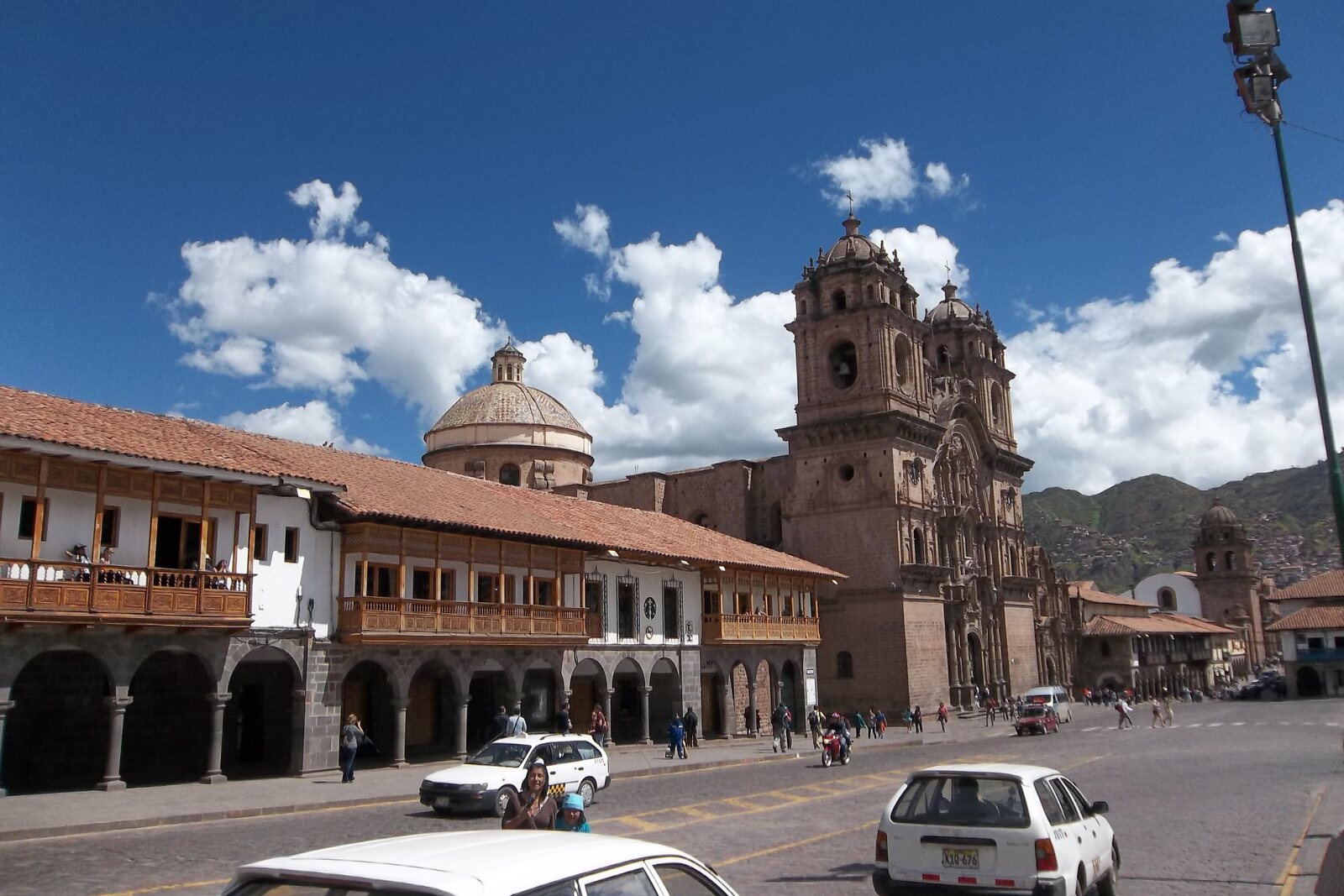
Look around first
What to notice
- The stone façade of the Church of the Society of Jesus
- Two towers
- The dome
- Three entrances from the square
The story of the place
Three entrances from the square lead into a stone church with two side chapels; above the façade rise a dome and two towers. Services were held here, and the church's official dedication is connected with the Transfiguration of the Lord. After the earthquake, the earlier church on this site was dismantled and replaced by the present building. The entire stone façade, dome, and both towers belong to that later reconstruction.
“Compañía” is the shortened Spanish name for the Society of Jesus, the Catholic order of Jesuits. They arrived in Cusco in fifteen seventy-one and founded a church here together with a college, an educational institution of the order. For this they chose Amarucancha, the former palace of the Inca Huayna Capac. In documents, the Jesuits explained their choice plainly: on the main square, townspeople would find it easier to come to sermons and classes. The site had to be bought from the heirs of the conquistador Hernando Pizarro after a long dispute over its price and ownership rights.
The first church stood until the earthquake of sixteen fifty. The damaged building was dismantled, and the Jesuits decided to build a church on its site larger than the previous one, with two side chapels, three entrances from the square, and tall towers. In their own description, the intention was even more explicit: the new church was to surpass the neighboring Cusco Cathedral in beauty.
The canon Diego Arias de la Cerda, the administrator of the cathedral's construction work, was responsible for the cathedral. On October twenty-second, sixteen fifty-six, he filed an official objection with the viceroy, the Spanish monarch's representative in Peru. Arias de la Cerda maintained that the Jesuits' bold and overly large church would diminish the dignity of Cusco Cathedral.
The viceroy decided the dispute in favor of the Jesuits. Then Pedro de Ortega y Sotomayor, Bishop of Cusco and head of the local diocese, appealed the decision to the royal appellate court. Meanwhile, the builders continued their work. Construction of the church would have stopped only after a direct prohibition, and no such prohibition came from Lima.
Seventeen years after reconstruction began, the Jesuits completed the church. On July twenty-fourth, sixteen sixty-eight, relics were ceremonially transferred here, and a week later they celebrated the feast day of Ignatius of Loyola, the order's founder. The service in the new church was conducted by the dean and chapter, the assembly of clergy from that very Cusco Cathedral whose representatives had tried to stop the construction.
Officially, the church is dedicated to the Transfiguration of the Lord, but the city retained for it the name of its patrons: Compañía. The present stone façade, dome, and two towers date from that disputed reconstruction. The first Jesuit church disappeared after the earthquake; what remains before Cusco Cathedral is precisely the church against which its canon filed a complaint.
Useful on site
The route uses an exterior view from the square and the entrance to Calle Loreto; an interior visit is not required.
Checked: June 15, 2026. Check the official source before visiting.Compare the buildings from some distance away. The wedding painting is inside and requires a separate entry.