 Guide On Map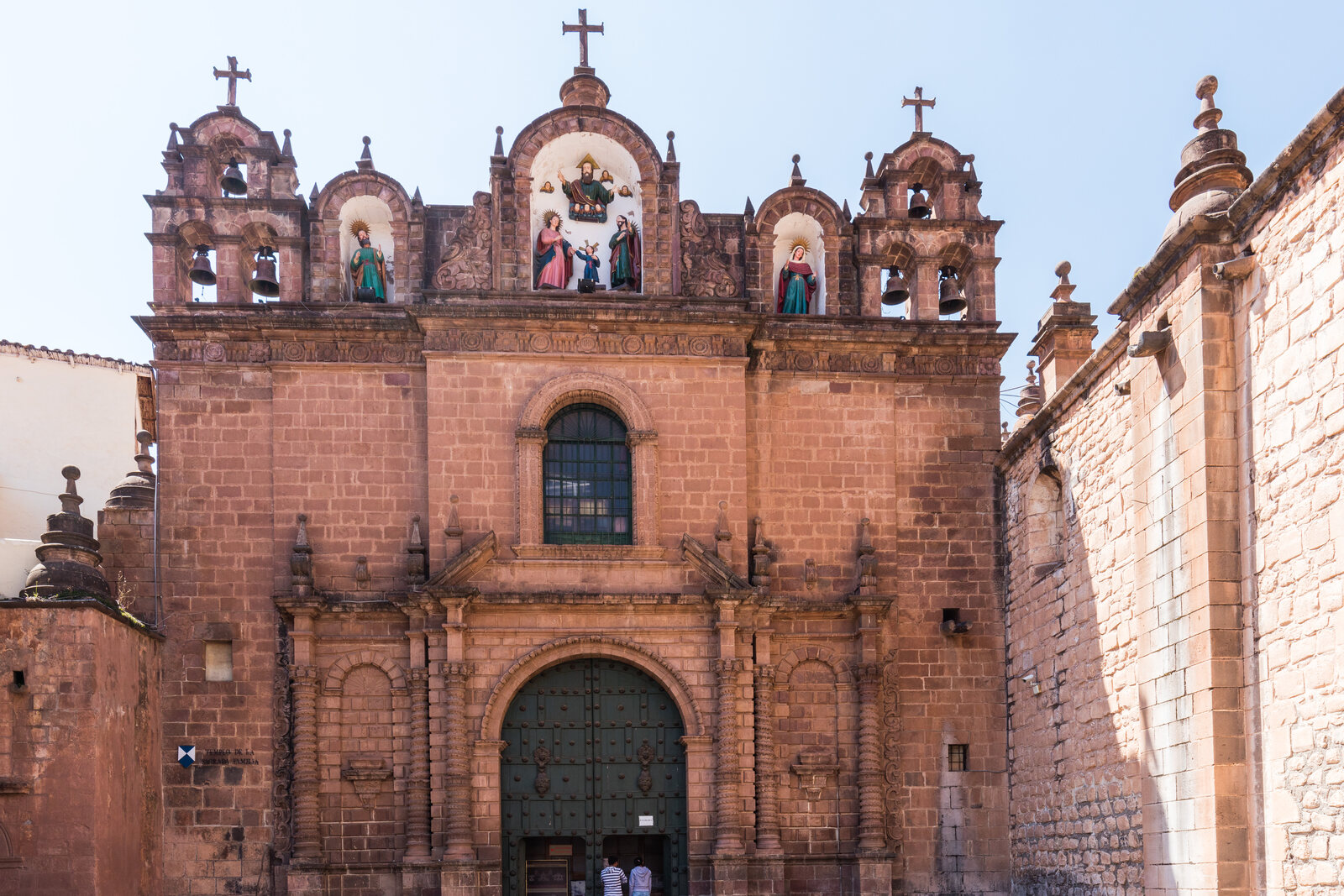
Look around first
What to notice
- Façade of the Church of the Triumph
- Two stone inscriptions from 1664
- Façade of Cusco Cathedral
The story of the place
The Cusco Cathedral Complex consists of three connected churches: Cusco Cathedral, the Church of the Holy Family, and the Church of the Triumph. The Church of the Triumph was the first main church of Spanish Cusco. Its name preserves the outcome of a battle that took place here before the great basilica appeared.
In fifteen thirty-three, the Spaniards recognized Manco Inca as ruler of the conquered capital. He hoped to retain the throne and at first helped the conquerors enter Cusco. They soon began demanding more treasures from their ally and imprisoned him. The Inca's position no longer protected either his freedom or his property.
Manco Inca obtained permission to leave the city on the pretext of a religious journey. He promised the Spanish commanders that he would bring them a gold statue. Once free, he assembled an army to retake the capital, and on May sixth, fifteen thirty-six, he surrounded Cusco.
A small Spanish detachment and several thousand of their Indigenous allies were in the city. Manco's warriors opened the canals, seeking to deny the cavalry firm ground, and hurled burning projectiles onto the thatched roofs. The defenders held the square and several large Inca halls. On the site of the present Church of the Triumph stood Suntur Wasi, a spacious ceremonial hall with a roof of dry grass.
Manco Inca was unable to destroy the garrison at once. The Spaniards recaptured Sacsayhuamán and began making sorties for food, while warriors from farming communities had to return to their fields: continuing the siege threatened their families with famine. After Spanish reinforcements arrived, Manco retreated first to Ollantaytambo, then to Vilcabamba. There he created an independent Inca domain, from which his successors continued the resistance. Cusco remained in the hands of the conquerors.
Later church tradition linked the defenders' salvation specifically to Suntur Wasi. According to legend, the Virgin Mary appeared on its burning roof and extinguished the flames, while Saint James the Apostle rode out on a white horse and joined the battle. This is tradition, not an established episode of the siege: accounts of miracles began entering the chronicles years later and grew ever more detailed over the following century.
The first church was erected on the site of Suntur Wasi, and then the great cathedral basilica was built beside it. In sixteen sixty-four, Diego Arias de la Cerda, the chief builder of the bishopric, received a commission to set the story of the miraculous salvation in stone. He placed here a pavilion with an image of the Virgin Mary and two inscriptions: one credited her with the victory and the extinguished fire, while the other stated that Saint James the Apostle rode out from here.
The pavilion was later dismantled, and the present Church of the Triumph was built in its place in the eighteenth century. Both inscriptions from 1664 were preserved on its façade. On one stone, the Virgin Mary still extinguishes the fire above Suntur Wasi; on the other, Saint James the Apostle rides out of the same building, which is no longer here.
Useful on site
The route uses an exterior visit from the square; no schedule for interior visits is required.
Checked: June 15, 2026. Check the official source before visiting.The main account works from outside. The cathedral's paintings and crucifix can be seen only on a separate visit, whose conditions are best checked in advance.