 Guide On Map
Old Bukhara: Water, Trade, and Power
From Lyab-i Hauz through the trading domes and the Ark of Bukhara to Chashma-Ayub
Guide On Map on your phone
Open the walk like a regular app
It takes about 10 seconds to install. No app store needed.
The whole path
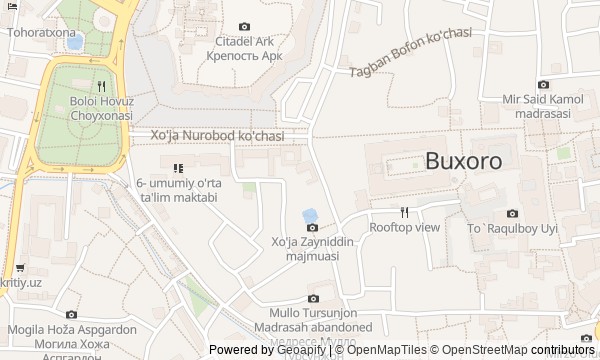
Route map
About the walk
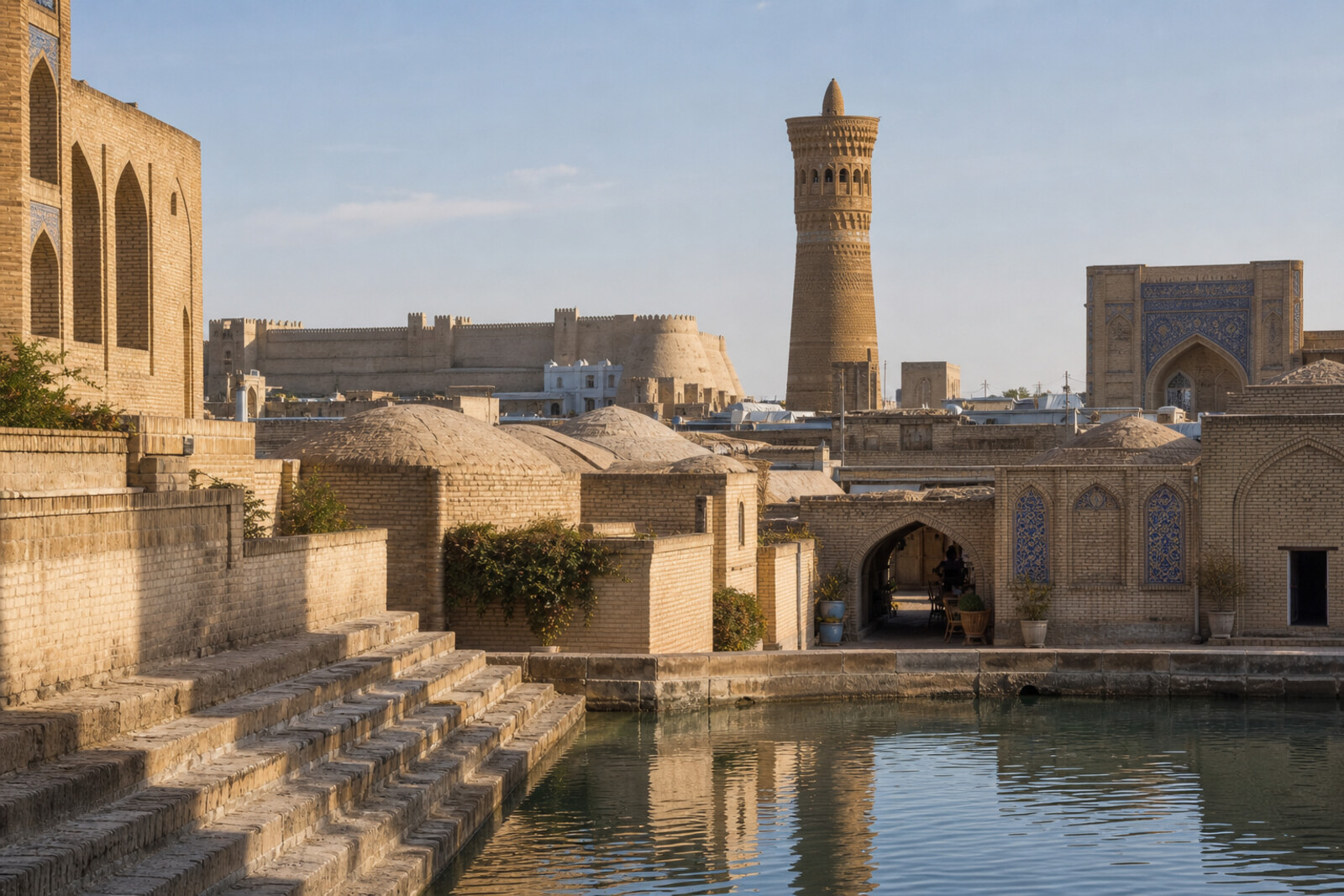
You will cross old Bukhara from the water of Lyab-i Hauz to the trading domes, the minaret, the fortress, and the spring at Chashma-Ayub. The road first follows a bazaar street, then reaches the ceremonial squares of power, and ends at an old shrine.
Behind familiar facades, you will find traces of decisions made not by architects: a widow's condition, a ruler's awkward praise, decoration left unfinished, a master's name on a tower. You will learn why a building can preserve the plan of an unrealized inn, and why a carved board can prove more persuasive than a scholarly manuscript. The answers remain within the stories.
The guide speaks calmly and precisely. A legend will be called a legend, a document a document, and a later version will not pass itself off as established fact. By the end, you will be able to explain why the route from a Bukhara hauz to a holy spring is read through trading domes, unfinished majolica, and one old board.
Why this order
The route begins at Lyab-i Hauz: water immediately links the city's needs with trade and a dispute over land. On the eastern bank stands another building by the same patron, so the next stop is Nadir Divan-Begi Madrasah, where a court decision changed the purpose of an already completed structure. From there, the road circles the hauz and leads to Magok-i Attari Mosque: after the repurposed caravanserai, you will see how outside intervention saved another building from disappearing.
The sunken mosque stands at the start of the trading chain. From there, the route enters beneath Toqi Sarrofon and follows the old market order as far as Toqi Zargaron. Beyond the last dome, two madrasahs face one another: after the shops and workshops, architecture emerges as a contest between patrons, cut short by a palace coup.
From the pair of madrasahs, the road returns past the jewelers' dome to Poi Kalyan—from the private rivalry of schools to the main place of Friday prayer. The story of moving the mosque away from the Ark of Bukhara prepares the next passage to the fortress itself. Across from its gates, Bolo Hauz Mosque shows how a ruler came out of the citadel to the townspeople while remaining separated from them by a carpeted path. The final stretch continues west along the line of old reservoirs and ends at Chashma-Ayub: city water gives way to a holy spring, and the dispute over land from the beginning of the route gives way to a dispute over what, exactly, is revered here.
Those following the main thread of old Bukhara for the first time Architecture lovers interested in the decisions and mistakes behind it Those who prefer legends with honest caveats
Those looking for a short walk around a single square Those who do not enjoy detailed historical stories Those for whom shopping at the bazaar matters more than the history of trade
Before you go
The route can be completed through outdoor spaces, so do not build it around entering every interior. Madrasahs and museum rooms may not always be open; facades, openly accessible courtyards, and the buildings' positions in relation to one another already provide plenty to discuss. Mosques remain religious places: choose modest clothing, speak quietly, do not disrupt prayer, and do not photograph people without permission. In the markets, keep passageways clear and ask first whether you may photograph a seller or merchandise up close. Near hauzes and excavated levels, watch your step and do not go beyond barriers.
When to go
For unhurried observation, choose the morning, before the squares and trading passages grow crowded. Soft late light brings out the brickwork of Magok-i Attari Mosque, the minaret, and the walls of the Ark of Bukhara. Do not plan a detailed visit to active mosques during communal prayer.
Backup plan
If you cannot enter the madrasahs, the Ark of Bukhara, or the museum, do not skip the stop: at Nadir Divan-Begi, read the original intention in the facade and the plan of the accessible section; at the paired madrasahs, compare the portals from the street; and at the Ark of Bukhara, study the gates, the ascent, the walls, and traces of destruction. Even when Chashma-Ayub is closed, it still concludes the route with its sequence of volumes from different periods and its unusual conical dome. If a service is underway at an active mosque, step back into the square, listen to the story from outside, and return to the visible details after the prayer ends.
Route conditions
Surface. Paved — 598 m (data covers 20% of the route)
Stairs. Flights: 1, 2 m in total
Access. Wheelchair — no; stroller — limited (stairs)
Facilities. Toilets — 14
Elevation. Ascent — 21 m; descent — 28 m
OpenStreetMap extract of July 2, 2026: database data, not a check on the ground. Data © OpenStreetMap contributors, ODbL licence
Walk plan
Open in maps ↗- 1
Lyab-i Hauz
The reservoir will set the main theme of the walk: who owned the land and water, and at what cost the city obtained them. - 2
Nadir Divan-Begi Madrasah
Its layout makes it possible to distinguish the building's original design from the purpose assigned to it at court. - 3
Magok-i Attari Mosque
Here you will see how the canceled demolition and the rising level of the city changed the entrances to the old mosque. - 4
The Trading Domes of Bukhara
The sequence of markets will show how money, textiles, and jewelry were linked by one street. - 5
Ulugh Beg Madrasah and Abdulaziz Khan Madrasah
Two façades make it possible to compare a finished school with a more lavish design left without its patron. - 6
Poi Kalyan
The complex shows why the main mosque was moved away from the citadel and which structure survived its destruction. - 7
Ark of Bukhara
The surviving and empty parts of the citadel reveal the former ruler's court and the consequences of the final assault. - 8
Bolo Hauz Mosque
The mosque will connect vanished court ceremony with the Friday prayer that continues here. - 9
Chashma-Ayub
The final stop brings together the spring, a pilgrimage legend, and an old written dispute over the shrine.
Route features
Everything you need stays in the browser
Progress, saves and your trip plan are stored on this device.
Add Guide On Map to your home screen so the walk opens outside the browser.
How we handle sources, maps and corrections: our editorial standards