 Guide On Map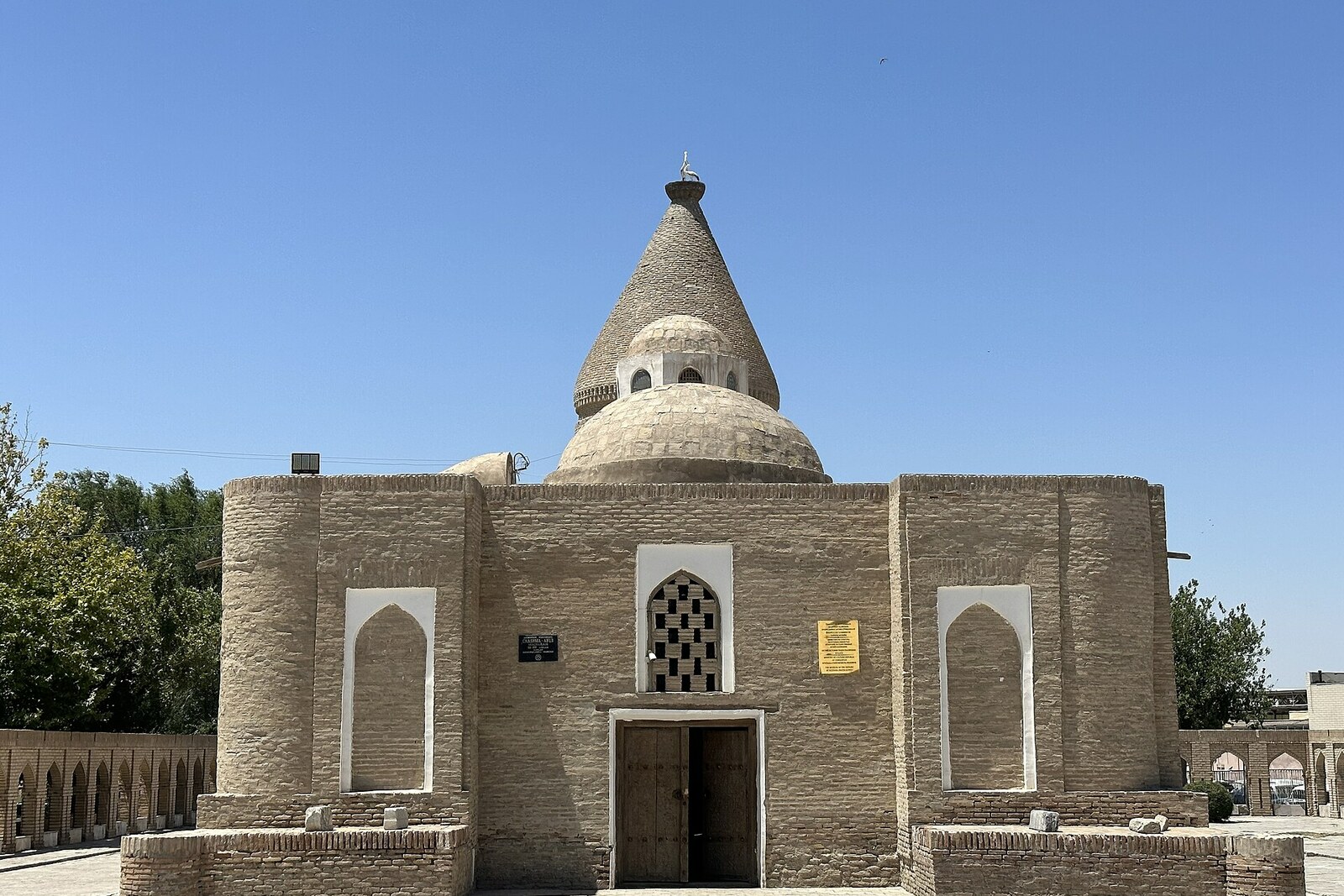
Look around first
What to notice
- The well under the conical dome
- The carved board
- The cenotaph
- Old ceramic pipes
The story of the place
A conical dome covers a well over which a revered Muslim shrine with several rooms was built. Beside the water stands a cenotaph, a grave marker without a proven burial; pilgrims draw water here, walk around it, and place rice, wheat, and sprigs of basil on it. Nearby rooms contain objects of the old urban water supply: leather waterskins, metal vessels, and ceramic pipes.
In the early fifteenth century, Ahmad ibn Mahmud, known as Mulla-zada, compiled a guide to Bukhara’s holy sites. The book was meant to lead a pilgrim to the right grave, name the person buried there, and explain why that person was venerated. Accuracy was required of the compiler: an error could turn someone else’s gravestone into a place of prayer.
At a spring on the outskirts of Bukhara, Mulla-zada encountered an already famous legend. Its hero was Ayyub—the name used in Islamic tradition for the biblical Job. During a drought, local people supposedly asked the wandering prophet to give them water. Ayyub struck the ground with his staff, and a spring burst forth. Chashma-Ayub therefore means “Ayyub’s spring.” This is a legend, not an established event.
One spring was not enough for the storytellers. By the end of the ninth century, Bukhara’s authors were claiming that Ayyub had died and been buried here. A shrine was erected over the well, and a tombstone appeared beside the shrine. Mulla-zada was an assistant to the influential theologian Muhammad Parsa and sought to base his guide on recognized religious writings. He gave the local version and then rejected it: scholars authoritative for him placed Ayyub’s grave in Hauran, not far from Damascus. In Mulla-zada’s book, Chashma-Ayub remained a famous Bukhara mazar, but it did not become the prophet’s true grave.
The compiler lost the dispute to those who controlled the shrine itself. In the second half of the sixteenth century, a wide carved board was placed on the symbolic tombstone—probably at the rulers’ instruction. It recorded the story of Ayyub’s arrival in Bukhara and stated outright that the prophet was buried “here, in this very place.” As confirmation, it cited the old History of Bukhara, which was later lost. Mulla-zada’s objection remained in a manuscript, while his opponents’ version acquired an object that the pilgrim could see before them.
Inside, the well and the cenotaph stand side by side—a grave marker without a confirmed burial. Pilgrims draw water they consider healing, walk around the cenotaph, and leave grains of rice and wheat and sprigs of basil on it. The other rooms now house a museum of water supply, displaying leather waterskins, metal vessels, and old ceramic pipes. Under the conical dome is the well that gave the shrine its name; beside it lies the board that established the prophet’s grave there, though its existence was disputed as far back as six centuries ago.
Useful on site
The exterior can be viewed at all times; inside is the Museum of the History of Bukhara’s Water Supply, but the current hours and ticket office must be confirmed on site.
Checked: date not specified. Check the official source before visiting.If the museum is open, look for water carriers’ waterskins, vessels, and ceramic pipes. If the entrance is closed, examine the building’s silhouette, assembled in sections, and finish the story outside.