 Guide On Map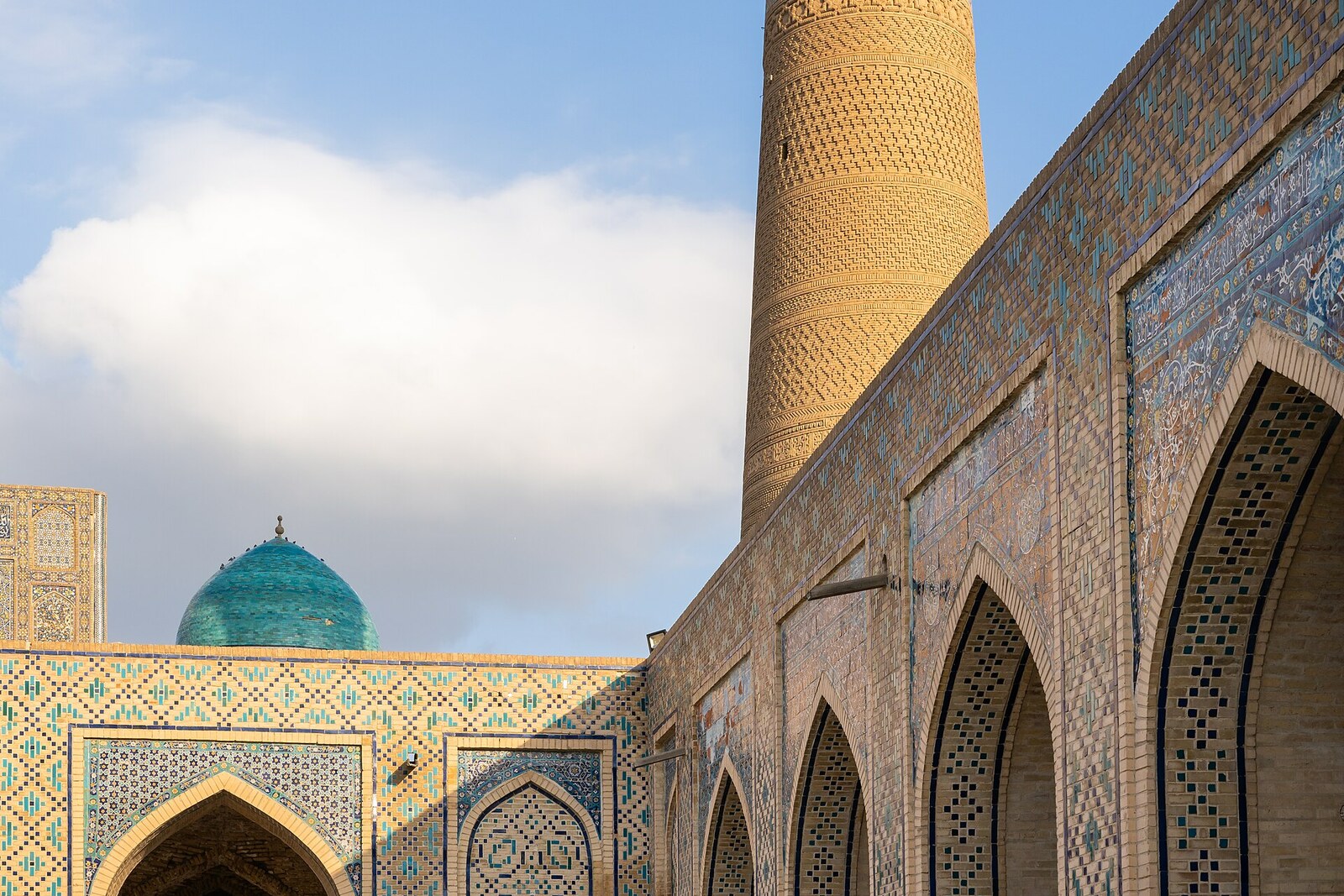
Look around first
What to notice
- Kalyan Minaret
- Construction inscription
- Courtyard of Kalyan Mosque
- Portal of the Mir-i-Arab Madrasah
The story of the place
In Poi Kalyan Square, the mosque, madrasah, and minaret stand beside one another. The present mosque was built on the site of the former one and rebuilt in the fifteenth and sixteenth centuries. People gather for prayer in its courtyard, students study in the madrasah opposite, and an arched passage leads from the mosque roof to the tower's internal staircase. The minaret rises above the whole ensemble; it is called the Great, and the name Poi Kalyan, the place at the foot of the Great, comes from it.
At the beginning of the twelfth century, Bukhara's ruler Muhammad Arslan Khan began buying up residential houses here. He needed to move the main Friday mosque farther from the Ark. The previous one stood right beside the citadel, and in one thousand sixty-eight, during the capture of the citadel, fire spread to its wooden parts. The mosque was rebuilt, but Arslan Khan decided not to leave the main place of communal prayer beside a possible battlefield any longer.
The purchased houses were dismantled, part of the old mosque was demolished, and a large courtyard for Friday assembly was built on the new site. A minaret was erected beside it: from its upper gallery, the call to prayer was delivered, meant to carry over the city's rooftops. When the builders had already installed the top of the tower, it collapsed onto the mosque. The debris smashed part of the building and destroyed carved, painted wood brought for its decoration. A medieval chronicle explained the collapse as witchcraft; the actual cause is unknown.
Arslan Khan had already paid for the houses and the mosque's construction, and now he had to pay for the minaret again. The second tower was entrusted to the master Bako. The builders took particular care over its strength and laid its upper part in fired brick. The work was completed in one thousand one hundred twenty-seven. Bako is named in the construction inscription: not even the first failed tower's master's name remains, while the second tower's author's name is still on his structure.
Almost a hundred years later, Genghis Khan's troops destroyed Bukhara and burned the mosque that stood here. The minaret remained. The story that Genghis Khan threw back his head, dropped his headdress, and ordered the tower spared because it had made him bow is a local legend. What is reliably known is different: the mosque building disappeared, but Bako's tower was not dismantled.
The present Kalyan Mosque was built later on the site of the former one and was rebuilt in the fifteenth and sixteenth centuries. At the same time, the Mir-i-Arab Madrasah appeared opposite it—a school named after the nickname of the Yemeni sheikh Abdullah al-Yamani, the spiritual mentor of the Bukhara khan. People gather for prayer in the mosque, study in the madrasah, and an arched passage leads from the mosque roof to the minaret's internal staircase.
The name Poi Kalyan means “at the foot of the Great.” The Great here is specifically the minaret—the second tower for which Arslan Khan paid after the first one fell, and on which the master Bako left his name.
Useful on site
The square is accessible at all times; the mosque is active, and the Mir-i-Arab Madrasah remains an educational institution. Free entry inside is not guaranteed.
Checked: date not specified. Check the official source before visiting.The mosque and madrasah require respectful behavior and covered clothing. Remain outside during prayer; the full scale of the ensemble is best appreciated from the square.