 Guide On Map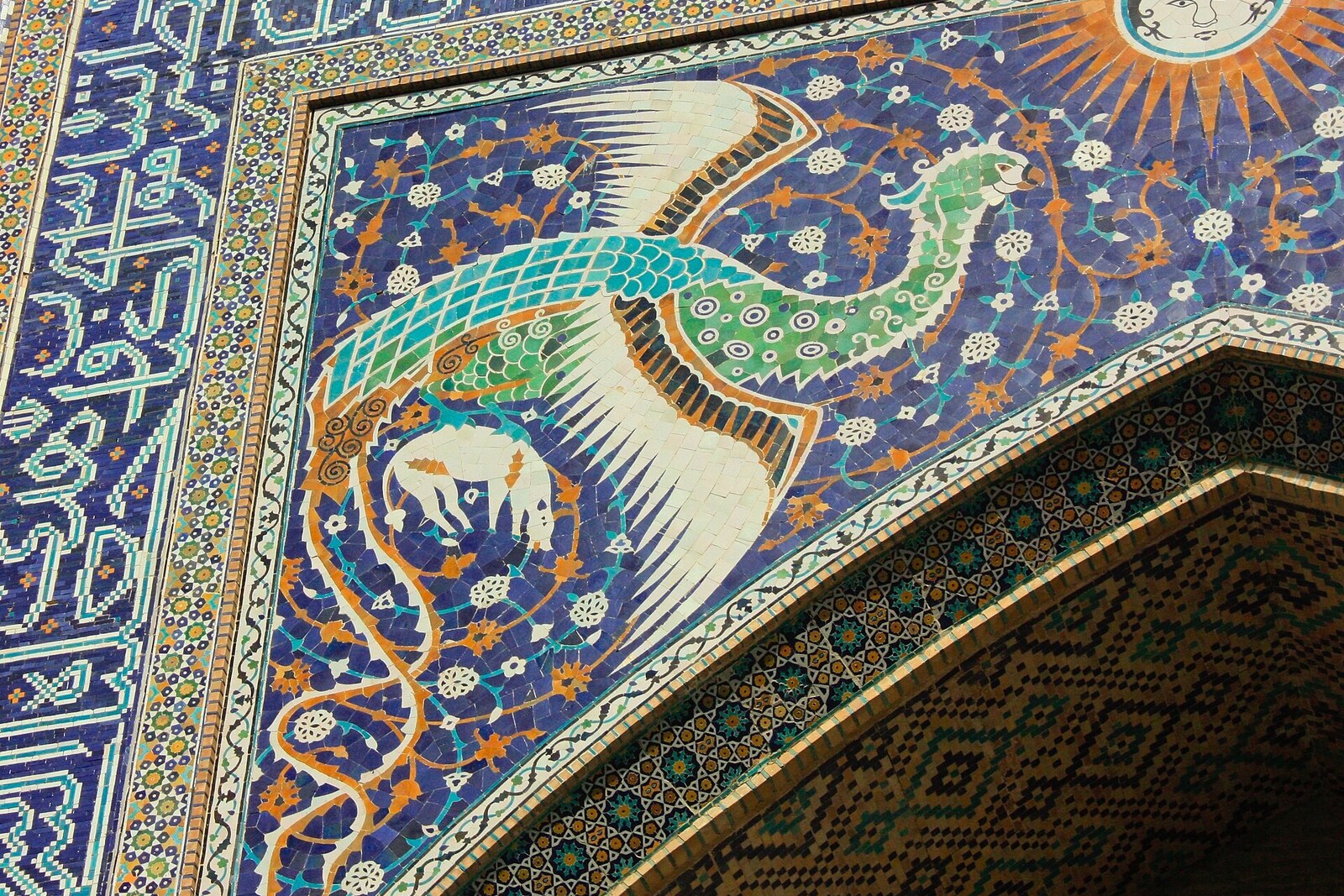
Look around first
What to notice
- Portal with birds and deer
- Two levels of hujras
- Corner towers
- Rectangular courtyard
The story of the place
Nadir Divan-Begi is a man's name fused with his office. Nadir Divan-Begi was called divan-begi because, under the Khan of Bukhara, he was responsible for finances, trade, and tax collection. It was this court administrator of revenues who built a caravanserai on the eastern side of Lyab-i Hauz in sixteen twenty-two and sixteen twenty-three.
The location was chosen carefully. Near the water and the market square, merchants needed rooms, storehouses, and a courtyard for pack animals. Behind the building stood a separate service courtyard; according to one version, the fees paid by lodgers were meant to support the Nadir Divan-Begi Khanqah on the opposite bank of the hauz.
The very conversion of the inn into a madrasah is confirmed by the layout. A Bukhara legend preserves the scene that led to it. At the opening, Imam Quli Khan, the ruler of Bukhara and Nadir's nephew, publicly congratulated his minister, on the advice of Sufi sheikhs, on the construction of a pious educational institution. To call the building a caravanserai after such words would have meant correcting the khan in front of the clergy and guests. Nadir did not argue.
The builders had to adapt the finished building. They added a high portal, loggias, and corner towers to the facade, and built a second floor with hujras—small rooms for students. There were seventy-one such rooms in the courtyard. Yet a separate mosque, a large teaching hall, and courtyard iwans, customary in Bukhara madrasahs, were never installed here: the original plan had already prescribed a different arrangement.
The change did not remain a mere court formality. A waqf document—a record of property and income set aside to maintain the school—dated July seventeenth, sixteen forty-two, reports that one mudarris taught here. He taught Muslim law and its foundations, and received five hundred tangas and one hundred mans of grain a year. Caravan drivers did not move into the rooms; students lived in them, and the man paid in money and bread really did teach classes.
Today, craft workshops operate in the former hujras, and musical and folk performances are held in the courtyard. Behind the portal decorated with birds and deer, there is still neither a large lecture hall nor its own mosque. The designation remained from the khan's decision, the name from the minister, and the plan from the caravanserai that Nadir was not allowed to open.
Useful on site
The facade is visible at all times; access to the courtyard and rooms depends on current use and events.
Checked: date not specified. Check the official source before visiting.First, look at the portal from the square. If the courtyard is open, enter calmly and look at the residential cells; lack of access does not prevent you from seeing the facade's main oddity.