 Guide On Map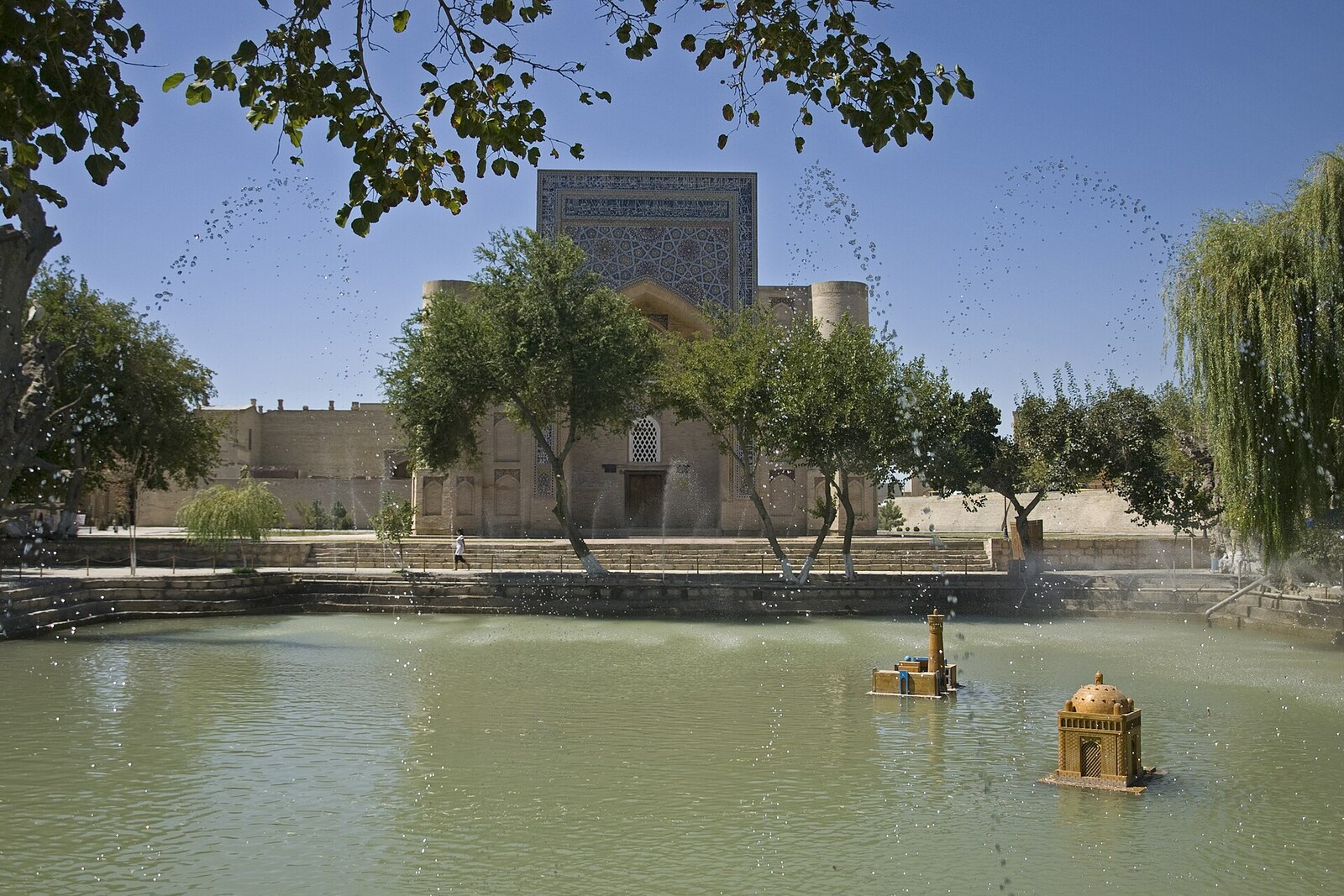
Look around first
What to notice
- The stone bowl of the hauz
- Limestone steps
- The khanqah on the opposite shore
The story of the place
The stone bowl of Lyab-i Hauz, lined with limestone steps, once held the city's water reserve. For densely built-up old Bukhara, such an open square was rare; a khanqah stands on the opposite shore. In season, aryqs replenished this reserve; water was allowed to settle here for drinking and household use, while the shore drew water carriers, merchants, and visitors to the teahouses. Later, the water supply system displaced the old system, almost all hauzes were filled in, and this bowl remained one of three in the city.
At the beginning of the seventeenth century, Nadir Divan-Begi, a vizier at the court of the Khan of Bukhara, conceived the idea of creating a large urban hauz here—a stone reservoir for water. The chosen plot was occupied by the house of a Jewish widow. Tradition has not preserved the woman's name; only what both parties to the dispute sought is known. The vizier needed the land, while the owner refused to sell her home.
According to a local legend, Nadir appealed to Imam Quli Khan, the ruler of Bukhara, hoping that he would compel the widow to sell. The khan summoned the muftis—experts in Muslim law. Their decision favored the owner: as long as she paid jizya, the poll tax on non-Muslims, the house could not be taken without her consent.
Nadir then ran an aryq supplying the hauz right beside the house. The water began to undermine the foundation. When the widow came to demand justice, the vizier offered money again. She agreed to leave, but set her own condition: instead of payment, the community was to receive land and permission to build a synagogue. Nadir accepted the deal. A hauz was dug on the site of the house, while the plot given in exchange became part of the Jewish quarter.
This is a tradition, not a court case reconstructed from documents. In popular memory, the reservoir acquired a second name—Hauz-i Bazur, “a hauz created by coercion.” The official name is more restrained: Lyab-i Hauz means “by the pond” in Persian. An active synagogue of the old Jewish quarter still stands in the neighboring lanes, while nothing of the widow's house remains in the square: the bowl of the hauz occupies the land for which she bargained with the vizier.
Water also determined the purpose of this square. Bukhara's aryqs filled only during part of the year, so water was stored and allowed to settle in hauzes for drinking and household use. Around the reservoir, an open space formed that was rare in a densely built-up city. The main trading street ran nearby; water carriers came to the water, while merchants and teahouses occupied the open shore.
By the beginning of the twentieth century, it had become clear what the price of such a system was. In Bukhara's stagnant hauzes, water stood still; infections and rishta—a parasitic worm that afflicted a significant portion of the city's residents—spread through it. In the nineteen twenties and thirties, public health services secured the construction of a water supply system, and the city authorities drained and filled in almost all the old reservoirs.
Lyab-i Hauz was preserved because of its stone bowl and the buildings of the sixteenth and seventeenth centuries built around it. Drinking water is no longer drawn here. Of the one hundred fourteen Bukhara hauzes that existed in nineteen twenty-five, three survived; one of them lies before you, surrounded by limestone steps, cafés, and places to rest.
Useful on site
The square and the shore of the hauz are accessible at all times; the hours of the establishments around it are not part of the route.
Checked: date not specified. Check the official source before visiting.Choose a place at the edge of the square without blocking the descent to the water. To understand this stop, it is enough to view the hauz and the surrounding ensemble from the outside.