 Guide On Map
From Market Square to the canals: who ruled Bruges
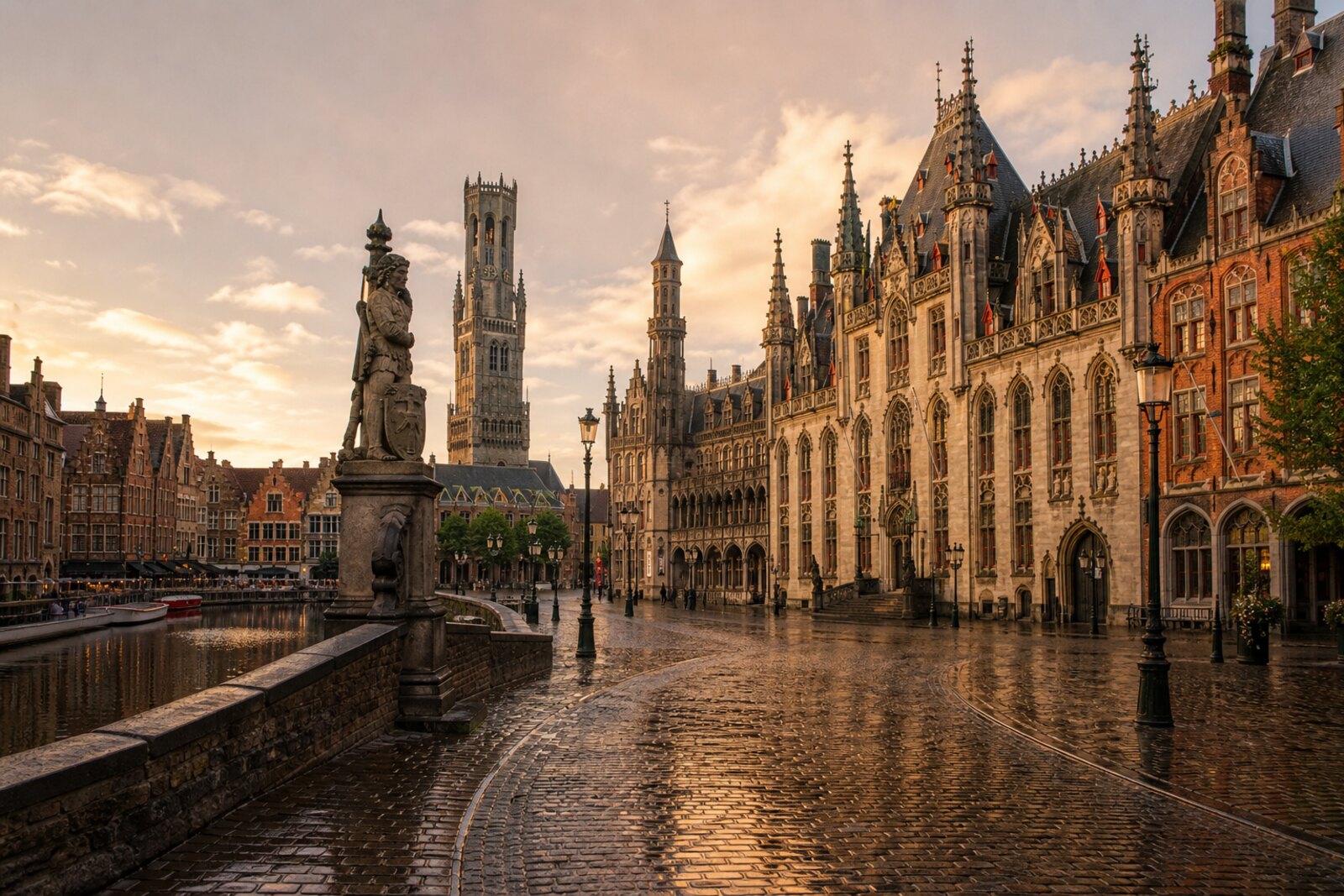
From Market Square through Burg Square and the Fish Market to Rosary Quay
Guide On Map on your phone
Open the walk like a regular app
It takes about 10 seconds to install. No app store needed.
The whole path
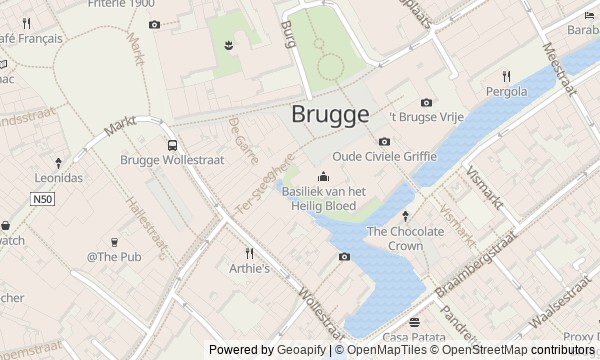
Route map
About the walk
You will walk through Bruges's grandest central district: cross Market Square, turn onto Burg Square, pass through a narrow passage to the Fish Market, and finish beside the water at Rosary Quay.
Along the way, you will find a tower with the city archive, a neo-Gothic provincial court, a city hall, chapels, and a trading colonnade. But this walk is not about architectural styles. You will trace how Bruges divided the right to dispense justice, collect money, keep documents, own a place for trade, and even control a relic.
Why did freedom require an oath in the square? What remained of the city's rights after a fire? Why did traders return their stalls overnight to the place from which they had been expelled? The answers emerge from accounts, records, and traces in the paving. The story separates later legend from the documented scene.
At Rosary Quay, you will be able to draw a line from the railings of the new archive to the stone fish stalls and explain why 2 neighboring squares in Bruges argued for so long with those who ruled them.
Why this order
Market Square sets the opening scene: here, the townspeople bargained with their ruler not over goods, but over the terms of power. From the square, the route goes straight to the Belfry of Bruges, because the dispute in the street depended on the charter, accounts, and archive kept in the tower. On the opposite side, the Provincial Court shows how later authority occupied the same Market Square and commissioned a medieval appearance for itself. Along Breidelstraat, the route crosses to Burg Square: after the trading square come the count's fortress and a vanished church, where a struggle over offices became a conspiracy. Bruges City Hall continues the judicial thread, while the neighboring Basilica of the Holy Blood tells the story of the city's control over a shrine. The archway leads from the institutions to the Fish Market, where a council decision remains visible in the arrangement of the stalls. Through Tanners' Square, the route ends at Rosary Quay: trade disappears, but its trace remains in the name of the quay.
Those who want to understand how a medieval city worked through specific conflicts Fans of documented history without ceremonial rhetoric Those interested in squares, city halls, and traces of vanished buildings
Those looking for a walk through quiet districts away from the center Those who want a route primarily about painting, lace, or chocolate Those who prefer to avoid stories of trials, uprisings, and executions
Before you go
The route can be completed entirely through open city spaces, so a closed interior will not derail the walk. If you want to climb the Belfry of Bruges or visit Bruges City Hall, the Provincial Court, and the museum spaces on Burg Square, check current visiting conditions and whether separate booking is required in advance. The Basilica of the Holy Blood remains an active church: during a service, silence your audio, do not block the entrance, and save the story for after you leave. Market Square and Rosary Quay can be crowded; headphones will help you hear the audio without turning up the volume.
When to go
About 100 minutes without visiting interiors. Allow extra time if you plan to climb the tower, visit the museum rooms, or wait calmly for an open spot by the water.
Backup plan
If Market Square is full of groups, begin listening from the edge of the square, where the monument and tower are visible, then return to the details later. If the Belfry of Bruges, Bruges City Hall, or the Basilica of the Holy Blood is closed, continue the route: the key architectural roles of these buildings are clear from outside. In rain, use the Fish Market arcade for a short break without occupying trading spots or passageways. If Rosary Quay is too crowded, finish the story a little farther along the same canal, where the view of the water and old facades remains.
Route conditions
Surface. Paved — 610 m (data covers 89% of the route)
Facilities. Toilets — 5; drinking water — 4
Elevation. Ascent — 0 m; descent — 4 m
OpenStreetMap extract of June 18, 2026: database data, not a check on the ground. Data © OpenStreetMap contributors, ODbL licence
Walk plan
Open in maps ↗- 1
Market Square
Here, an open market square becomes the setting for a bargain between the townspeople and their ruler. - 2
Belfry of Bruges and Cloth Hall
The archive fire will explain why keeping accounts became part of the struggle for self-government. - 3
Provincial Court
The dispute over the appearance of the new institution will show how provincial power established itself in the old center. - 4
Burg Square
The vanished church will restore the square's fortress geography and the scene of a conspiracy. - 5
Bruges City Hall
The military tribunal will show how the building of the city court became a court of the occupying power. - 6
Basilica of the Holy Blood
This stop separates the city records of the relic's rescue from the later legend of its origin. - 7
Fish Market
Here, the city's smell and an old privilege will clash in a single decision over a marketplace. - 8
Rosary Quay
The ending will explain why a vanished product outlived its stalls in the name of the quay.
Route features
Everything you need stays in the browser
Progress, saves and your trip plan are stored on this device.
Add Guide On Map to your home screen so the walk opens outside the browser.
How we handle sources, maps and corrections: our editorial standards