 Guide On Map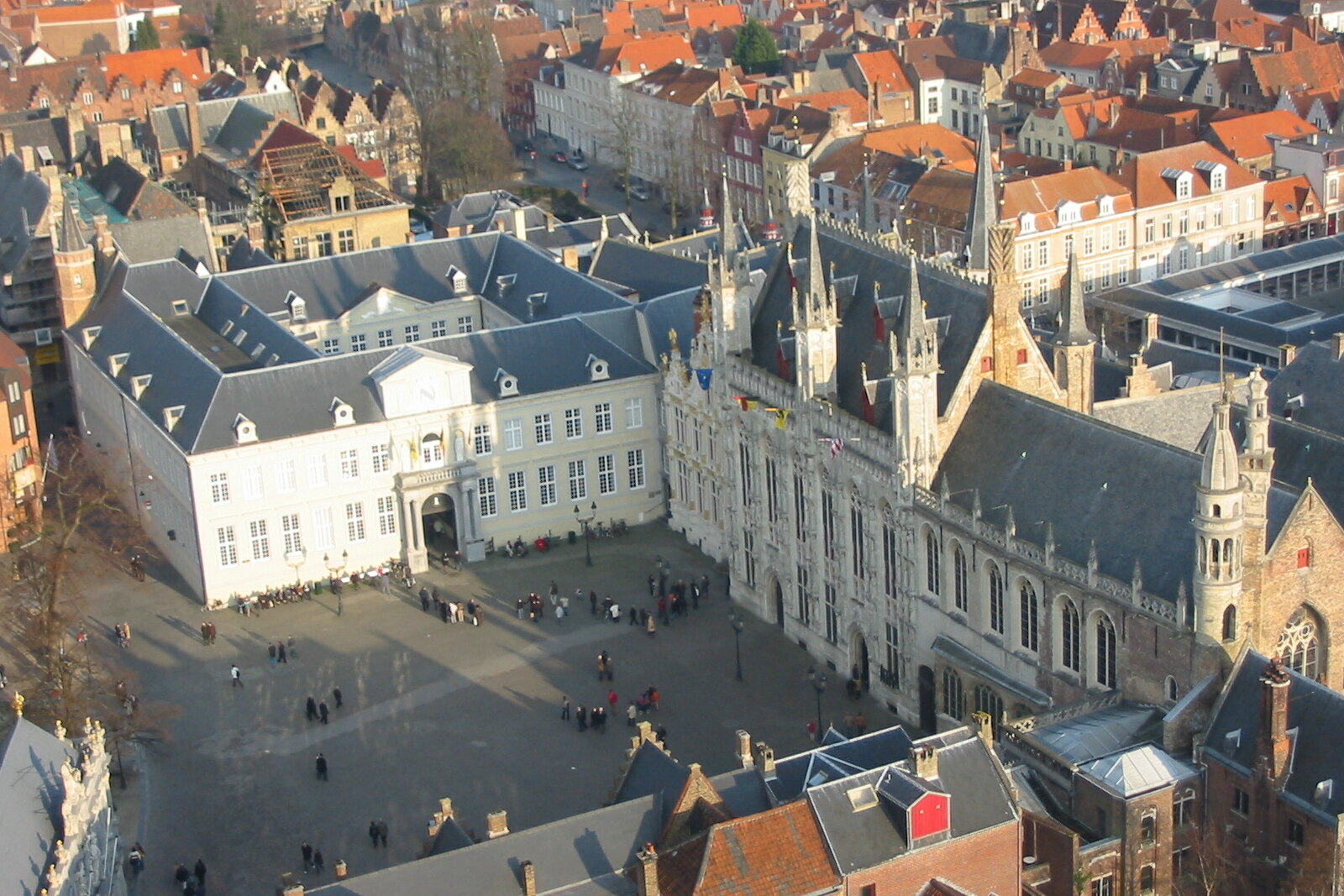
Look around first
What to notice
- The outline of St. Donatian's Church in the paving
- The Gothic façade of Bruges City Hall
- The basilica façade
The story of the place
At the site of the northern part of today's Burg Square, St. Donatian's Church stood in the early twelfth century. The residence of the counts of Flanders stood nearby, and a covered gallery connected the palace to the church. A fortress wall surrounded both buildings. The square takes its name from this fortification: the Dutch word “burcht” means fortress.
Bertulf, the head of the Erembald family, served in this cramped complex. He was the provost of St. Donatian's Church—he led its community of priests—and at the same time headed the chancery of the County of Flanders. His relatives owned land, married into noble families, and held important court positions.
At the end of the winter of eleven twenty-seven, Charles the Good, Count of Flanders, began legal proceedings into the Erembald family's origins. He intended to prove that the family's ancestors had been his serfs—people personally unfree and dependent on the count. Such a ruling would have stripped the family of the privileges, property, and offices on which its prosperity rested.
It is no longer possible to establish whether the Erembald family really descended from serfs. The main account of these events was left by Galbert of Bruges, an official in the count's chancery. He wrote after the murder of his lord and explicitly placed the blame on Bertulf. One thing is undisputed: the Erembald family did not wait for the legal outcome.
On the morning of March second, eleven twenty-seven, Charles went from the palace through the gallery into the church. The count prayed and handed out alms. The armed conspirators were led by Isaac, Bertulf's relative and Charles's chamberlain—a courtier admitted to the count's private chambers and councils. They burst into the church and hacked Charles to death near the altar.
After the murder, the Erembald family seized the count's residence, looted it, and shut themselves inside the church and its adjoining tower. What had served as the palace church became their last stronghold. Opponents of the family and some of Bruges's townspeople began a siege. The conspirators broke up church benches and altar tables, tied them together with bell ropes, built barricades, and threw stones down from the tower. In April, the besiegers breached the wall with a battering ram and drove the defenders to the upper floors.
Bertulf managed to descend from the complex by ropes at night and escape. He was captured and hanged in Ypres. Other participants in the conspiracy were executed after the siege; the family lost precisely the lands, offices, and privileges for which it had committed murder. Charles died without an heir, so several claimants began fighting for his place. The civil strife continued until Thierry of Alsace won in the summer of eleven twenty-eight.
St. Donatian's Church later became a cathedral. In seventeen ninety-nine, its ruins were sold and dismantled. The outline of the vanished building is marked in the paving of the northern part of Burg Square, and fragments of the Romanesque choir have been preserved in the basement of Crowne Plaza Brugge. Where the edge of the open square now runs stood the altar, the gallery, and the tower in which the Erembald family's attempt to save its position came to an end.
Useful on site
Open square; surrounding buildings follow separate schedules.
Checked: June 28, 2026. Check the official source before visiting.Choose a place by the wall: the center of the square is needed by passing groups, cyclists, and service vehicles.