 Guide On Map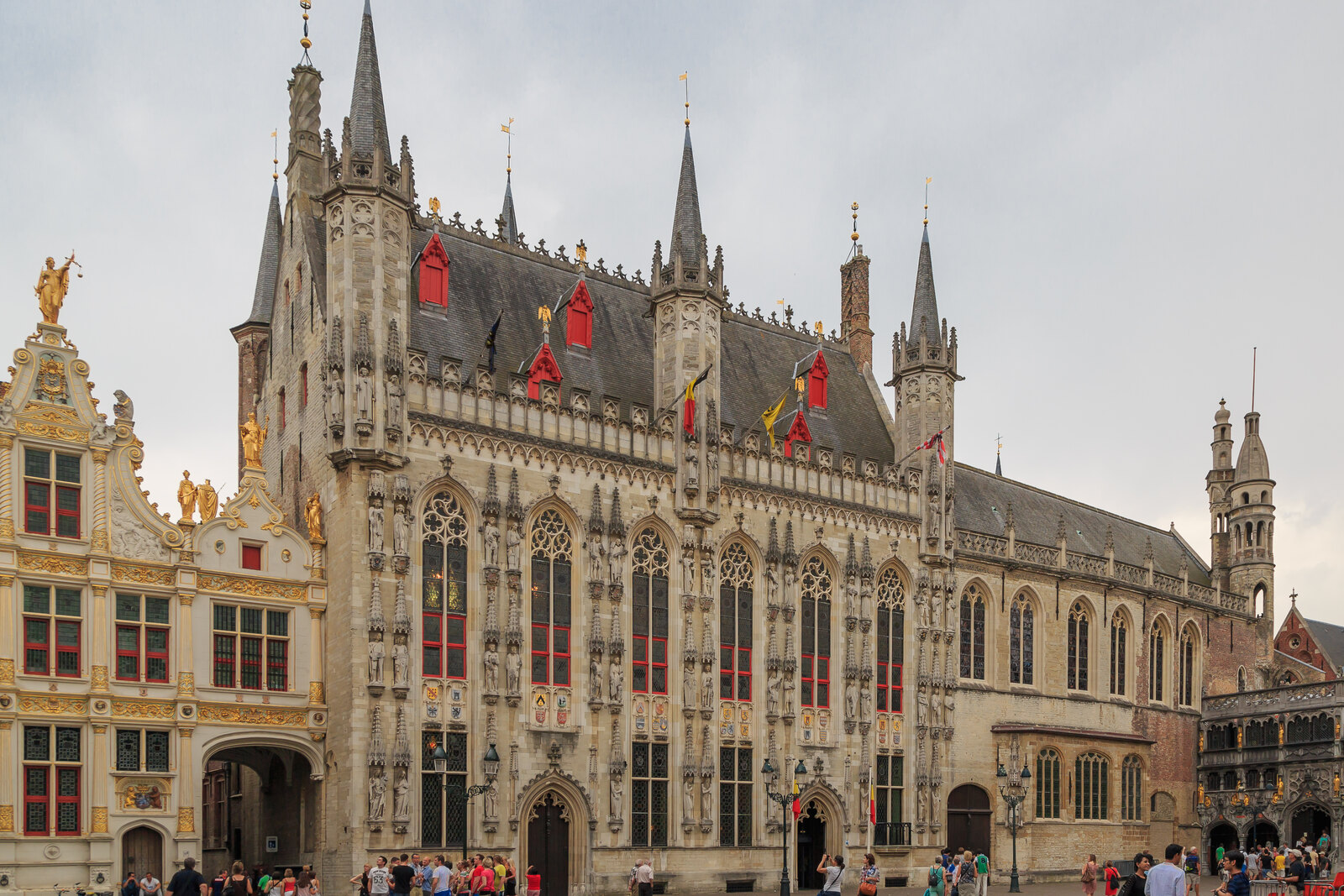
Look around first
What to notice
- Gothic façade
- Façade turrets
- Upper-floor windows
The story of the place
On the upper floor of Bruges City Hall, the Bruges city council meets once a month. In the Middle Ages, its predecessors were the aldermen—officials who both governed the city and administered justice. After the Belfry of Bruges burned down, they moved into the count's prison that stood here. In thirteen seventy-six, Count Louis of Male ordered it demolished and laid the first stone of the present building. Bruges City Hall was completed in fourteen twenty-one.
On July twenty-seventh, nineteen sixteen, justice was administered here by German naval officers. Occupied Bruges had become the center of the German naval zone in Flanders, and the military tribunal took over Bruges City Hall. Charles Algernon Fryatt, captain of the civilian steamship SS Brussels, was brought before it.
Fryatt worked for the Great Eastern Railway Company and sailed vessels between England and the Netherlands. With his captain's salary, he supported his wife Ethel and their seven children. On March twenty-eighth, nineteen fifteen, the German submarine U-thirty-three surfaced in front of SS Brussels and ordered it to stop. British instructions told merchant captains not to surrender: if a submarine was directly ahead, they were to head straight for it at full speed and force it to dive. Fryatt turned the steamship's bow toward the submarine. It managed to dive; there was no collision, and SS Brussels got away.
The Admiralty awarded the captain a gold watch. That award turned the ship's successful escape into evidence. A year later, several German destroyers captured SS Brussels, and Fryatt was sent to a camp in Germany and then returned to Bruges for trial. He did not have the watch with him—the captain had left it at home—but the prosecutors had the Admiralty's official commendation.
The tribunal declared Fryatt a franc-tireur, meaning a civilian who takes part in hostilities on his own initiative and therefore does not receive the protection granted to a prisoner of war. The captain's defenders insisted that he had followed a government instruction and saved the ship. The proceedings were conducted in German and lasted an hour or two. Fryatt was sentenced to be shot; the German emperor Wilhelm II approved the sentence.
Several Bruges aldermen were urgently summoned as witnesses to the execution. That same evening, the captain was shot by the wall of Aurora Court near Kruispoort Gate. The next day, residents saw posters in German, Dutch, and French: the German command announced that the attempt to sink a submarine had been avenged. The British government called what happened a judicial murder; the German side continued to regard the sentence as lawful.
In nineteen nineteen, Fryatt's remains were taken out of Bruges. After a funeral service at St Paul's Cathedral in London, he was buried in Dovercourt, where his family lived. The railway company and the state granted Ethel Fryatt pensions, and two children were offered funding for their education.
Today, city councilors meet in Bruges City Hall again and register marriages. The surname of the man convicted under this roof for a single maneuver in the North Sea remains on the map of Bruges: near the port of Zeebrugge, there is Kapitein Fryattstraat.
Useful on site
Bruges City Hall follows the Musea Brugge museum calendar; check opening hours, tickets, and closures.
Checked: June 28, 2026. Check the official source before visiting.The stop's main subject is visible from outside; the frescoes and museum works are accessible only with a separate visit.