 Guide On Map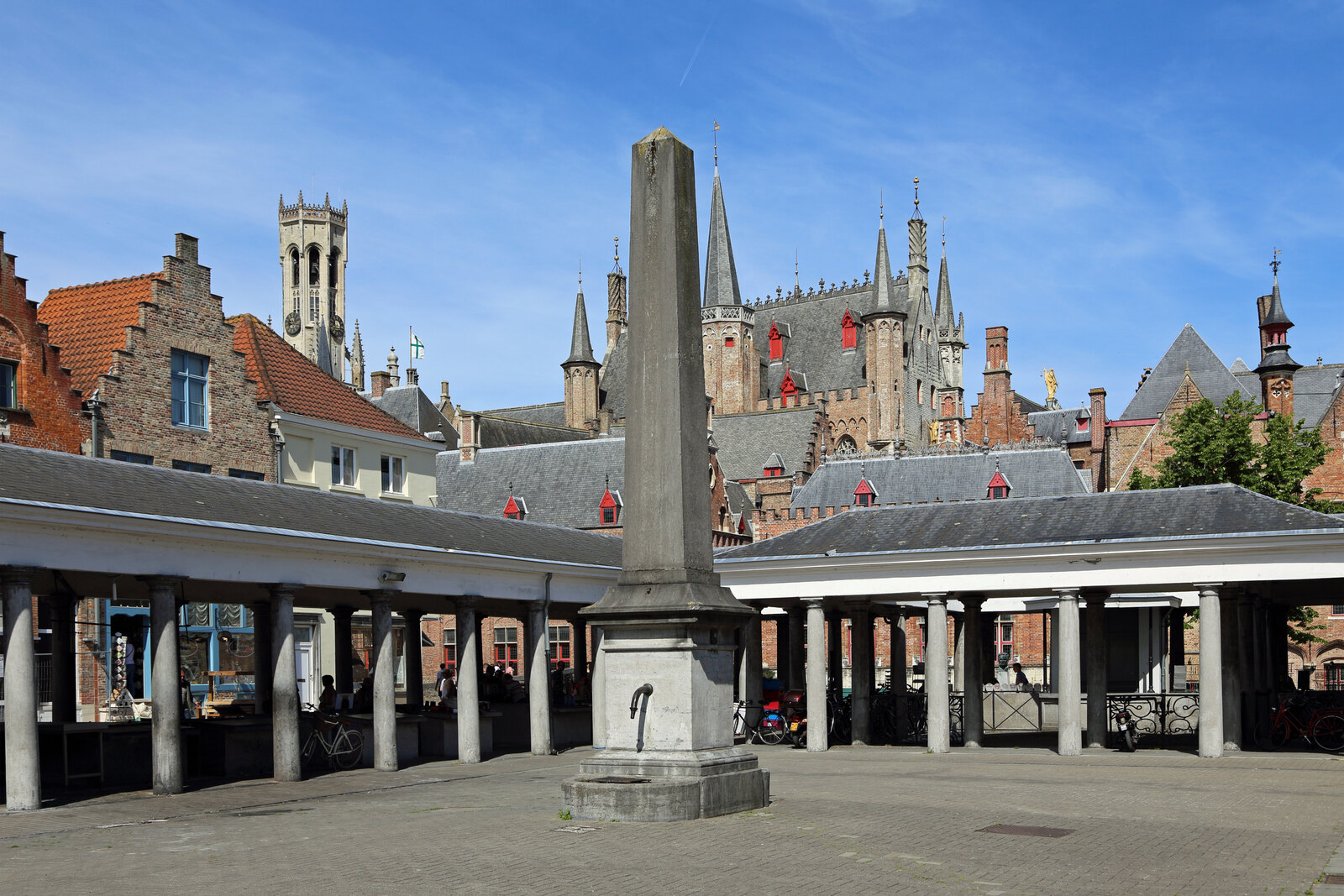
Look around first
What to notice
- Double colonnade
- Stone countertops
- Pavilions with slate roofs
The story of the place
Two rows of columns support the slate roofs of the fish pavilions, with stone stalls stretching between them. Before fish was traded on Braamberg, grain was sold there; then fish was laid out on collapsible wooden stalls. At the beginning of the nineteenth century, the city replaced them with a covered market, and in the early years an individual place cost so much that one stall was sometimes shared by four women sellers. On Wednesday through Saturday mornings, fish, shellfish, and crustaceans are sold here, and later craftspeople also remain under the colonnade.
On the night before August second, seventeen forty-five, Bruges fish traders returned their collapsible stalls to Market Square within a few hours. In the morning, city councilors found the rows of stalls in the very place they had just ordered them removed from.
That summer, during the War of the Austrian Succession, French troops occupied Bruges. For the ceremonial entry of Louis XV, the French king, who wished to appear before the townspeople with due ceremony, Market Square was cleared of fish, stalls, and traders. The fish traders were ordered to move temporarily to the distant Biskajersplein for the duration of the king's stay.
The order affected an old privilege. In fourteen sixty-nine, Duke Charles the Bold assigned the north side of Market Square to the guild of free fish traders. “Free” was the name given to members of the privileged corporation: places and rights in it could be inherited. Pieter Anchemant became the guild's representative in the dispute—a city alderman, that is, a member of the magistracy, the fish traders' treasurer, and the hereditary owner of one of the stalls. His family leased that place to an active seller and received rental income every year. Anchemant pressed for the traders to be returned to the place where their right was recognized by the ducal charter.
As soon as Louis left, the guild moved the stalls back overnight. The council decided that they would no longer be allowed onto Market Square. The city resolution explicitly named the dirt and strong smell from the fish rows as the reason. Anchemant was summoned and asked for the guild's consent to a new relocation. He replied that he could not give such consent: the traders considered the order a violation of their privileges.
The council set a deadline—until six o'clock that same evening of August second. The fish traders complied, with the reservation that they were yielding only temporarily. They were sent here, to Braamberg, where the grain market had formerly been held. Grain traders took the vacated place on Market Square, while the fish traders remained on Braamberg. The temporary decision was never revoked.
The present colonnade did not yet exist. Fish was sold from collapsible wooden stalls. In May eighteen ten, Baron de Croeser, the mayor of Bruges, showed two experimental stone pavilions with slate roofs to Napoleon, who had come to the city. The emperor asked how expensive it would be to replace all the old stalls with such pavilions. De Croeser carried out the idea later, when he again became mayor: city architect Jean-Robert Calloigne designed a covered market with a double colonnade.
By the autumn of eighteen twenty-one, the pavilions were ready. On April first of the following year, women fish sellers began renting places. The fee was so high that a single stall was sometimes shared by four sellers. The wooden countertops were replaced with the present stone ones in eighteen fifty-two.
It is now Belgium's oldest surviving covered fish market. On Wednesday through Saturday mornings, fresh and prepared fish, shellfish, and crustaceans are sold here; the colonnade is also used by sellers of handmade goods. The square's former name remains on the neighboring Braambergstraat. The square itself acquired a new name—Fish Market—left here by the traders who once returned to Market Square overnight and lost their place again by six o'clock that evening.
Useful on site
The colonnade is accessible at all times; fresh fish is usually sold Wed–Sat mornings.
Checked: June 28, 2026. Check the official source before visiting.If trading is underway, keep to the passageway and do not occupy the stalls; at other times, you can look around the gallery at ease.