 Guide On Map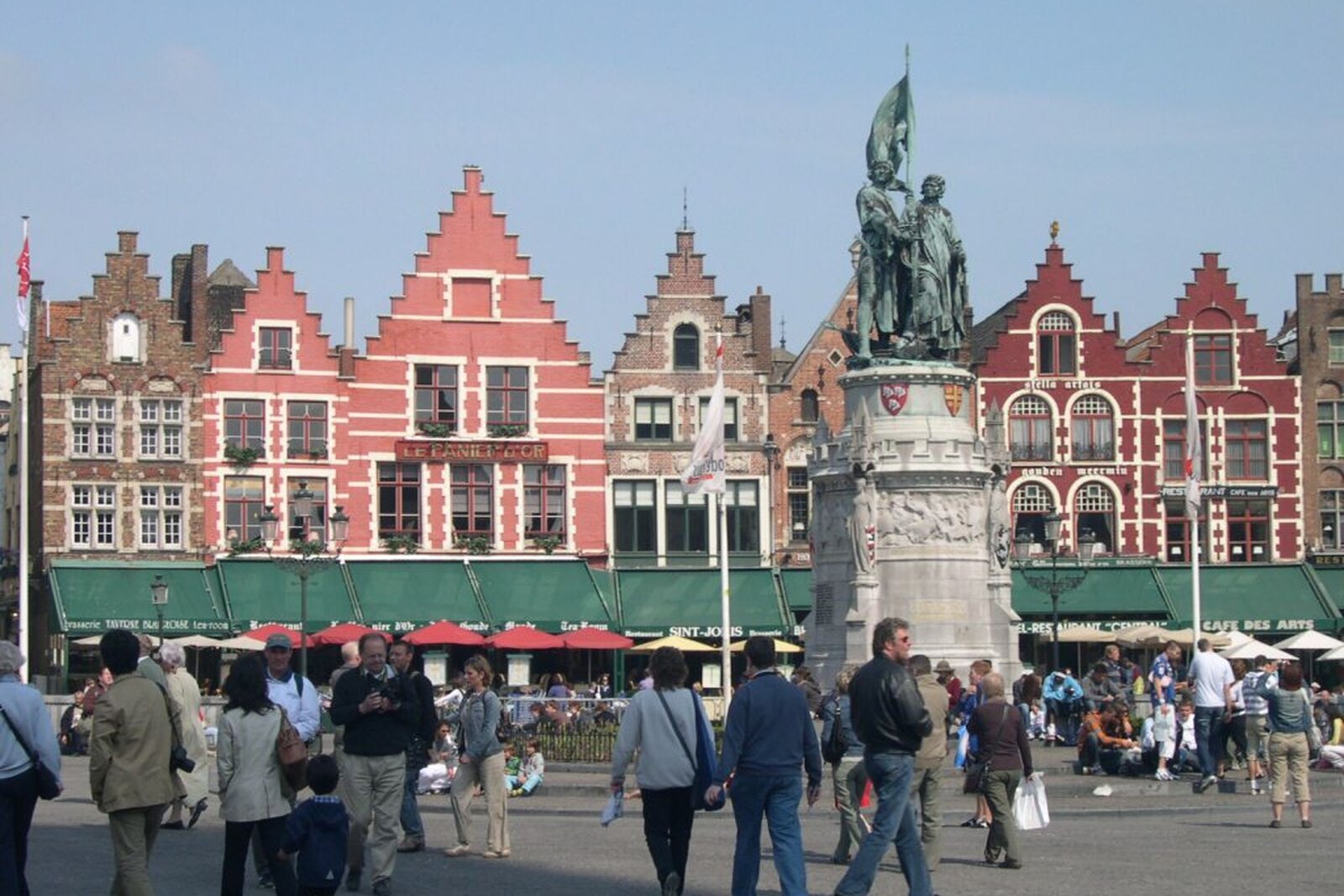
Look around first
What to notice
- The bronze figures in the center of the square
- Cranenburg House at number 16
- The open space of Market Square
The story of the place
Market Square means “market” in Dutch. The commercial quarter emerged here, where the old overland road approached the Kraanrei canal. Goods arrived by water, while the streets spreading out from the square led to the houses of craft guilds and merchants. In twelve hundred, the count of Flanders confirmed Bruges’s right to hold an annual fair; the name Market Square was first recorded in thirteen oh two. The canal was later covered beneath the east side of the square, but trade did not disappear: stalls selling food and flowers are still set up here on Wednesdays.
The two bronze figures in the center are Pieter de Coninck and Jan Breydel. De Coninck was a weaver and a leader of artisans seeking to secure the guilds’ participation in city government. Wealthy merchants holding offices in Bruges supported Philip the Fair, the king of France; he brought Flanders under his control and stationed a garrison in the city. Early on the morning of May eighteenth, thirteen oh two, rebellious townspeople slaughtered the French soldiers. Two months later, the militias of Flemish cities defeated the king’s army of knights near Kortrijk, after which Bruges’s guilds gained broad representation on the city council.
Jan Breydel is less certain in every respect. He belonged to the butchers’ guild and took part in later uprisings alongside De Coninck, but his role as a leader of the thirteen oh two revolt appeared in late chronicles. In the nineteenth century, the writer Hendrik Conscience made them both the main characters of the novel The Lion of Flanders. In eighteen eighty-seven, they were placed side by side on Market Square. The bronze fixed the version in which the documented leader De Coninck and Breydel, a hero of legend, act as equals.
The killings of thirteen oh two took place throughout the city, and the decisive battle was fought far from Bruges. The strongest documented scene on Market Square itself unfolded almost two centuries later. After the death of Duchess Mary of Burgundy, her widower, Maximilian of Austria, became regent for their underage son Philip the Handsome. Maximilian wanted to retain control of Flanders and demanded money for wars with France.
Pieter Lanchals, the son of a Bruges carpenter, rose to head Burgundian finances and helped collect that money. He received a large salary, gifts, and bribes, and in fourteen eighty-four Maximilian appointed him city schout—an official who, on the ruler’s behalf, oversaw the courts and the carrying out of sentences. Lanchals forced Bruges to pay military expenses, persecuted the regent’s opponents, and soon could no longer walk through his native city without eighteen armed bodyguards.
At the beginning of February fourteen eighty-eight, Bruges artisans captured Maximilian. On February fifth, they locked him in Cranenburg House on the west side of Market Square. Lanchals went into hiding, but the townspeople found him. On March twenty-second, before the scaffold erected in the square, he signed his will, and then the city executioner cut off his head. Maximilian was forced to watch the execution of his treasurer from Cranenburg House.
On May sixteenth, an altar was set up on Market Square. Maximilian publicly swore to withdraw the soldiers, pardon the participants in the uprising, and renounce the regency in Flanders. After the oath, he was released. The terms did not last long: the war resumed, and at the end of fourteen ninety, Bruges capitulated.
Cranenburg House survives on the corner of the square at number sixteen; it is now a café. Its brick Neo-Gothic facade appeared only in nineteen fifty-six, so the prisoner saw a different Market Square and a different house from the windows. The scaffold and altar have long been gone. Cranenburg House and the open square remain, where one man was executed and another was forced to swear an oath in exchange for his release.
Useful on site
Open square; the weekly market on Market Square is usually held on Wednesdays, 8:00-14:00.
Checked: June 28, 2026. Check the official source before visiting.Listen at the edge of the square, without stopping in the flow of pedestrians and horse-drawn carriages.