 Guide On Map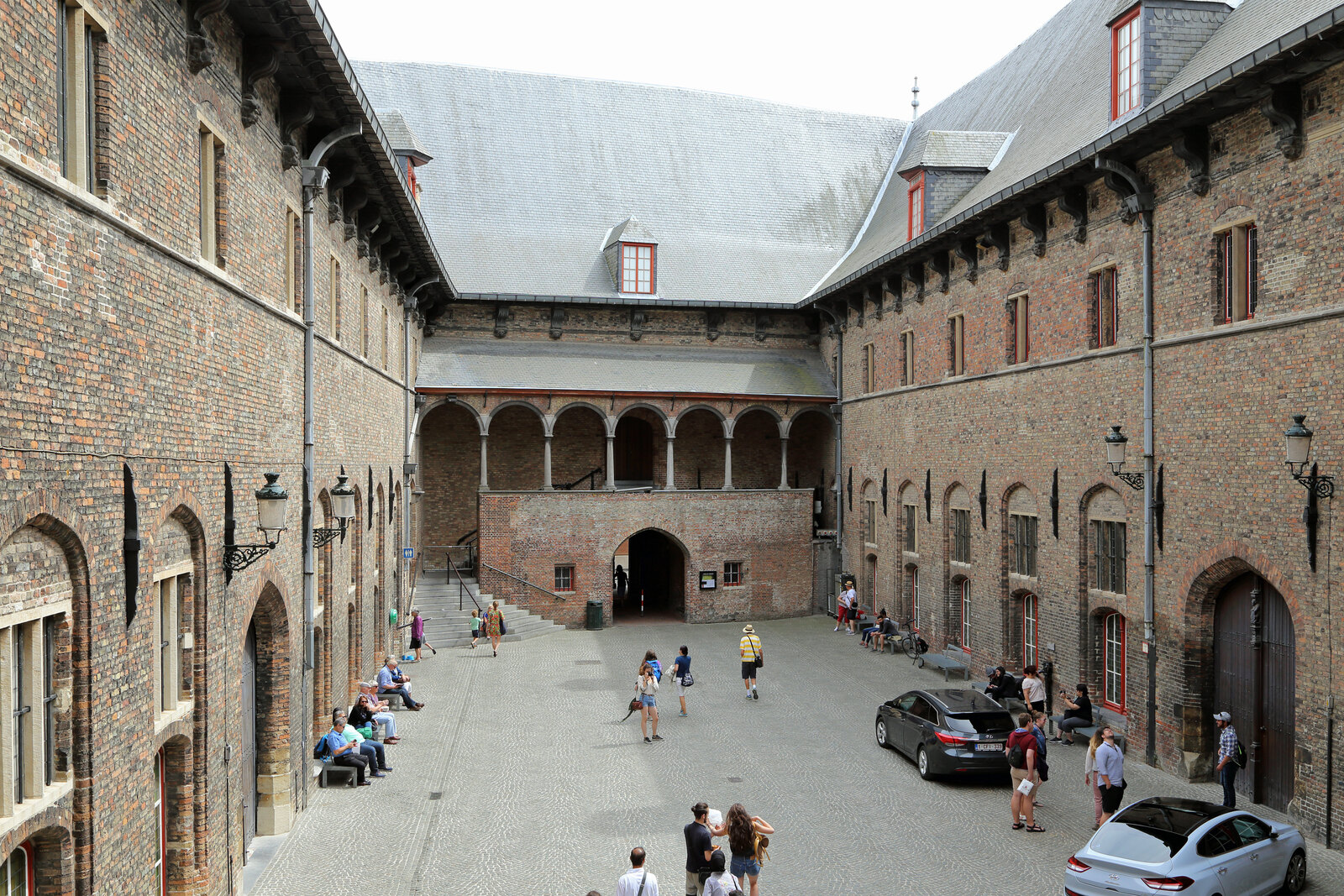
Look around first
What to notice
- Belfry of Bruges tower
- Cloth Hall arcade
- Double wrought-iron grille of the former treasury
The story of the place
The Belfry of Bruges is the city tower above the Cloth Hall, a covered market where cloth was stored and sold. In medieval Bruges, these two parts of the building served the same people. Merchants made money from English wool and Flemish cloth below, while city officials above kept the treasury, seal, accounts, and the charter recording the townspeople's rights.
The cloth trade was controlled by wealthy merchant families from the Flemish Hanse of London, an association connected with imports of English wool. Members of the same families held posts in the city government. Their opponents called themselves the Many. This group included newly wealthy merchants, craftsmen, and several dissatisfied members of the old nobility. They wanted access to offices and city money. The Many were not seeking equality for everyone: one wealthy group was trying to push aside another.
In August twelve eighty, a fire broke out in the Belfry of Bruges. Contemporaries suspected arson connected with the struggle between city factions, but there is no evidence for this. The fire destroyed the archive, including the charter of city privileges. This scroll defined which matters Bruges decided independently and what the city owed the Count of Flanders in return. After the fire, the townspeople no longer had the old document with which they could confirm the previous terms.
Guy of Dampierre took advantage of this. He had recently become Count of Flanders and was seeking greater control over the wealthy cities of his County of Flanders. On October first, the Many overthrew city officials accused of dishonest accounting and embezzlement. The coup was accompanied by looting and the burning of houses. The count brought in troops, restored the previous leaders, and punished Bruges with a fine of four hundred Parisian pounds and a permanent annual payment.
Guy of Dampierre then issued the city a new charter to replace the one that had burned. Most cases of violence now had to be heard in the count's court, and the count kept for himself the approval of new city rules. Thus, the archive fire gave him the opportunity to rewrite Bruges's relationship with him on his own terms.
The new charter angered more townspeople than had originally supported the coup. In the summer of twelve eighty-one, a second uprising began, this time against the restrictions imposed by the count. It too was suppressed, several leaders of the first uprising were executed, and the sides concluded an armed truce that lasted about ten years. Of the changes introduced then, the requirement to inspect the city accounts annually together with representatives of the Bruges community remained.
The medieval documents that had lain in the Belfry of Bruges before the fire disappeared forever. The present collection of city accounts begins in twelve eighty and then continues with almost no gaps through the end of the eighteenth century. In the former treasury inside the tower, a double wrought-iron grille remains, installed after the uprising, in twelve ninety-one or twelve ninety-two. The new archive was kept behind it—the former charter was no longer there.
Useful on site
Paid climb according to the Visit Bruges / Musea Brugge calendar; on 28.06.2026, it indicated closure because of heat.
Checked: June 28, 2026. Check the official source before visiting.The outside account does not require entry; plan the climb up the tower separately and check access in advance.