 Guide On Map
Chartrons: From Wine Warehouses to Jardin Public
From the contemporary art museum along the Garonne, via Rue Notre-Dame, to Jardin Public
Guide On Map on your phone
Open the walk like a regular app
It takes about 10 seconds to install. No app store needed.
The whole path
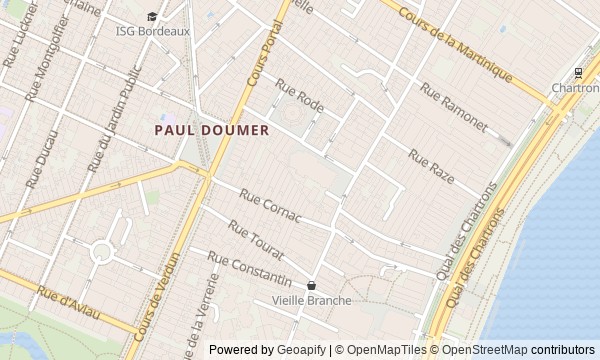
Route map
About the walk
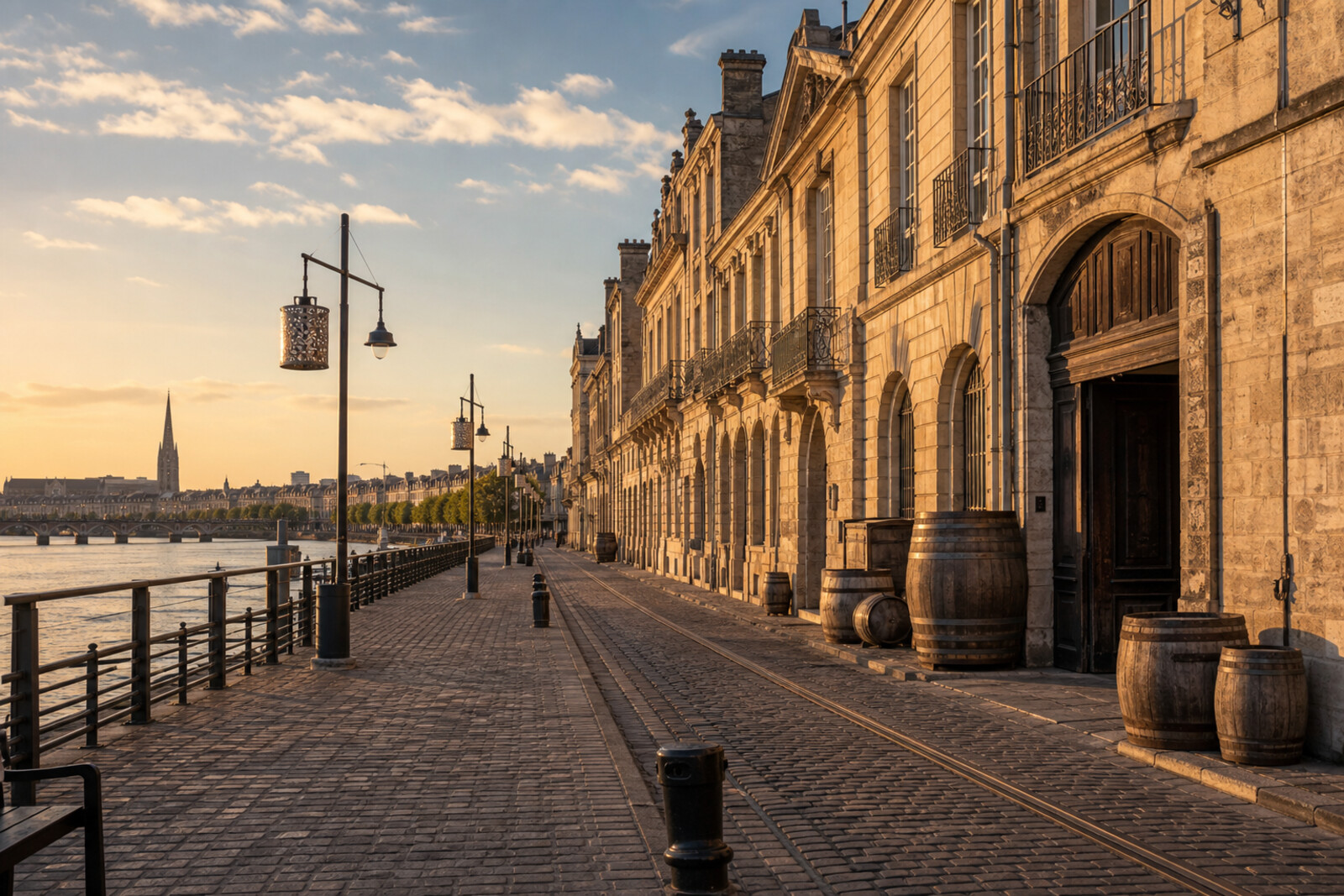
You will begin beside the Garonne, at a former customs warehouse, then follow the water before turning into Chartrons. Behind the stern facades lie offices, cellars, cooperages, and the homes of people who sold Bordeaux wine long before the familiar tasting routes existed.
The walk runs from museum arches to the quay, then along narrow commercial streets, past antique shops, a church, and a former market. In the end, stone gives way to the paths of Jardin Public.
The story rests on private decisions and chance turns. Why will a homeowner find his own address surprising? What will be uncovered beneath the market's concrete shell? Why will an old warehouse need a figure on its elevator shaft? The answers remain within the stops.
After the walk, you will recognize Chartrons not by its wine signs, but by the way its houses were arranged: where goods were kept, deals were made, and old buildings were cleared for new life.
Why this order
The route first shows Chartrons at its largest scale of trade: the warehouse on the Garonne and the quay itself, where house, office, and ships formed a single enterprise. It then leaves the river along Rue Borie and heads into the neighborhood: the Musée du Vin et du Négoce explains the layout of a wine merchant's house better than the facades along the quay can. From there, Rue Notre-Dame continues the story of those same deep rooms after the wine merchants departed—antique dealers now occupy them. Saint-Louis des Chartrons Church comes next: the street name leads to the site of the vanished Carmelite church, while the newer church shows why the old plot continued to shape the neighborhood. The nearby market is a necessary continuation: its land was once proposed for a church, and later architects freed the pavilion itself from newer outer layers. The final walk to Jardin Public broadens the story from individual buildings to urban land: the wine trade appears here not through warehouses, but through plots, roads, and a place for wine merchants to meet in the evening.
Those who want to understand wine-trading Bordeaux without going to a château Lovers of urban history told through houses, deals, and transformations Those who prefer a quiet walk by the water and along residential streets
Those expecting a route through vineyards Those mainly looking for tastings Those who do not enjoy detailed stories of trade and urban redevelopment
Before you go
The route's main ideas are available from outside, but CAPC Museum of Contemporary Art of Bordeaux and Musée du Vin et du Négoce offer a chance to see the spaces discussed here: the warehouse's central nave and the vaulted cellars. Check visiting availability separately rather than making the whole walk depend on it. Saint-Louis des Chartrons Church may be closed or in use for a service, and Halle des Chartrons may host an event; in either case, take in the building and square calmly from outside. On Rue Notre-Dame, some details are hidden behind gates or inside working premises, so do not enter closed courtyards or expect to see everything mentioned in the story.
When to go
Choose daylight hours: it is easier to read the facades along the quay and Rue Notre-Dame, and to make out the structure of the landscape in the garden. If you plan to visit the museums, check their availability first and allow extra time. Without interiors, the route can be done at an unhurried pace, leaving Jardin Public as a proper, unhurried finale.
Backup plan
If the museum or church is closed, do not redesign the whole route: listen to the story at the facade and focus on the scale, materials, and layout of the surrounding neighborhood. In rain, spend less time on the open quay and more by the sheltered parts of the buildings; it makes sense to leave Jardin Public for another time if the paths are uncomfortable for walking. If you tire earlier, Halle des Chartrons can make a meaningful finishing point: by then, the thread of warehouses, wine, streets, and public spaces will already have come together.
Route conditions
Surface. Paved — 1.9 km; unpaved — 76 m (data covers 73% of the route)
Access. Wheelchair — limited; stroller — limited
Facilities. Toilets — 5; drinking water — 4
Elevation. Ascent — 12 m; descent — 18 m
OpenStreetMap extract of June 18, 2026: database data, not a check on the ground. Data © OpenStreetMap contributors, ODbL licence
Walk plan
Open in maps ↗- 1
CAPC Museum of Contemporary Art of Bordeaux
Here you will see how a port building was preserved and adapted for art. - 2
Quai des Chartrons — trade at the river's edge
The quay will connect the wine trade with family risk, overseas offices, and a fleet of its own. - 3
Musée du Vin et du Négoce — a house arranged around a barrel
The layout of the house shows how living quarters, an office, and work with barrels fit under one roof. - 4
Rue Notre-Dame
This stop will show who moved into the deep commercial premises after the wine warehouses left. - 5
Saint-Louis des Chartrons Church — a new church with old memories
The new church will explain how parishioners preserved the memory of a dismantled church but did not get the square they had planned. - 6
Halle des Chartrons
The pavilion will show the result of a transformation in which the architects did not add anything new, but removed a later shell. - 7
Jardin Public — the city’s living room among the trees
The finale will show how a dispute over land for the garden changed the boundary of Chartrons and the value of neighboring plots.
Route features
Everything you need stays in the browser
Progress, saves and your trip plan are stored on this device.
Add Guide On Map to your home screen so the walk opens outside the browser.
How we handle sources, maps and corrections: our editorial standards