 Guide On Map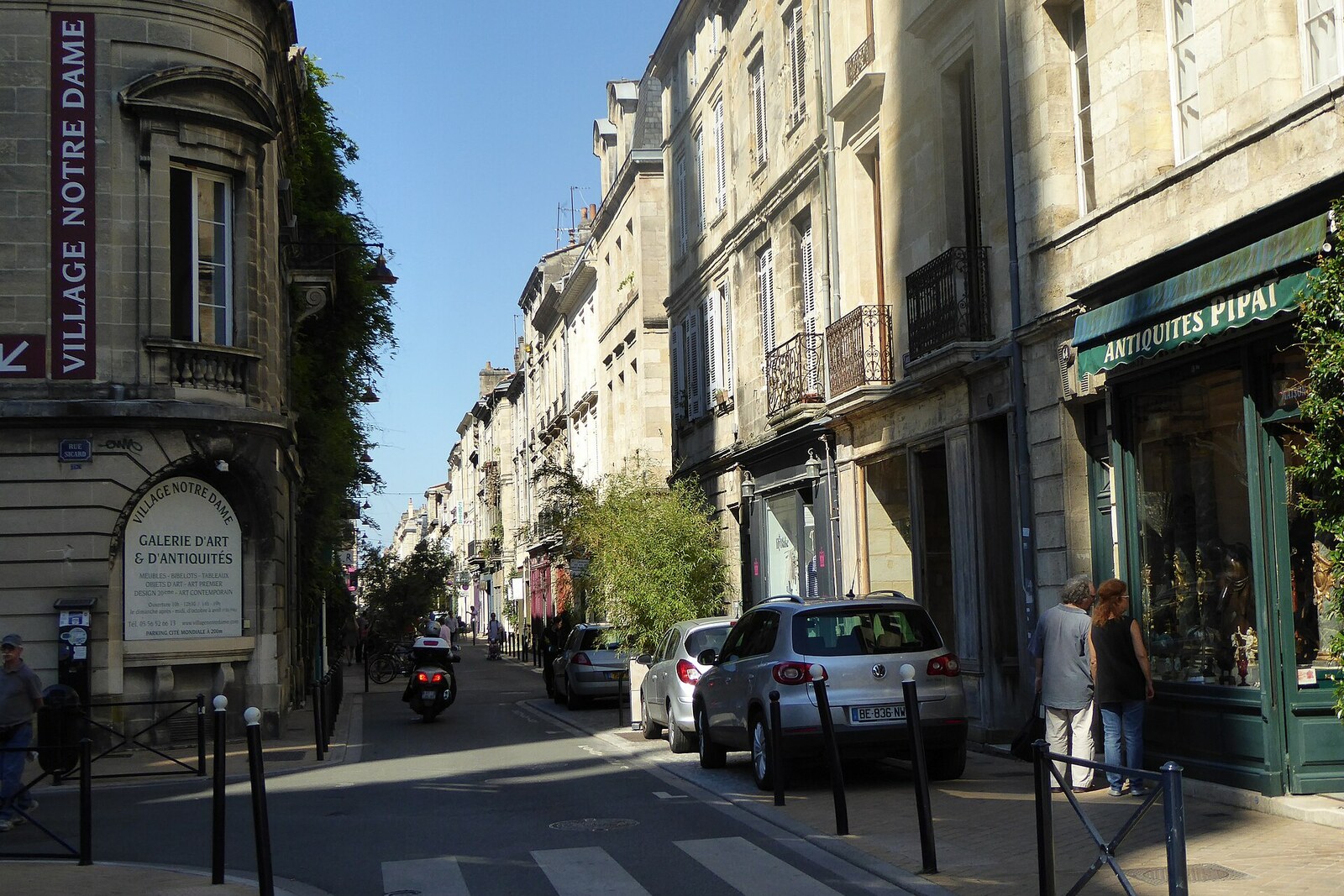
Look around first
What to notice
- House No. 61
- Wide gates
- “Village Notre-Dame” sign
- Antique-shop displays
The story of the place
The wide gates in the stone façades were made for heavy goods: behind them stretch deep lower floors with low vaults. For a long time, this street functioned as part of a commercial district, where cargo was taken from the pavement into enclosed premises rather than displayed openly. House number sixty-one is easy to recognize by its Village Notre-Dame sign: its former print shop now brings together separate shops under one roof. Alongside furniture, items from the middle of the last century are sold here, and there are galleries, cafés, and clothing shops.
The street sign still bears the name of a vanished church. In sixteen sixty-seven, the Discalced Carmelites established a monastery beside a country road through marshy lowlands. Their church was dedicated to Notre-Dame—the Virgin Mary—and this dedication passed to the district’s main road. The Carmelite church was later dismantled; Saint-Louis des Chartrons Church stands in its place, while the street retained its former name.
In the following centuries, wine merchants built houses along it with wide openings and vaulted rooms below: these gateways made it easy to roll barrels through. When trading houses needed large, modern warehouses outside the center in the twentieth century, some of these premises stood empty. They suited antique dealers better: large furniture could pass through the old gates, and the deep ground floors could be divided into salesrooms.
The most striking transformation took place at house number sixty-one. In nineteen eighty-two, Jacques Dubourg, a professional antique dealer and one of the creators of the new gallery, took over a former print shop with his colleagues. They divided two floors into separate booths and opened Village Notre-Dame—the first permanent antiques gallery in Aquitaine. Each dealer remained independent: each found, restored, and sold the objects on which that dealer’s livelihood depended. Dubourg did not become merely a manager either. For the gallery’s twenty-fifth anniversary, he displayed his own seventeenth-century Dutch bronze lamp and said that he had restored its shine with ordinary Marseille soap.
Dozens of booths occupied one roof, and buyers no longer had to wait for a rare fair. By the twenty-fifth anniversary, about twenty antique dealers worked here, and their goods filled thirty sections. Dubourg continued to manage the gallery for many years. In two thousand nineteen, a new owner bought the building, Dubourg stepped back from management, but the antique dealers remained.
Now, individual shops still occupy the former print shop, and around them old furniture dealers stand alongside sellers of items from the nineteen fifties, nineteen sixties, and nineteen seventies, galleries, cafés, and clothing shops. Above the entrance to house number sixty-one is the inscription “Village Notre-Dame,” although neither the print shop nor the Carmelite church that gave the street this name still operates here.
Useful on site
Open public street; individual shops, antique dealers, and galleries keep their own hours.
Checked: June 28, 2026. Check the official source before visiting.View the houses from public spaces: the gates of former baths may be closed, and shops and galleries keep their own hours.