 Guide On Map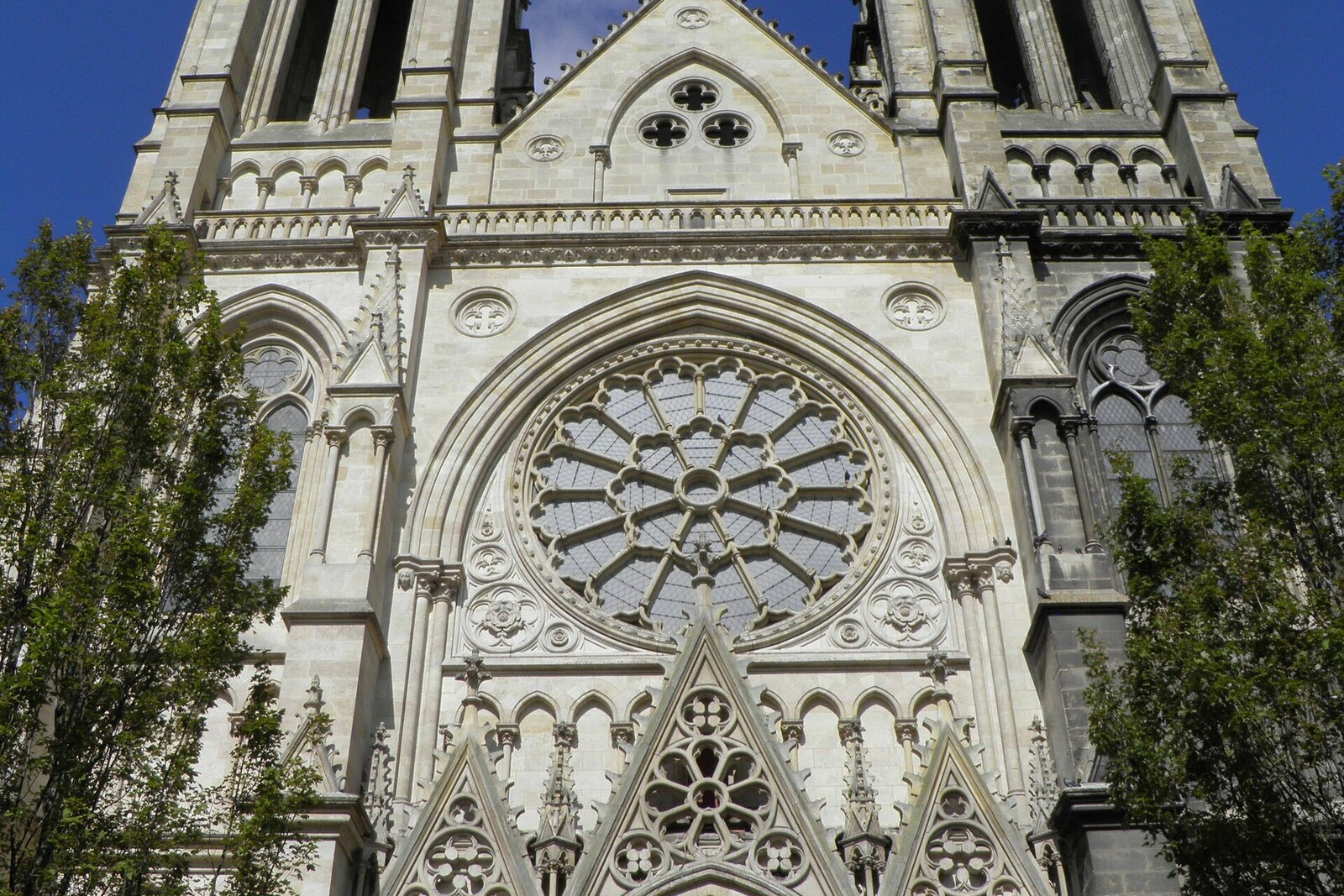
Look around first
What to notice
- Two towers with spires
- Three portals
- Statue of Saint Louis
- Marble altar
The story of the place
In eighteen sixty-four, an expert discovered dangerous transverse cracks in the old church in Chartrons. At the time, the Church of the Discalced Carmelites stood here, built back in the eighteenth century. Its vaults had collapsed twice before, and now the masonry was being forced apart again.
Pierre Doni, the parish priest, pressed for a safe and sufficiently spacious church for his community. He persuaded the parish council—the people who then managed the church funds and looked after the building—to print a memorandum in support of architect Pierre-Charles Brun's project and launch a subscription campaign. Parishioners contributed money, and the council invested it in railway company bonds. By the laying of the first stone, they had accumulated two hundred forty thousand five hundred eighty francs—almost three quarters of the original estimate.
The main dispute concerned the site. Doni and the parish council asked for the site of the demolished Chartrons market to be given over to the church. A square with an exit onto Cours Portal could have been created there. The municipal councilors decided otherwise: in eighteen sixty-seven, they chose the former Carmelites' site on Rue Notre-Dame. Doni warned that the large church would be hemmed in between houses.
Construction was postponed anyway. The city first restored the market and finished two other churches. In eighteen seventy-two, a new inspection of the old building was so alarming that the architect had to urgently bind its walls with iron. Only two years later did the municipal council authorize work to begin. In the summer of eighteen seventy-five, the dilapidated church was closed, services were moved to a temporary chapel on Rue Ferrère, and builders dismantled the old walls.
Brun was left with the same marshy ground that earlier builders had feared. He drove pine piles down to a gravel layer at a depth of fourteen and a half meters. The nave, two towers, and spires rose on these piles. The first part of the new church opened in November eighteen seventy-nine, and it was handed over in full to the parishioners in May of the following year. Doni remained parish priest for another eight years: he had time to serve in the church for which he had raised money and argued with the city.
It inherited its name from the former parish. In seventeen ninety-one, the Constituent Assembly redrew the boundaries of Bordeaux's parishes, and the former Carmelite church was dedicated to Saint Louis. This is Louis IX (Saint Louis), the thirteenth-century French king who was canonized after his death. His statue was installed above the facade of the new building, and the stained-glass windows show the king's departure on the Seventh Crusade and his presentation of the Crown of Thorns he had acquired to the Archbishop of Paris.
When the Carmelite church was dismantled, part of its furnishings was preserved. Craftsmen transferred the confessionals, the carved canopy over the pulpit, and the marble altar of seventeen forty. By the end of eighteen eighty, they had reassembled the old Cuban mahogany panels in the sacristy. Today, masses are held and organ concerts are organized at Saint-Louis des Chartrons Church. The large square Doni had planned never appeared in front of the three portals, while beneath the Neo-Gothic vaults the altar of the dismantled Carmelite church remains.
Useful on site
Exterior viewing is unrestricted; access to the interior depends on services and parish/cultural events, so check the parish schedule.
Checked: June 28, 2026. Check the official source before visiting.If the doors are open, enter quietly and do not disturb the service; the interior and the organ cannot be fully seen from the square.