 Guide On Map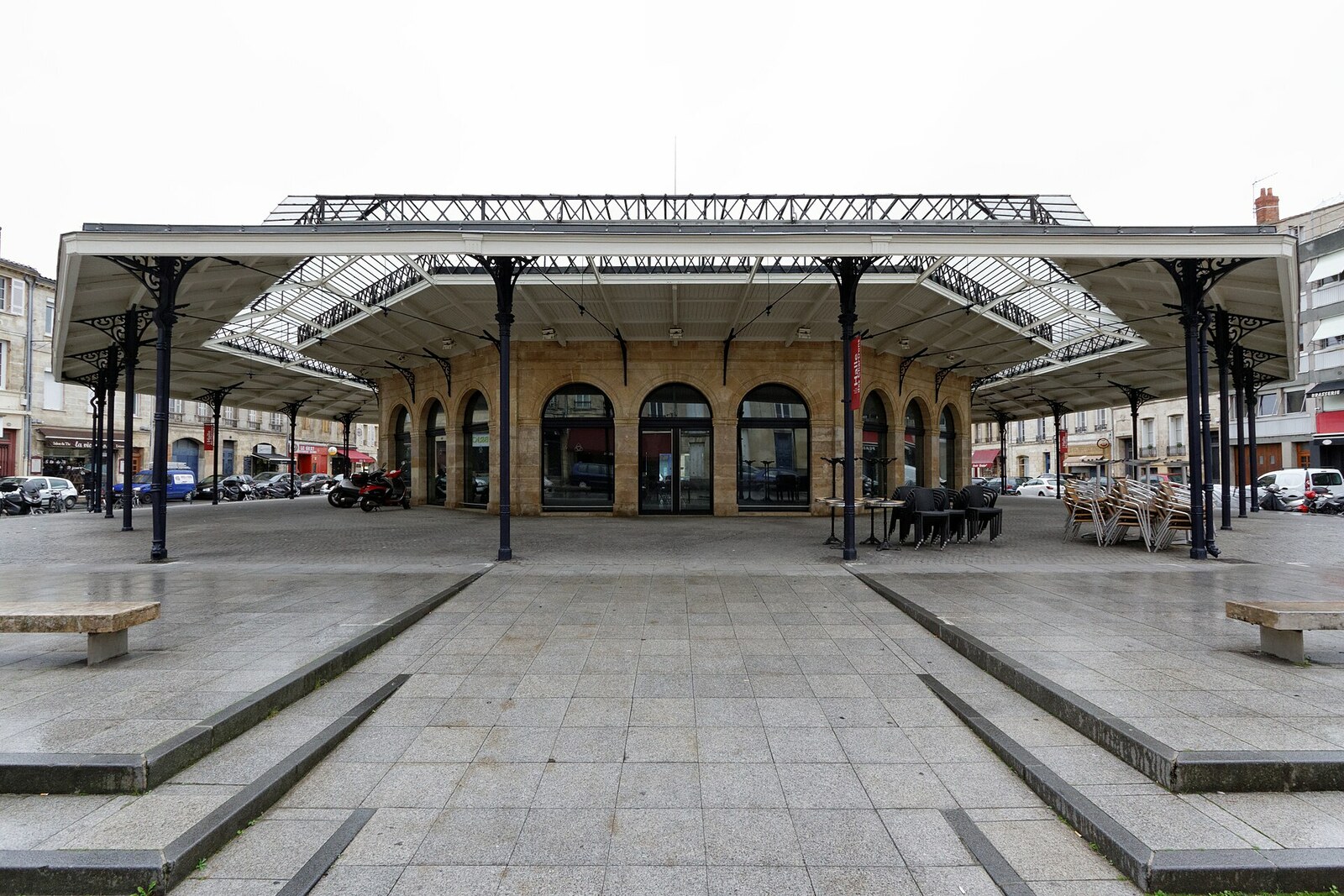
Look around first
What to notice
- Stone octagon
- Cast-iron columns
- Metal roof
- Glass gallery
The story of the place
Once a market square was established on the land of the former Carmelites, this multilayered pavilion gradually rose at its center. Behind the stone facets of the octagon stand slender cast-iron columns, beyond them stretches a glass gallery, and above it another metal tier closes in: with each rebuilding, the former structure did not disappear but ended up inside the new one. It was cramped here for market stalls and inconvenient for receiving goods, so permanent trade never took hold; now the space hosts exhibitions, concerts, and festivals.
In the summer of nineteen ninety-seven, the architect Christine Mathieu directed demolition here. Workers were breaking up a concrete belt that had completely concealed the old market pavilion since nineteen sixty-one. The city tasked Mathieu with restoring the historic structure; beneath the concrete, they had to find the stone octagon, the cast-iron supports, and the metal roof.
These parts ended up one inside another by decision of the city architect Charles Burguet. A market square was laid out here only after the revolutionary municipal council set aside the former Carmelite land for a market in seventeen ninety-two. First, the architect Michel Bonfin arranged market shelters on the rectangular square; later, an octagonal stone pavilion was erected at its center.
In eighteen sixty-nine, Burguet was commissioned to expand the market. He retained the octagon and surrounded it with an open gallery with a glass roof on slender Corinthian columns. There was still not enough space, so the architect added another crown, this one entirely metal. Each expansion left the former market inside the next one.
The expectation of brisk trade did not come true. Vendors who depended on daily sales of produce needed convenient deliveries, but the square was tightly hemmed in by the neighborhood and difficult to access. Merchants avoided the pavilion, so it was used far less than the city had expected. The concrete shell, added nearly a century later, covered both the stone center and the metal galleries.
Christine Mathieu and Bernard Bouzou decided to remove this shell. By nineteen ninety-eight, they had opened the old structures toward the square again and adapted the cleared space for exhibitions, concerts, salons, and festivals. There are now no permanent stalls inside. What remains of the market is its name, the stone octagon, and the metal crown; the concrete layer beneath which Mathieu found both of them is gone.
Useful on site
The square is freely accessible; Halle opens for events. The covered Chartrons market nearby operates from Tuesday to Saturday, approximately 07:00–13:00.
Checked: June 28, 2026. Check the official source before visiting.The building may be occupied by an exhibition or meeting; even without access inside, its layers are clearly legible from the square.