 Guide On Map
Yaowarat Road and Talat Noi: Commercial Bangkok
From Hua Lamphong Railway Station through Sampheng and Yaowarat Road to Song Wat Road and Talat Noi
Guide On Map on your phone
Open the walk like a regular app
It takes about 10 seconds to install. No app store needed.
The whole path
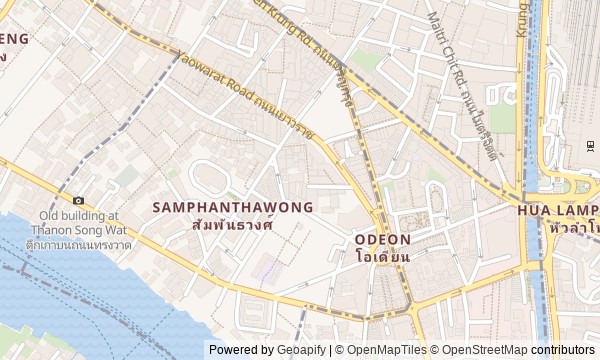
Route map
About the walk
You will walk from the dead-end tracks of Hua Lamphong Railway Station to the river, through temple courtyards, Sampheng's wholesale passages, the shopfronts of Yaowarat Road, and the old warehouses of Song Wat Road.
The neighborhood first meets you with a railway facade and a statue that people mistook for something else for decades. Beyond the ceremonial gate, the streets grow tighter and trade louder: bundled goods, red displays in gold shops, a bank corner, piers, and a family courtyard.
This is not a story of "Chinese color." It is a story of land, credit, and the right to remain. Why were owners not allowed to rebuild their shops after a fire? How did a bank begin in 2 neighboring premises? Why did a deep swimming pool appear in an old courtyard?
The account follows documents, human decisions, and traces still visible today. Where there is a legend or a disputed version, you will hear the qualification. By the end, you will read Yaowarat Road not as a food street, but as a neighborhood where trade repeatedly reshaped land, temples, and family homes.
Why this order
Hua Lamphong Railway Station provides an outer entrance to the neighborhood: from the dead-end station, the road leads to Wat Traimit Witthayaram, where a statue was once moved from a monastery that had lost its place. Just beyond the temple, Odeon Circle marks the boundary of Bangkok Chinatown and introduces the relationship between the trading community and royal power. From Chinatown Gate, Charoen Krung Road leads to Wat Mangkon Kamalawat, a permanent home the community built for its own monks and rituals. Next, Sampheng reveals the neighborhood's trading environment and the cramped conditions that made a fire alter the very map of its streets. After the narrow wholesale passage, broad Yaowarat Road shows another way of remaking the same land: the planned construction of a road through residential plots. Along the commercial line, the route reaches Ratchawong Road and Song Wat Road, where riverside warehouses explain how a bank could grow out of 2 shops. Then the walk along the river brings you to Talat Noi: at So Heng Tai Mansion, the history of great trade contracts into a single family courtyard, which the heirs now have to sustain through a new business.
Those interested in Bangkok beyond the temple checklist Those who want to understand Bangkok Chinatown through trade, land, and family affairs Those who enjoy documented stories and legends honestly marked as such
Those looking only for an evening food route Those expecting a quiet walk away from commercial streets Those who do not want to hear about fires, property disputes, and the cost of urban change
Before you go
Before setting out, check whether visitors are admitted to the temple interiors, the heritage center at Wat Traimit Witthayaram, and So Heng Tai Mansion: an active monastery, exhibitions, and a private residence may each operate under different rules. For sacred sites, choose clothing that covers your shoulders and knees, and shoes that are easy to remove. Bring water, sun protection, and as little as possible: in Sampheng, a backpack and an open umbrella can easily get in other people's way. Save an offline map of the Trok San Chao Rong Kueak to Soi Wanit 2 section, but on the ground follow open public passages and do not cut through courtyards or workshops.
When to go
Start in the morning if you want quieter temples and Sampheng at work. By midday, the market becomes denser and hotter; in the evening Yaowarat Road is brighter and more active as a food street, but interior exhibitions and private places may already be inaccessible. On major Chinese New Year holidays, allow extra time: processions, offerings, and crowds can change the usual rhythm of the whole neighborhood.
Backup plan
If Wat Traimit Witthayaram, Wat Mangkon Kamalawat, or So Heng Tai Mansion is closed, do not leave it out of the walk: take in the accessible facades, entrance spaces, and surrounding buildings without trying to pass beyond barriers. If Sampheng is excessively crowded, follow the open edge of the trading district and return to the route sequence at Song Wat Road; do not squeeze against carts and deliveries. In heavy rain, wait out the strongest downpour in a permitted public place, since shop awnings and private thresholds are not always meant for visitors. If an alley in Talat Noi is blocked, return to the last open exit and look for an approach from Soi Wanit 2, staying on the eastern bank.
Route conditions
Surface. Paved — 3.5 km (data covers 63% of the route)
Stairs. Flights: 2, 44 m in total
Access. Wheelchair — no; stroller — limited (stairs)
Facilities. Toilets — 11; drinking water — 2
Elevation. Ascent — 36 m; descent — 35 m
OpenStreetMap extract of June 23, 2026: database data, not a check on the ground. Data © OpenStreetMap contributors, ODbL licence
Walk plan
Open in maps ↗- 1
Hua Lamphong Railway Station
The dead-end track layout explains why a routine depot inspection ended in disaster in the passenger hall. - 2
Wat Traimit Witthayaram and the Golden Buddha
This stop will show how a failed move forced people to reassess the value of a familiar sacred statue. - 3
Chinatown Gate at Odeon Circle
The arch will link the entrance to the commercial district with an attempt by the royal family and the community to overcome postwar alienation. - 4
Wat Mangkon Kamalawat
Here it becomes clear why the trading community needed a permanent monastery and its own recognized leader. - 5
Sampheng's Trading Alleys
The wholesale passage will show the price of the road laid after the great fire. - 6
Yaowarat Road
A broad commercial street will reveal the dispute over whose homes had to make way for the new road. - 7
Song Wat Road
The river trade corridor explains why a small bank was immediately entrusted with sums greater than its own capital. - 8
Talat Noi and So Heng Tai Mansion
The finale will bring together a family obligation, an old trading courtyard, and an unexpected new source of income.
Route features
Everything you need stays in the browser
Progress, saves and your trip plan are stored on this device.
Add Guide On Map to your home screen so the walk opens outside the browser.
How we handle sources, maps and corrections: our editorial standards