 Guide On Map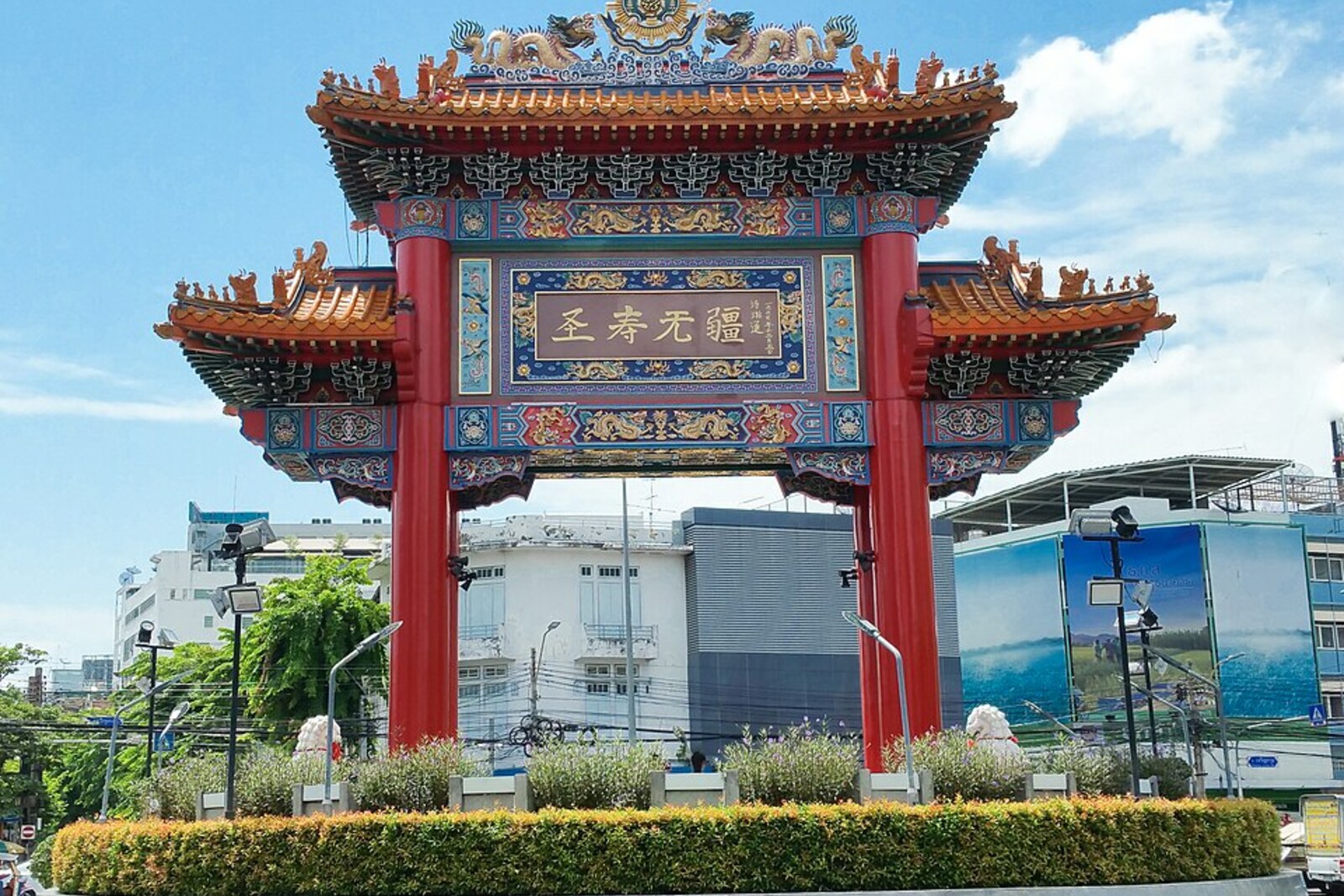
Look around first
What to notice
- Red ceremonial arch
- Thai inscription on the pediment
- Chinese calligraphy under the roof
- A pair of white jade lions
The story of the place
A red ceremonial arch with two white jade lions marks the beginning of Yaowarat Road, the commercial street of Bangkok Chinatown. There are no gate doors here: this kind of arch serves as a sign of a community boundary, not a barrier across the road. It was chosen and paid for by families who ran shops, warehouses, and workshops in the district, to mark the connection between their earnings and this neighborhood. A fountain once played in the center of the circle, and this place’s name remained from a cinema that no longer exists: its site is now occupied by a multistory parking garage.
On December fifth, nineteen ninety-nine, Princess Maha Chakri Sirindhorn opened the gate here. Yaowarat merchants had built it for the seventy-second birthday of her father, King Bhumibol Adulyadej (Rama IX). Seventy-two years meant six complete twelve-year cycles. Hence the official name on the pediment: “Gate in Honor of the King’s Sixth Birth Cycle.”
The money was raised by Thai entrepreneurs of Chinese descent. Their families made their living through trade: they ran shops, warehouses, and workshops, and moved goods between the port and the markets. A fountain stood on the site of the gate at the time. The merchants secured its replacement and chose the Chinese form of a pailou—a ceremonial arch without doors. It does not close off the street but marks the boundary of a community. The beginning of Yaowarat Road was a fitting address for a gift from people whose earnings were tied to this district.
Bhumibol had been part of Yaowarat’s local history long before he became king. After World War II, relations between the Chinese community and Bangkok’s other residents deteriorated sharply. Chinese people celebrated Japan’s defeat; Thailand’s wartime government had cooperated with Japan. Armed clashes broke out on Yaowarat Road. Then merchants closed their shops out of fear of attacks and looting. For a family that kept all its property in merchandise and the premises of its shop, a closed door meant the loss of a day’s income and the risk of losing accumulated capital.
King Ananda Mahidol, Bhumibol’s elder brother, decided to walk through Sampheng and Yaowarat Road to end the alienation. The government objected: the area was considered unsafe. Ananda insisted on the visit and took along his eighteen-year-old brother, then a prince, who wanted to support his decision.
On June third, nineteen forty-six, the brothers walked a three-kilometer route for four hours. Chinese merchants closed their shops again, this time for the reception, and set up seven temporary arches above the streets with wishes for long life in Chinese and Thai. They gave the king porcelain, jade items, and thirteen thousand baht—a large sum at the time. Ananda gave the money to Chulalongkorn Hospital for the treatment of poor patients. After the visit, tensions in the district eased, and the shops resumed trading.
Six days later, Ananda died. Bhumibol succeeded to the throne and became Rama IX. Fifty-three years later, a new generation of merchants installed a permanent arch at the entrance to Yaowarat Road in honor of that very younger participant in the walk.
Princess Sirindhorn, Bhumibol’s daughter, wrote four Chinese characters for the gate with a brush: “Sheng shou wu jiang,” a wish for the king to have a long life without limit. Her calligraphy was placed under the roof opposite the Thai name. On the opening day, the princess walked beneath the inscription she had created herself. After that, the organizers of Chinese New Year began launching the official ceremonies and Yaowarat Road’s festive lighting here.
The name “Odeon” has nothing to do with the king. A cinema named after the British Odeon once stood nearby. It closed in the late nineteen eighties; a multistory parking garage now stands in its place. The gate took the place of the former fountain, and the circle took the name of the vanished cinema.
Useful on site
An outdoor city landmark at Odeon Circle; access depends on traffic, road closures, and festival crowds.
Checked: June 28, 2026. Check the official source before visiting.View the details only from a safe pedestrian area: the circle is surrounded by traffic. Do not step into the roadway for a symmetrical photo or a viewpoint beneath the arch.