 Guide On Map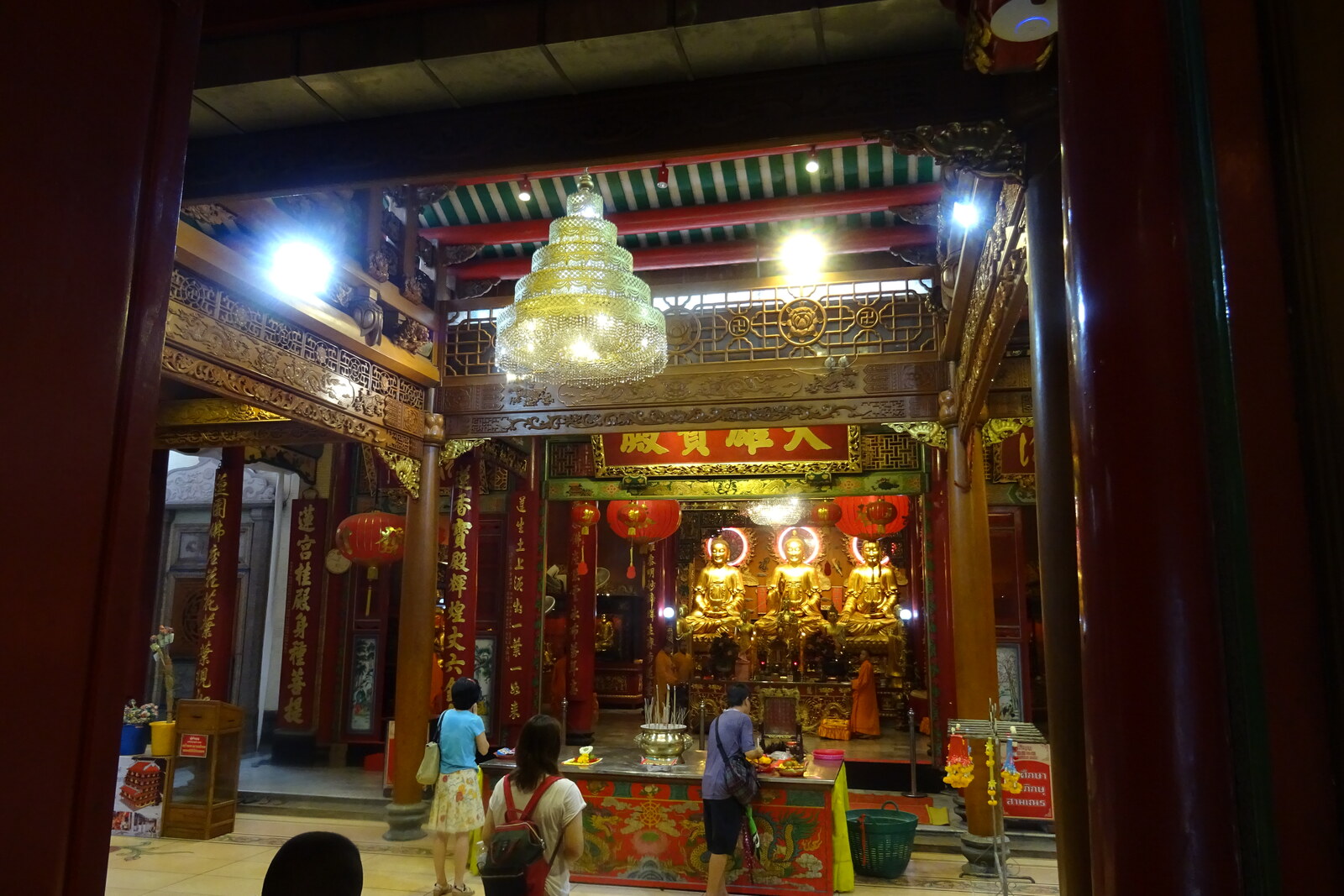
Look around first
What to notice
- Horizontal plaque with the Thai name
- Vertical Chinese inscription
- Altar of Three Buddhas
- Pavilion of the first abbot
The story of the place
Under one roof, a sequence of halls extends here: at the entrance stand the Four Heavenly Kings, farther on is the main hall with Three Buddhas, and behind it is the hall of the masters. This order came from temples in southern China and was intended for a monastic residence where monks live permanently, perform rites, and pass on teaching. Above the entrance, two inscriptions can be read side by side: the horizontal Thai one preserves the name bestowed on the temple, while the vertical Chinese one retains the former name, Leng Nei Yi, which joined dragon, lotus, and temple. Behind the main hall is a pavilion dedicated to the first abbot and the early Chinese monastic community of this district.
At the altar of Tai Sui, visitors leave slips bearing their name and year of birth. In this way, they entrust their fate for the coming year to the deity who, according to the Chinese calendar, governs this period of time. At the end of the annual cycle, the monks conduct a thanksgiving rite and burn the slips. It is precisely to “correct an unlucky year” that many Bangkok residents come to Wat Mangkon Kamalawat today.
The presence of Chinese rites here is connected with the monk Sok Heng. He arrived from Guangdong and settled in an abandoned hall of Guanyin nearby. He had neither a monastery of his own nor support. Chinese residents of Bangkok fed the monk with alms, then raised money, repaired the hall, and established a small monastic residence beside it. Other Chinese monks began joining Sok Heng, and the former space proved too small.
In eighteen seventy-one, King Chulalongkorn (Rama V) allocated a plot by Charoen Krung Road for a new monastery—four rai and eighteen square wa, or a little more than one and a half acres. Phraya Choduek Ratchasetthi was entrusted with overseeing the undertaking. This was the title of the head of the Left Port Department: he was responsible for trade with China, royal junks, and the court’s ties with Chinese merchants. That is why the task of gathering builders and donations was given to someone who knew this particular community and lived by its trading affairs.
Chinese worshippers funded the work for eight years. They built the monastery in the style of temples in southern China: first the hall of the Four Heavenly Kings, then the main hall with Three Buddhas, and behind it the hall of the masters. This sequence showed what the builders were seeking. The trading district needed a place where monks lived permanently, performed rites, and passed on their line of teaching, rather than a separate shrine that laypeople opened on holidays.
When construction was completed in eighteen seventy-nine, Sok Heng was invited to become the first abbot. The king bestowed on him the Thai monastic title Phra Archan Chin Wang Samathiwat and appointed him the first head of Siam’s Chinese Buddhist community. The visiting monks gained a recognized leader, the worshippers a permanent monastic residence, and subsequent abbots an office that could be passed on to a successor. This is also why Three Buddhas, Guanyin, Tai Sui, and deities of healing and prosperity now stand together here: the people who raised money for the temple brought their entire religious life with them.
The residence’s first name was in Teochew—Leng Nei Yi: “leng” means dragon, “nei” lotus, and “yi” temple. The official Thai name appeared later. On February sixteenth, nineteen twelve, King Vajiravudh (Rama VI) bestowed on the temple the name Wat Mangkon Kamalawat—the same pair, dragon and lotus, rendered in Thai.
That is why two different plaques hang above the entrance. The horizontal one, in Thai, gives the name bestowed by the king. The vertical Chinese inscription preserves the former name and Sok Heng’s calligraphy. Behind the main hall stands the pavilion of the first abbot—a separate place for the monk whom Chinese merchants once supported beside an abandoned shrine and then made the head of their own community.
Useful on site
Daytime access for visitors; secondary current sources usually indicate around 08:00–16:00/17:00, but check signs and festival changes on site.
Checked: June 28, 2026. Check the official source before visiting.Clothing should be suitable for an active temple. Do not cross the path of processions, do not touch offerings, and keep in mind that incense smoke inside can be thick.