 Guide On Map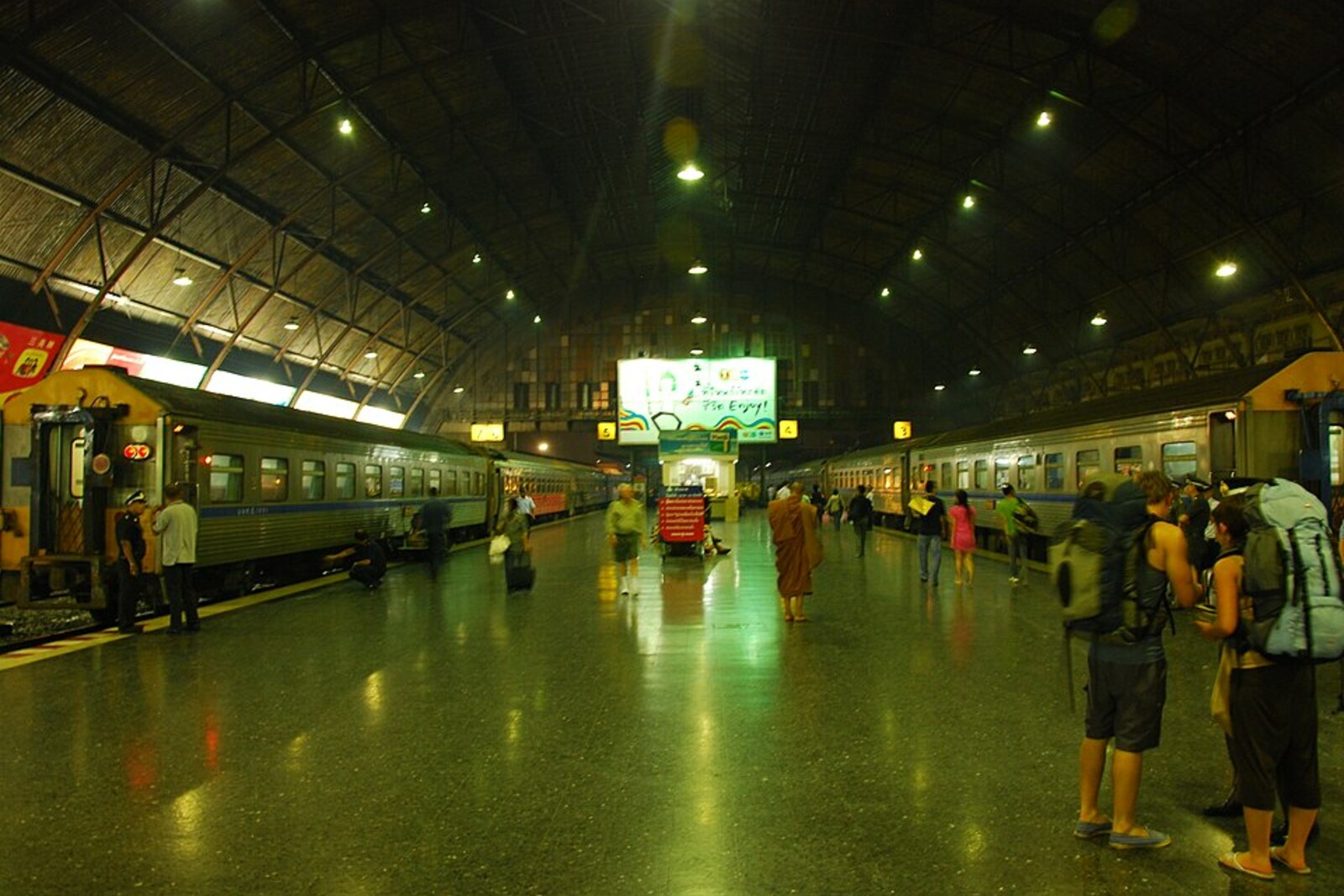
Look around first
What to notice
- The names “Bangkok” and “Hua Lamphong” on the facade
- Long canopies above the tracks
- Buffer stops
- The passenger hall in front of the ends of the tracks
The story of the place
Two names appear side by side on the facade: “Bangkok” and “Hua Lamphong.” For most of its life, the station was officially called Bangkok Railway Station. Hua Lamphong was its informal name, inherited from another terminal—the private Paknam Railway. It stood opposite, roughly where people now descend to the metro, and was dismantled after the line closed.
The present building opened on June twenty-fifth, nineteen sixteen. It is a dead-end station: trains enter beneath the long canopies and stop at buffer stops in front of the passenger hall. That layout proved decisive on the morning of November eighth, nineteen eighty-six.
At Bang Sue Depot, mechanic-inspector Somchit Phyluk was preparing six coupled diesel locomotives for service. He was responsible for inspecting and repairing them, supervised four subordinates, and by then had worked on the railway for more than twenty years. While checking one of the locomotives, Somchit left its engine running and stepped away to handle another assignment; another mechanic remained in the cab.
Somchit later said that this mechanic set the controls to move forward. When the coupled locomotives started moving, he tried to brake, then jumped out without shutting down the engine. The six locomotives rolled out of the depot without a driver, reached the main line, and began picking up speed toward Hua Lamphong Railway Station.
A warning reached the station in time. Staff led hundreds of passengers off the platforms, but only a few minutes remained. The coupled locomotives traveled about fifteen kilometers, hurtled onto the fourth track, smashed through the buffer stop, and burst onto the platform. The leading locomotives knocked down two large timetable boards, an information office, a book kiosk, a drinks stand, and a currency-exchange booth. One of them toppled onto its side just five meters from the entrance doors.
Four people died and another four were injured. Most of the victims were trapped beneath the fallen timetable boards—the objects passengers had been using seconds earlier to choose the right train.
The railway commission placed responsibility on the employees who had left the locomotives unattended. Somchit was dismissed without a pension and convicted of negligence. His initial sentence was eight years in prison; after appeals, the term was reduced, and thanks to a pardon he spent eighteen months in prison. After his release, the former railway worker worked as a hospital mechanic, tried fish farming, and then became a security guard. Twenty-three years after the disaster, he was still talking about a demand to pay several million baht in damages and about his wife, who had had to support the family together with him.
Krung Thep Aphiwat Central Terminal now serves as Bangkok's main railway station. Ordinary, commuter, and excursion trains still depart from Hua Lamphong Railway Station. The old boards, kiosks, and currency-exchange booth are no longer in front of the tracks. The dead-end layout itself remains: the rails end at the passenger hall, and beyond the buffer stops there are still only a few meters to the entrance doors.
Useful on site
An active SRT/MRT station; check accessible areas and services against the current timetable and on-site signs.
Checked: June 28, 2026. Check the official source before visiting.Do not enter staff or platform areas without the appropriate authorization. In the main hall, stand clear of passenger traffic and pay attention to announcements.