 Guide On Map
Layers of Amman: from the citadel to Rainbow Street
From Jabal al-Qal'a through the Roman center and markets to First Circle
Guide On Map on your phone
Open the walk like a regular app
It takes about 10 seconds to install. No app store needed.
The whole path
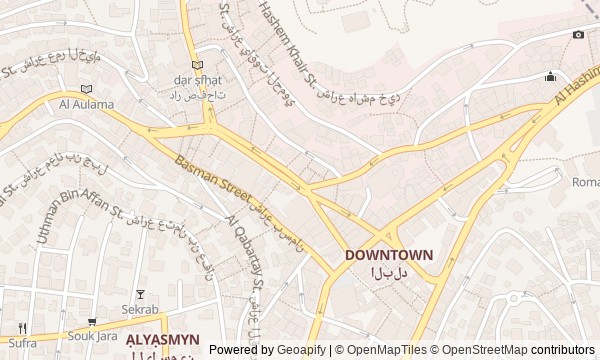
Route map
About the walk
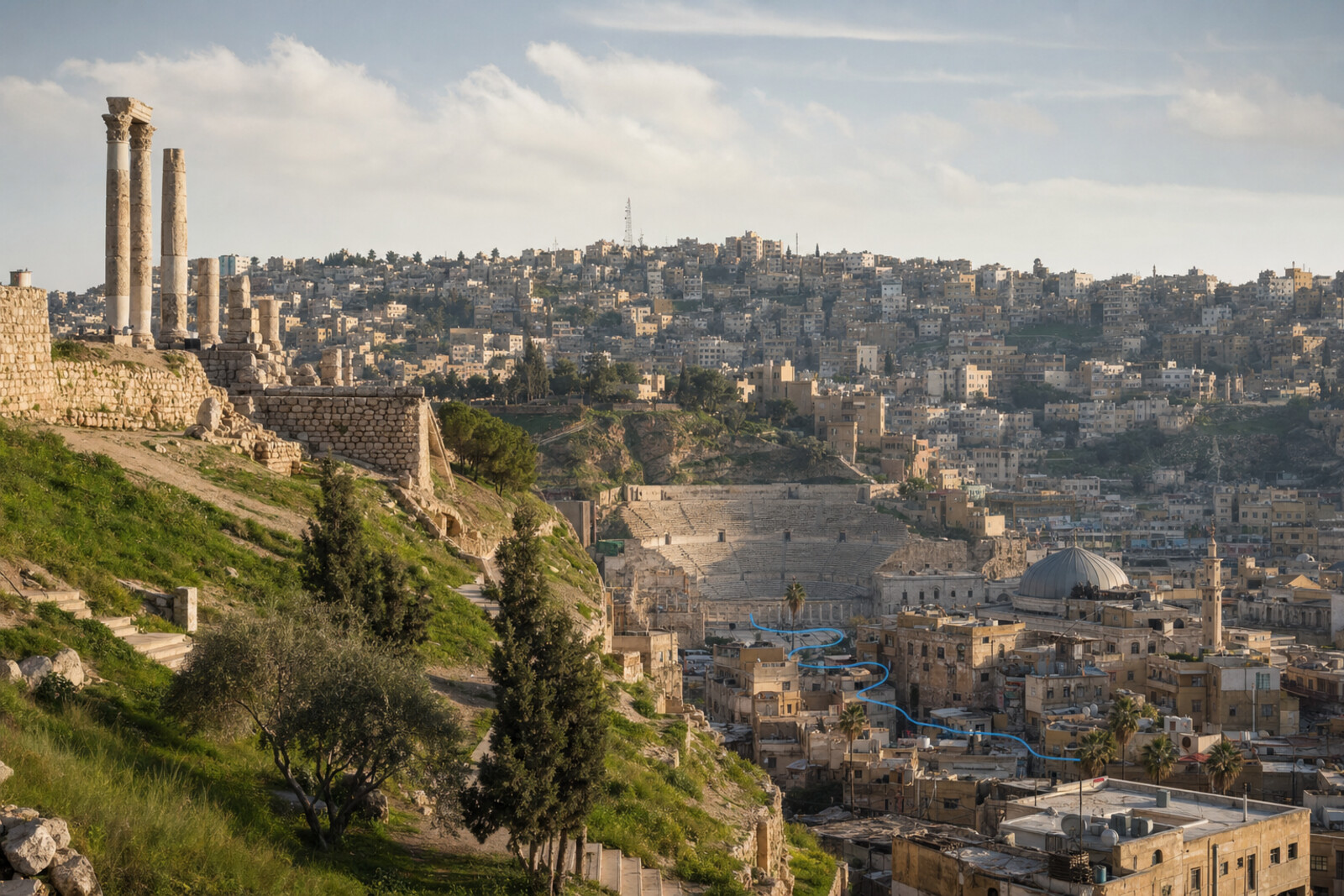
You will begin above the Amman valley, at the edge of Amman Citadel, and finish on the crest of Jabal Amman at First Circle. The route first passes the fortress wall, palace, reservoir, and Roman columns, then drops sharply toward the theaters and a vanished city fountain. Below, ancient stone gives way to vegetable stalls, an old postal house, and the climb to Rainbow Street.
This is a walk through an Amman that people repeatedly rebuilt around water, trade, and new urban habits. The stories move from clue to question: why was a column placed in the reservoir, who owned the giant marble fingers, and why has a cinema's name survived above a residential street?
By the end, you will be able to explain how the water supply on the citadel, a permanent shop in the valley, and a movie theater on a new hill marked 3 different ways of bringing Amman together.
Why this order
The route begins at the edge of Jabal al-Qal'a, where the height reveals both the fortress's strength and its dependence on water. From there, the path leads into Amman Citadel, to the Umayyad Complex and reservoir: after the story of a siege, you will see how later residents solved the same problem inside the walls. The route then turns toward the Great Temple of Amman, trading an administrative complex for a Roman ceremonial space and beginning the descent from the upper city to the lower one.
The Odeon comes first on the eastern side of Hashemite Plaza; the neighboring Roman Theatre continues the story of spectacle, but expands it from an intimate hall to a structure where the first residents of the new Amman made their homes. From the theater, the route heads west toward the Nymphaeum along the ancient lower city, where water appears not as a reserve for a siege but as part of a public facade.
Just beyond the Nymphaeum begins Souq al-Sukar: the move from pool to market shows how the valley floor shifted from a water function to a commercial one. After the stalls, the route reaches a house on King Faisal Street—the next permanent address of the young city, now for post, hotel guests, and meetings. The final climb to First Circle completes the sequence: after institutions and trade, the center rises onto a residential hill, where a single cinema gave an everyday name to an entire street.
Those who want to connect Roman ruins with the history of modern Amman Those interested in archaeological guesses, inscriptions, and traces of unfinished work Those who enjoy routes with markets, an old center, and a sharp change in elevation
Those looking for a walk only around Amman Citadel, without descending into the city Those who do not want to climb from the old center to Jabal Amman Those mainly looking for cafes and contemporary street life
Before you go
Wear shoes with reliable grip: the route includes a steep descent from Amman Citadel, stone steps, and the climb back up to Jabal Amman. Bring water and sun protection—there is little shade on the upper terraces and in the theater. Before setting out, check access to Amman Citadel and the theater: the story depends on their relationship to each other, but interior access may be limited. Do not count on entering Duke's Diwan or getting inside the Nymphaeum enclosure; both stops still make sense from the street. In Al-Balad, pay closer attention near traffic, do not obstruct deliveries to the stalls, and ask permission before taking close-up photos of vendors.
When to go
Start during the cooler part of the day. Morning works well because the open citadel is easier to handle, and the markets are already finding their rhythm by the time you descend. A later start brings softer light to the hills, but leaves less time for interior sites and the final climb. It is best to do the route in one continuous movement: here, the alternation of height, water, and urban density matters more than long cafe stops.
Backup plan
If Amman Citadel is inaccessible, begin at the Roman Theatre: the upper hill will remain in view and still set the route's vertical line. After the Odeon and Nymphaeum, continue through the markets to Duke's Diwan and Rainbow Street. A closed theater can still be read from Hashemite Plaza through the shape of its bowl and its position on the slope. If you cannot get close to the Nymphaeum, examine its facade, niches, and vaults from the accessible side. If Duke's Diwan is closed, linger by the yellow staircase and facade. If the climb back proves too demanding, finish the main route in Al-Balad and visit First Circle and Rainbow Street separately.
Route conditions
Surface. Asphalt — 2.4 km; paving_stones — 190 m; concrete — 67 m; compacted — 18 m (data covers 63% of the route)
Stairs. Flights: 8, 453 m in total
Access. Wheelchair — no; stroller — limited (stairs)
Facilities. Toilets — 1; rest points — 4
Elevation. Ascent — 116 m; descent — 112 m
OpenStreetMap extract of August 25, 2026: database data, not a check on the ground. Data © OpenStreetMap contributors, ODbL licence
Walk plan
Open in maps ↗- 1
The Edge of Jabal al-Qal'a
The height explains why the walls withstood assaults and why the fortress's fate depended on a single route to water. - 2
The Umayyad Complex and the Water Reservoir
Here, dynastic politics will connect with the everyday task of supplying a settlement on the summit with water. - 3
Great Temple and Stone Fingers
The excavations will give the monument a confirmed dedication, but leave the main question about the colossal statue open. - 4
Odeon
The unfinished masonry reveals what archaeologists were able to conclude amid construction work, a private boundary, and a shortage of material. - 5
Roman Theatre
The ancient galleries will become the starting point for the story of the people whose settlement grew into the new capital. - 6
Nymphaeum
Archaeological finds make it possible to reconstruct the role of water in a structure of which primarily the stone façade remains. - 7
Souq al-Sukar
Permanent shops will show how street trading became a family business with an address and heirs. - 8
The Post Office That Became Duke's Diwan
The succession of a post office, ministry, hotel, and open house explains why the building was saved from demolition. - 9
First Circle and Rainbow Street
The final stop will link the city’s westward growth to a sign that residents turned into an everyday address.
Route features
Everything you need stays in the browser
Progress, saves and your trip plan are stored on this device.
Add Guide On Map to your home screen so the walk opens outside the browser.
How we handle sources, maps and corrections: our editorial standards