 Guide On Map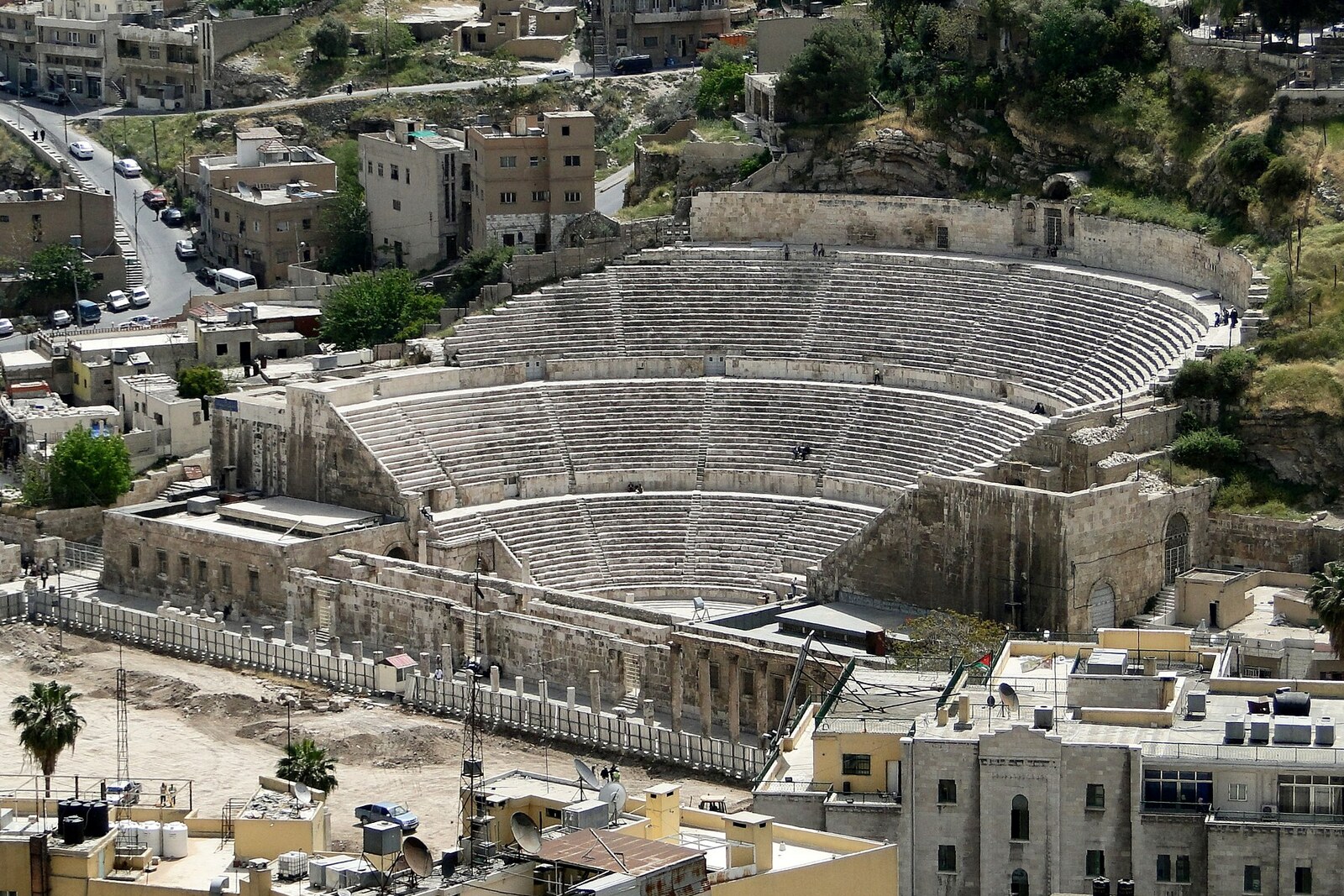
Look around first
What to notice
- Three tiers of seating
- Vaulted passages
- Orchestra
- Side galleries by the stage
The story of the place
In place of the vanished multistory façade above the orchestra, the sky is now open, but three tiers of stone seats still rise up the steep slope of Jabal al-Jufa. In the second century, the Romans built or substantially enlarged the theatre for performances and civic gatherings; its seating held up to six thousand inhabitants of ancient Philadelphia. The slope gave the seats the necessary rise, while vaulted passages by the stage and beneath the seating distributed the crowd between the tiers, the orchestra, and the stage.
In eighteen seventy-eight, several hundred Shapsug Circassians made homes in the side galleries of this theatre. The Russian Empire had expelled them from the North Caucasus; many families were first resettled in the Ottoman Balkans, and after the Russo-Turkish War they again had to look for a home. Ottoman officials sent the Shapsugs to almost abandoned Amman, allotted them land, and hoped the settlers would strengthen the road between Damascus and Medina.
By then, the theatre had stood here for about seventeen centuries. It was built or substantially enlarged in the second century, under Emperor Antoninus Pius: a Greek building inscription once located on the façade by the stage says so. Six thousand spectators could watch performances and civic ceremonies. The slope of Jabal al-Jufa gave the builders the steep rise for the seating rows, while vaulted passages allowed a large flow of people to be distributed between the tiers, the orchestra, and the stage. By the nineteenth century, the multistory stage façade had disappeared and earth had buried the lower part, but the galleries remained usable shelter.
The Shapsugs arrived here as farmers and herders. They needed water, arable land, and a roof before they could gather their first harvest. A stream in the valley allowed them to grow vegetables and fruit trees; the stone vaults provided temporary rooms. The settlement nearly fell apart: by eighteen seventy-nine, about one hundred fifty people remained here. Those who did not leave built houses on the slopes. At first, they built the walls of dried brick, then of stone; the masonry also included blocks taken from Roman ruins. Circassian carpenters made wooden roofs and carts on which families carried their harvests.
Then new groups of settlers arrived. People cleared fields, sold land, and opened workshops and shops. At the beginning of the twentieth century, a station on the Hejaz Railway drew merchants here from neighboring towns. When Emir Abdullah chose Amman as the capital of the new emirate in nineteen twenty-one, a city had already formed around the Roman Theatre, grown from a Circassian farming settlement.
The side vaults by the stage have survived. They now house the Jordan Museum of Popular Traditions and the Jordan Folklore Museum, while concerts and ceremonies are again held in the open area. The first houses of modern Amman fit inside a structure designed for six thousand inhabitants of ancient Philadelphia.
Useful on site
The official schedule for the theatre and the Odeon is seasonal: opening is usually from 8:00, closing is around 16:00 in winter and later in the warm season; during Ramadan, 9:00–17:00. Check Fridays and holidays.
Checked: date not specified. Check the official source before visiting.The steps are high and uneven in places; you do not need to climb all the way to the top to understand the scale. During event preparations, some sections may be inaccessible.