 Guide On Map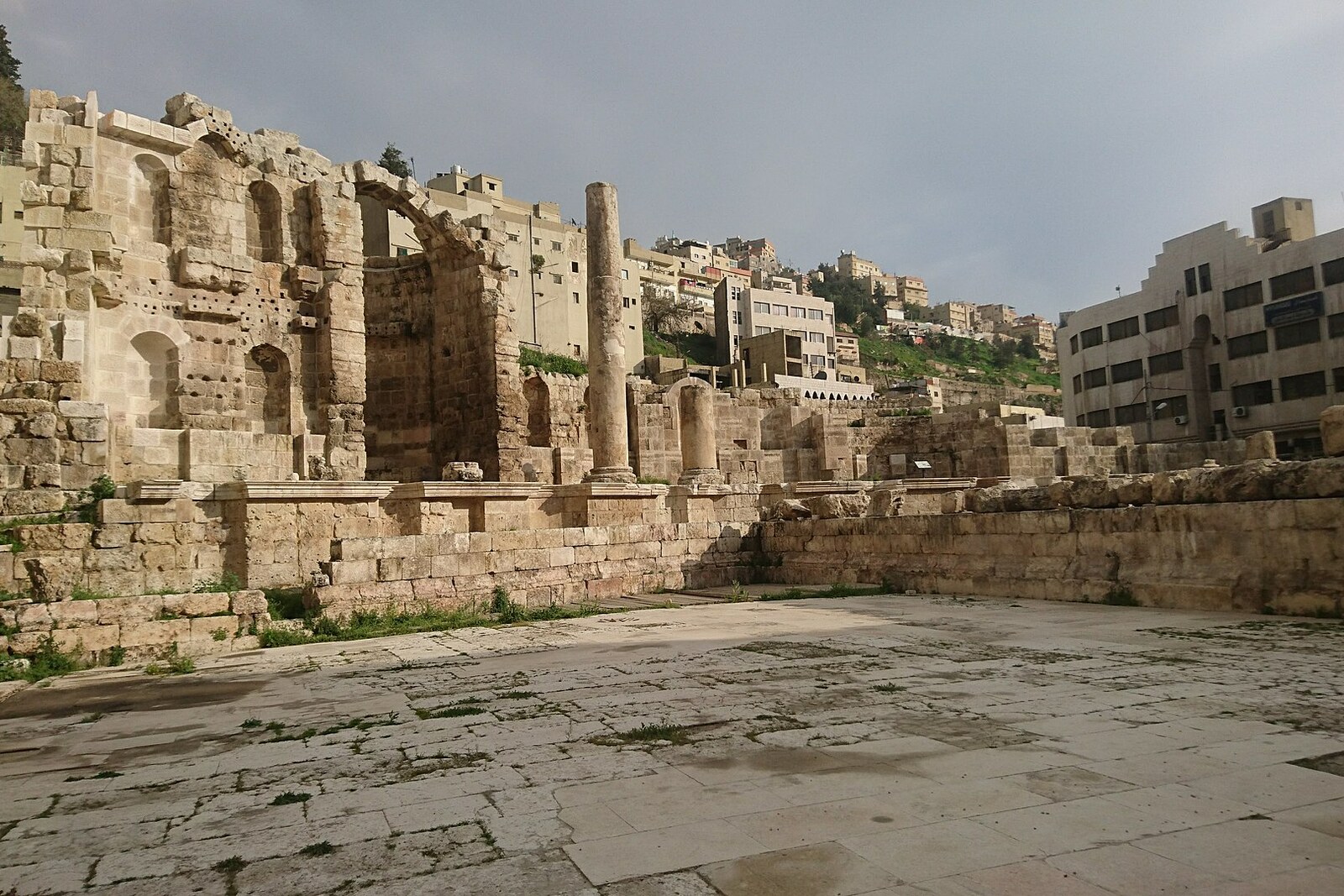
Look around first
What to notice
- Three semicircular niches
- Holes for attaching cladding
- A basin filled with gravel
- Lower stone arches
The story of the place
The Romans called nymphaea ceremonial urban fountains dedicated to nymphs, the mythological guardians of springs. In the second half of the second century, such a fountain was built at the intersection of the main streets in lower Philadelphia, ancient Amman, where residents of one of the busiest districts converged. Along a façade about sixty-eight meters long, three large rounded niches alternated with two tiers of smaller ones; statues stood in them, and a filled basin lay before the stone wall. Today the basin is filled with gravel, holes from the marble cladding remain in the wall, and stone arches have survived below.
In the mid-nineteen nineties, the archaeologist Mohammad Waheeb began excavations in front of this wall to settle an old dispute. Some researchers considered the ruins to be baths, others a public building, and still others a monumental fountain. Waheeb led a field team from the Jordan Department of Antiquities. It had to determine the structure's purpose and investigate it before the dense development of the city center closed off the surviving sections.
The deeper the archaeologists went beneath the façade, the more water rose. They had to lower its level; otherwise, they could not reach the lower vaults. This complication also explained why Roman builders chose the site. Watercourses converged here, and water from the surrounding hills emerged at the foot of the lower city. The builders ran the stream beneath the building through vaulted passages. They then widened the supports and raised a ceremonial upper level above them: the wet ground had to bear the enormous stone façade.
In front of the façade, Waheeb's team uncovered part of a basin measuring approximately twenty-six by fifteen meters. Beneath the paving lay fragments of water pipes along with second-century pottery. Two construction stages of the lower arches also survived: early vaults with a keystone, and later ones that widened the base of the upper level. The excavations confirmed that water was the organizing element of the entire structure, although the exact system that supplied the basin has still not been reconstructed.
The ruins thus received a convincing explanation. The Romans called ceremonial fountains associated with nymphs—mythological guardians of springs—nymphaea. Amman's Nymphaeum, probably built in the second half of the second century, occupied one of Philadelphia's busiest sites, near the intersection of the main streets. Its façade stretched for approximately sixty-eight meters. Statues stood in three large semicircular niches and two rows of small niches; holes in the stone show where the marble cladding was attached. A water-filled basin lay in front of them.
This partially uncovered basin is now filled with gravel. Beneath it, the vaults of the old watercourse and fragments of pipes have survived, while the walls retain the fittings of the vanished marble. The water has gone from the exposed basin; during the excavations, it still rose from below and prevented the archaeologists from freely reaching the foundation.
Useful on site
Visible from the street at any time; access inside the fenced archaeological area and the condition of the passages may vary locally.
Checked: date not specified. Check the official source before visiting.Do not expect a working fountain or free access inside. View the structure from the accessible side and take traffic on the neighboring streets into account.