 Guide On Map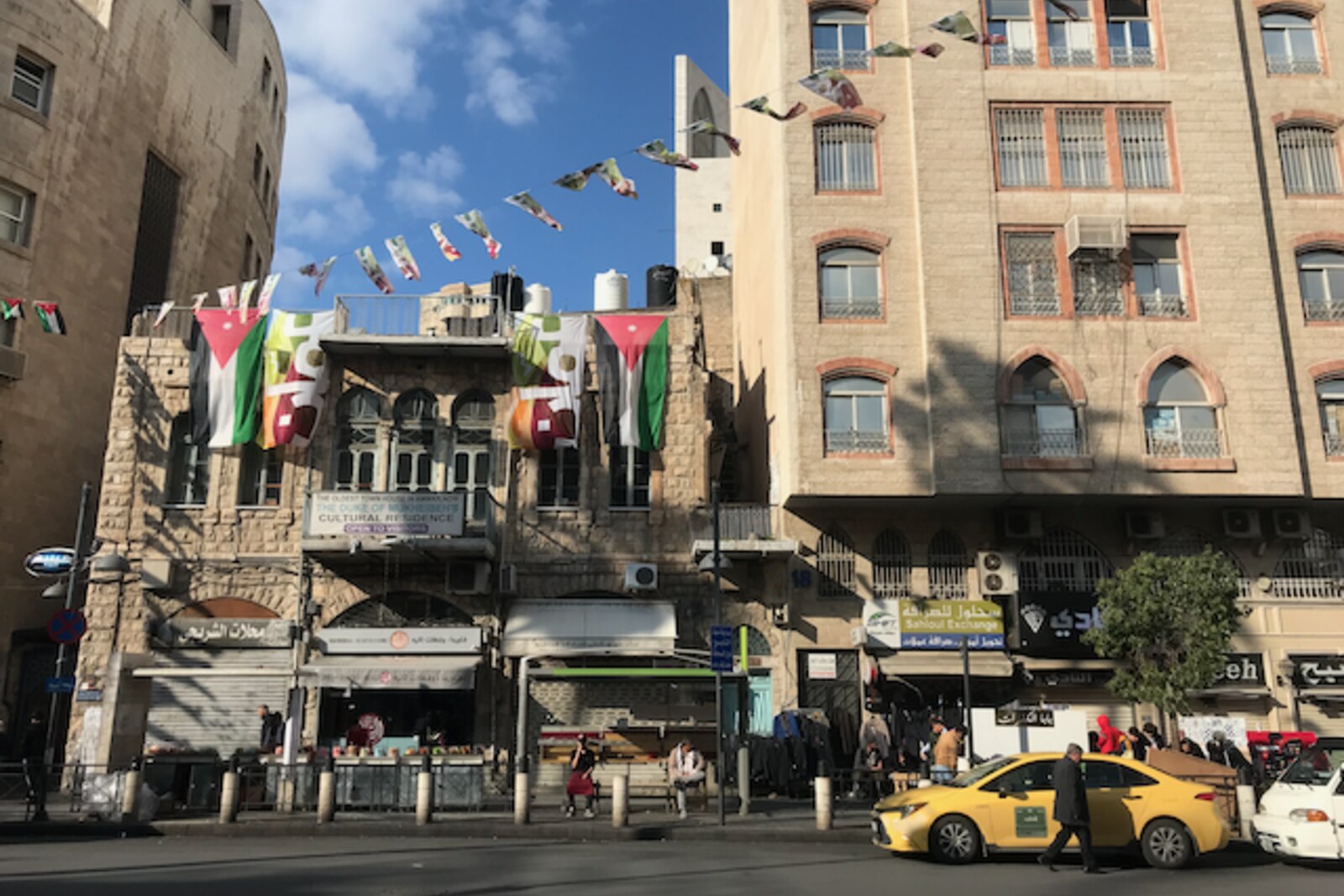
Look around first
What to notice
- Blue entrance door
- Yellow staircase
- Old tiled floors
- Central salon
The story of the place
In Amman's old commercial center, a two-story town house survives, with five rooms arranged around a shared salon. It was built for private life, but the young capital was desperately short of its own official premises, and houses like this became part of its everyday infrastructure. The blue door leads to a yellow staircase of twenty-eight steps; upstairs, old tiled floors stand alongside books, paintings, and furniture.
In two thousand one, this house was due to be demolished. Mamdouh Bisharat, a landowner, collector, and defender of Amman's old houses, leased it from the Madi family, even though he had to pay above the market rate for the deteriorating building. He came from one of Jordan's wealthiest landowning families and called himself a farmer. Bisharat paid the rent and upkeep himself, but kept admission free.
He was saving a building that had grown up alongside the new capital. In nineteen twenty-four, Abd al-Rahman Pasha Madi commissioned a two-story town house here. Amman had become the capital of the Emirate of Transjordan only three years earlier. There was not enough money or government space, so officials housed institutions in private homes. The government rented a floor from Madi for Amman's first central post office. The address was chosen on King Faisal Street, where the city's commercial center was already taking shape.
The post office was replaced by the Jordanian Ministry of Finance, and in nineteen forty-eight the Haifa Hotel opened here. Five former rooms around the central salon became hotel rooms. The hotel lasted half a century, but closed by the end of the nineteen nineties: businesses and wealthy clients had long been leaving the old center for western districts, while the building stood empty and fell into disrepair. Its next transformation was meant to be demolition.
Bisharat chose a different function. King Hussein gave him the nickname Duke of Mukheiheh, after Bisharat's family lands and agricultural projects. In an Arab house, a diwan is a room open to guests. So Duke's Diwan refers both to its owner and to the arrangement he established: artists, poets, students, and people without invitations may come here. The rooms host exhibitions, readings, performances, and meetings; Bisharat did not impose strict selection on emerging authors.
Behind the blue door, twenty-eight yellow steps still lead to five rooms connected by a salon. There are no longer any postal counters or hotel rooms here. Old tiled floors remain on the upper floor, along with books, paintings, and furniture brought in by Bisharat. The house survived because the landowner kept paying for a building that belonged to someone else and once again made rooms that had been rented to the post office accessible to outsiders.
Useful on site
Irregular access: it can always be viewed from outside; go inside only if the doors are open or you have local permission; do not treat it as a guaranteed museum.
Checked: date not specified. Check the official source before visiting.Access inside may change; do not take the open house as a guarantee of free entry. If the door is closed, the staircase and facade still convey the street's former scale.