 Guide On Map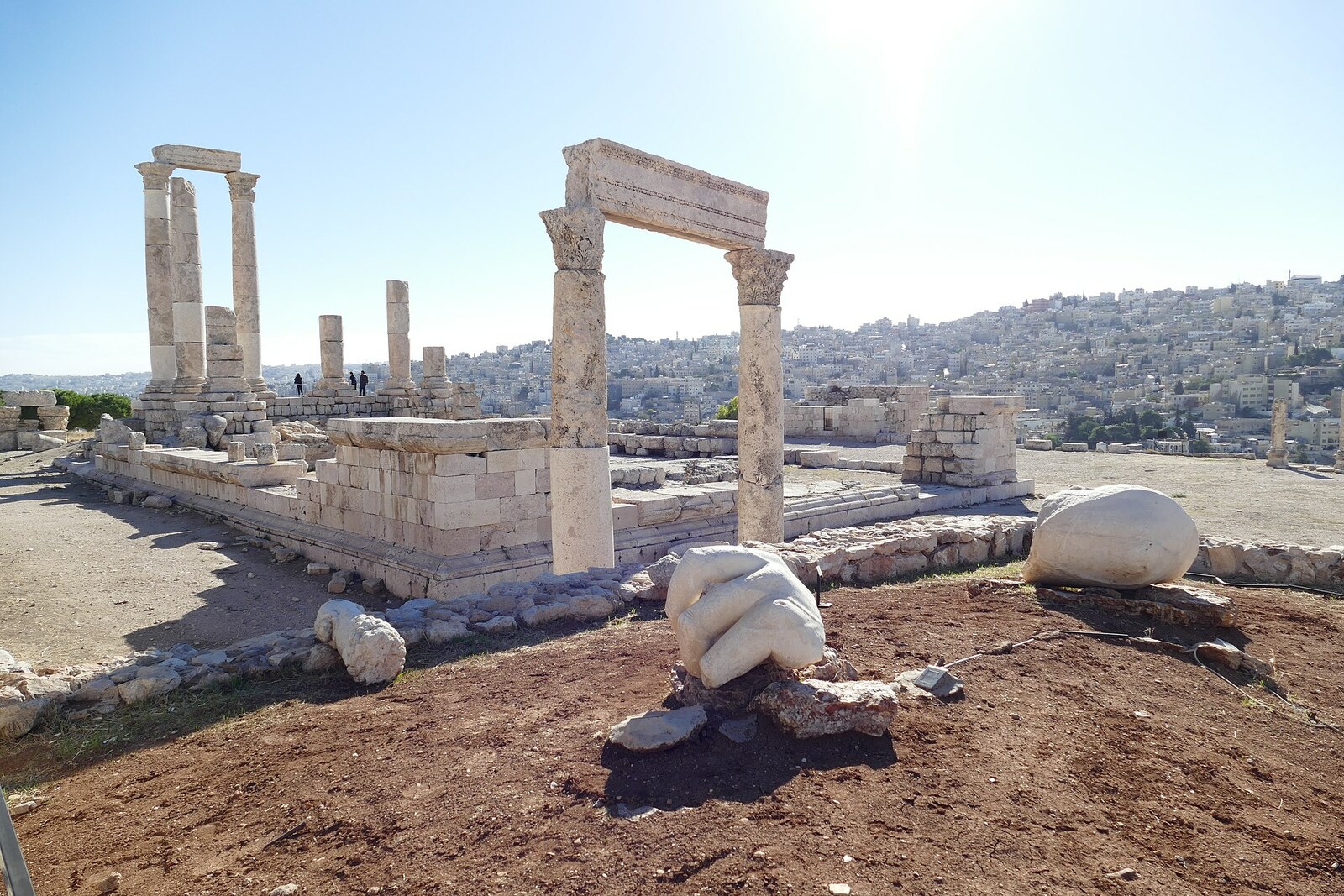
Look around first
What to notice
- Two standing columns
- Marble fingers
- Marble elbow
- Column drums
The story of the place
The route from the lower part of Roman Philadelphia ended at the upper temple platform. Beside the main temple stretched a courtyard encircled by colonnades, where the city gathered for communal religious ceremonies. On the ground beside the two columns lie three marble fingers and an elbow; they once formed part of a statue about thirteen meters tall. The ancient stones were almost entirely dismantled for other buildings, so the standing columns join surviving details to modern stone.
In nineteen ninety-one, archaeologist Kenneth Russell, one of the leaders of the excavations at the Amman Citadel, was searching among the fallen blocks for missing parts of a temple inscription. The accuracy of the reading would determine what he and his colleagues were to call the entire monument: for an archaeologist, an error in the name of a deity meant an error in the main conclusion of years of work.
The team found another fragment of an architrave—a stone beam above the columns—and joined its text to fragments discovered earlier. The result was a phrase about a “sanctuary of Hercules and a place of festivities.” The Romans called the Greek Heracles, the hero of the twelve labors whom they revered as a god, Hercules. Another inscription reported that the temple was built between one hundred sixty-one and one hundred sixty-six CE, when Geminius Marcianus governed Arabia Petraea. The co-emperors Marcus Aurelius and Lucius Verus were named on the facade.
This established the purpose of the site. In Roman Philadelphia, there was a sacred courtyard surrounded by colonnades, with the main temple here; a monumental staircase rose to it from the lower city. The words about festivities show that people came here not for solitary prayer: the city held communal religious ceremonies here.
However, the architect and archaeologist Chrysanthos Kanellopoulos, who led the study and restoration of the building, did not accept the name Hercules without qualification. Three enormous marble fingers and an elbow lay beside the temple—the remains of a statue about thirteen meters tall. They were usually declared to be parts of Hercules. Kanellopoulos studied the shape of the fingernails, the elongated fingers, and the modeling of the elbow, and decided that the hand looked female and that the elbow lacked the pronounced musculature usual in depictions of the hero. He suggested that the statue might have depicted a goddess with her right hand raised. He could not identify her with confidence. The excavators’ joint report was published under the cautious title “Great Temple of Amman.”
Kanellopoulos and the Jordanian engineer Mohammed Tayem had to solve another problem: how to show the scale of a building of which too little had survived. Most of its stones had been dismantled and reused even before the earthquake of the mid-eighth century; the last four columns fell then as well. In nineteen ninety-two, restorers installed three newly carved column drums. Individual drums weighed up to eleven tons. A year later, a crane lifted a sixteen-ton architrave onto two columns.
In the present columns, ancient details are joined to stone from the nineteen nineties. And at their foot lie the three fingers and the elbow: the name Hercules is confirmed by the reconstructed inscription, but the excavators never agreed on whom the colossal statue depicted.
Useful on site
The official timetable changes by season: usually from 8:00, in winter until 16:00, in the warm season until 17:30–18:30, during Ramadan 9:00–17:00; Fridays and holidays may be shorter.
Checked: date not specified. Check the official source before visiting.Examine the shape of the fingernails and the proportions of the hand up close, but do not climb on the fragments. Treat the name “Hand of Hercules” as a popular version, not an established fact.