 Guide On Map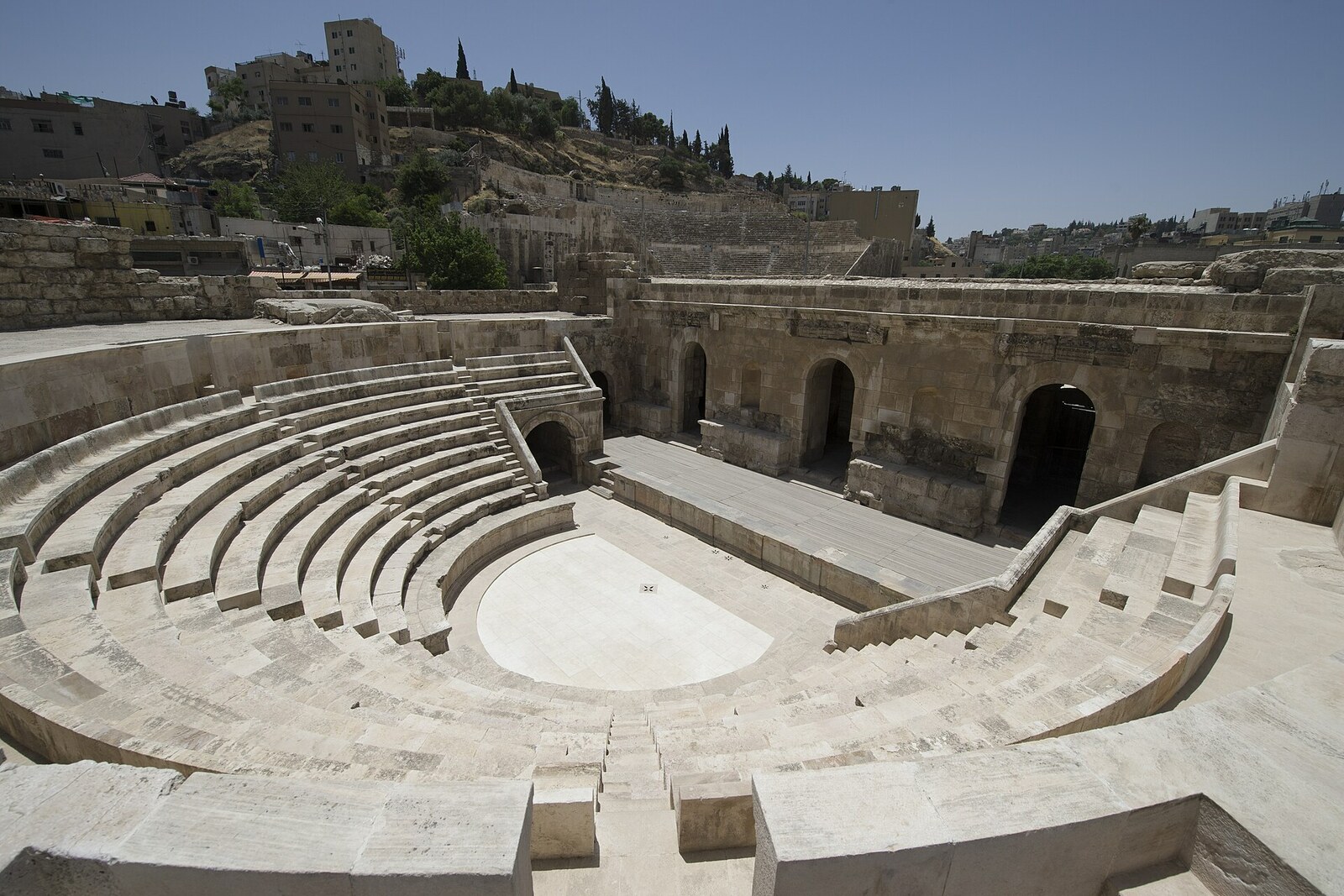
Look around first
What to notice
- The stone semicircle
- Nine restored rows
- Rough projections on the blocks
- Chisel marks
The story of the place
Near the Roman forum, a small auditorium survives where music, recitations, and dramatic performances were heard. Sixteen rows of stone seats descended in a semicircle toward the stage; spectators entered through side passages, and rooms for performers lay behind the stage. There was probably a wooden roof or canopy over the hall, so people could come here in the cool season as well, but archaeologists found no trace of the covering itself. Today the semicircle hosts concerts again, although only the nine lower rows have been reassembled, and above them remains the empty space of the vanished upper tier.
In the mid-nineteen sixties, archaeologist Adnan Hadidi worked here according to someone else's schedule. He led salvage excavations of the Roman forum while municipal builders were simultaneously laying sewers and creating a city park. Archaeologists were not permitted to delay construction: postponing another stage increased the cost of the entire program. The excavations were a joint project of the Jordan Department of Antiquities and an American development program, and Hadidi intended to use the material he found as the basis for his doctoral dissertation. He needed to obtain a coherent picture of the city before the trenches were closed.
One of the areas he selected lay immediately behind the Odeon's stage wall. A street and modern buildings already covered most of the ancient square. The Philadelphia Hotel was especially obstructive: it stood over the part of the structure where the theatre entrance might have continued, but it was private property, and the team had no right to excavate beneath it.
On the accessible strip, the archaeologists uncovered two parallel walls. Between them lay a dense foundation of mortar and small stones. From their height and position, Hadidi concluded that a broad entrance with at least two steps led to the Odeon. He could not fully verify the conclusion: its continuation remained beneath the hotel. Thus, the schedule of the sewer works and the boundary of the private plot determined which part of the Roman Theatre could be understood and which had to remain a question.
The word “odeon” itself referred to a small hall for music, recitations, and dramatic performances. Construction began around the year one thirty and was completed by about one forty-one. The semicircular hall held around four hundred spectators. Together, the lower and upper tiers had sixteen rows; side passages led to the stage, and rooms for performers stood behind it. The hall was probably covered by a wooden roof or canopy, which is why it is sometimes called a winter theatre. No remains of the covering were found, and the roof remains an archaeological reconstruction.
Hadidi's excavations also gave the Odeon a later biography. Coins and pottery in the layers by the walls showed that the structure continued to be used at least into part of the fourth century. Above them began a collapse deposit that formed only after the theatre had ceased to operate. Hadidi suggested that the upper walls may have fallen in the major earthquake of the year three sixty-five, but there is no direct evidence of precisely such a destruction.
The unfinished stonework, however, was visible directly. Roman masons left heavy rough projections on the faces of some blocks. Chisel marks survived on adjacent stones: the craftsmen had begun removing these projections but stopped. Hadidi believed that the patrons were hurrying to finish the Odeon or had run out of funds. Spectators were nevertheless admitted inside, and the unfinished masonry remained part of a functioning hall for several centuries.
In nineteen eighty-six, the Jordan Department of Antiquities restored the Odeon and brought performances back here. The restorers reassembled the nine lower rows. They did not rebuild the seven upper ones: no material survived from which their exact form could be restored. During concerts, spectators once again occupy the stone semicircle, but only its lower half; above the last row remains the space of the vanished tier.
Useful on site
The official timetable for the theatre and the Odeon is seasonal: usually opening from 8:00, closing around 16:00 in winter, later in the warm season, and 9:00–17:00 during Ramadan; check Fridays and holidays.
Checked: date not specified. Check the official source before visiting.Stand in the center of the semicircle and listen to how the sound changes. The plaza remains an active public space, so do not block the passageway or the stage.