 Guide On Map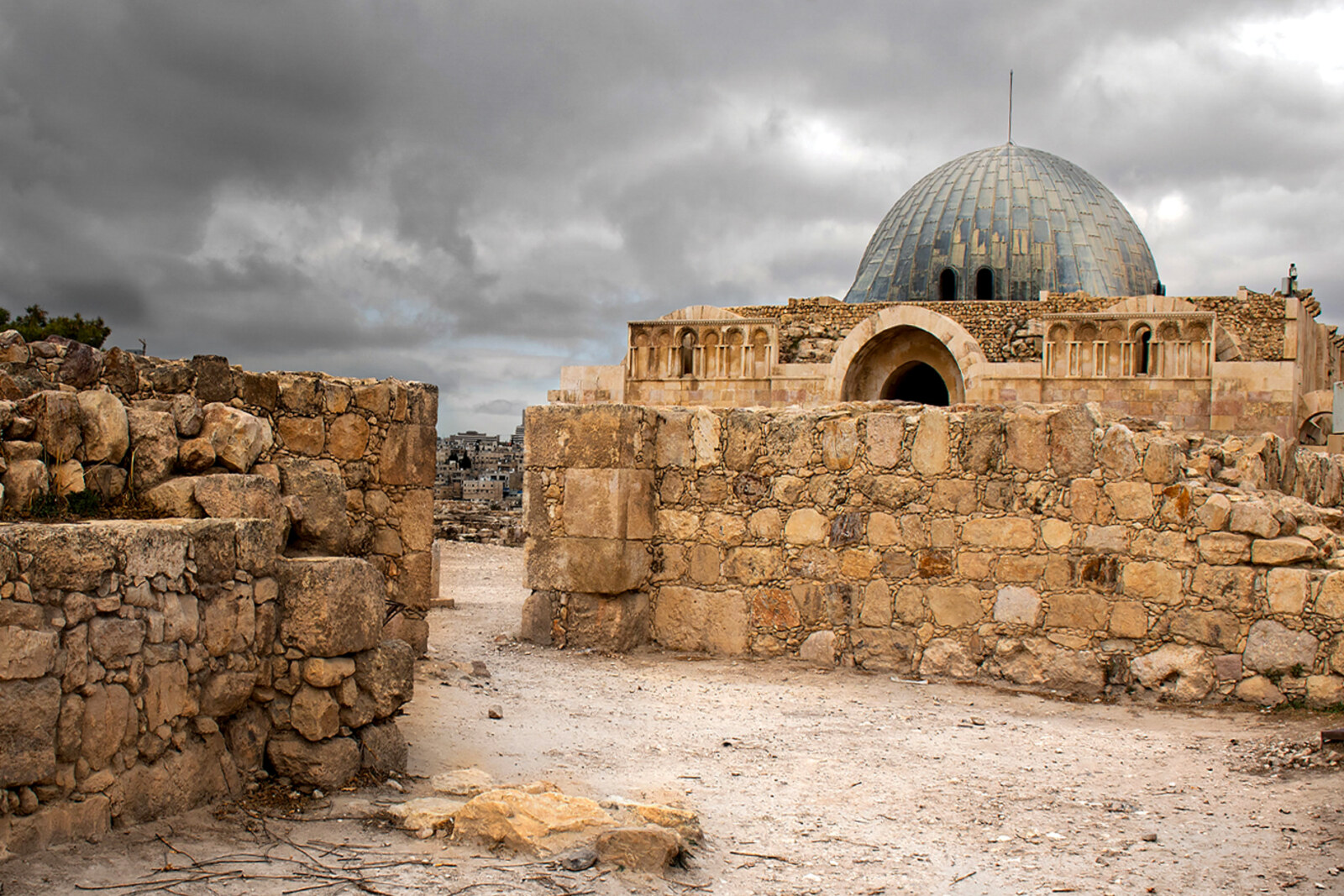
Look around first
What to notice
- Domed entrance hall
- Circular reservoir basin
- Stone staircase
- Column in the center of the reservoir
The story of the place
Behind the entrance hall began the palace quarter, where receptions were held; beyond it were a courtyard, the houses of officials and retainers, a mosque, commercial premises, and a bathhouse. The dome above the entrance was added during modern restoration. To the east lies the open circular basin of the reservoir, where rainwater was collected through channels and a settling basin for the settlement on the height. In the empty basin, the waterproof coating, steps for cleaning the bottom, and the old column shaft once used to measure the water supply can still be seen.
In seven forty-four, Suleiman ibn Hisham escaped from the fortress atop Amman. He was an Umayyad prince and experienced military commander whom the new caliph considered a dangerous rival. Suleiman did not leave empty-handed: a medieval chronicle reports that he took the state funds kept in Amman. This was where the provincial governor's residence, the treasury, and a prison for people capable of raising an army of their own were located.
The complex was built around seven thirty, under Suleiman's father, Caliph Hisham ibn Abd al-Malik. Hisham tried to remove the appointed heir and pass the throne to one of his own sons. When the former heir nevertheless became caliph in seven forty-three, al-Walid II wanted to secure the throne for his two young sons and began eliminating relatives who stood in the way of that plan.
Suleiman was especially inconvenient. He commanded campaigns and used the income from his estates to maintain a personal detachment of several thousand warriors, mainly non-Arab Muslims. Al-Walid ordered his cousin flogged and imprisoned in Amman. The punishment of a popular commander gave the caliph more opponents. In the spring of seven forty-four, conspirators seized Damascus; al-Walid fled, was caught, and killed. Suleiman escaped imprisonment, took the Amman treasury funds, and soon commanded the new caliph's troops: he defeated al-Walid's supporters marching from Homs to Damascus.
These relatives belonged to the Umayyads, hence the complex's present name. Their caliphs ruled the state from Damascus, while here the governor administered the region around Amman. The domed hall served as a ceremonial entrance and a place for receptions. Behind it were a courtyard, the houses of officials and retainers, a mosque, commercial premises, and a bathhouse.
A settlement like this on the summit needed its own water supply. East of the palace, the builders constructed an open circular reservoir about six meters deep and more than seventeen and a half meters across. It held roughly thirteen hundred cubic meters. Rainwater flowed here through channels and a settling basin; the walls and floor were covered with waterproof plaster. An old ancient column shaft was placed in the middle, and its level was used to monitor the water level. The stone staircase was intended for people who, before the rainy season, had to descend to the bottom and scoop out the sediment carried in by the water.
The earthquake of seven forty-nine brought down a substantial part of the palace. Later governors restored only individual buildings. Archaeologists have not identified the exact room where Suleiman was held, and the dome above the entrance hall was added during modern restoration. In the empty reservoir, the old waterproof coating, the steps for the cleaners, and the column once used to measure the water supply are still visible. Suleiman carried the treasury funds out of the fortress; the stone water gauge remained.
Useful on site
The official schedule changes by season: usually from 8:00, until 16:00 in winter, until 17:30–18:30 in the warm season, and 9:00–17:00 during Ramadan; Fridays and holidays may have shorter hours.
Checked: date not specified. Check the official source before visiting.Distinguish the wooden reconstruction from the ancient masonry. At the cistern, watch your step and do not go beyond the barriers: its scale is easy to grasp from above.