 Guide On Map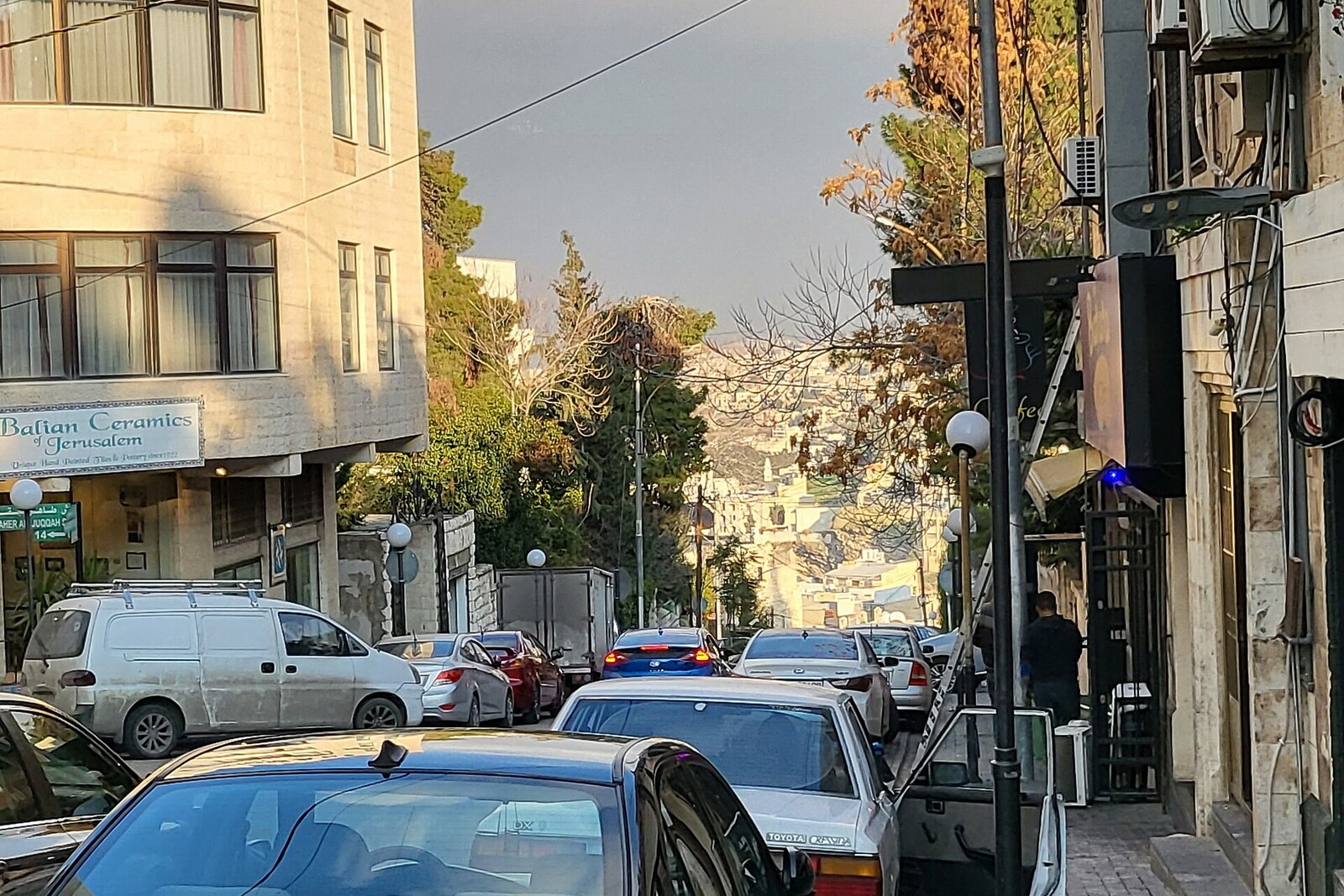
Look around first
What to notice
- Roundabout
- Facade of Rainbow Cinema
- Cinema sign
- Art Deco decorative details
The story of the place
First Circle is the eastern point of a chain of interchanges that city planners extended westward as Amman grew. Abu Bakr al-Siddiq Street leads downhill from here. Abu Bakr was Prophet Muhammad’s closest companion and father-in-law, and after the Prophet’s death he became the first caliph. The epithet al-Siddiq means “the truthful one” or “the one who confirmed the truth.” That is the street’s official name. In everyday speech, it is Rainbow Street—the Street of the Rainbow.
The name appeared thanks to the cinema’s owners. In the mid-nineteen fifties, Amman cinema entrepreneurs began following their audiences from the crowded center to the residential hills. Civil servants, businesspeople, and wealthy families lived around First Circle, and expensive shops opened nearby. For a cinema owner, being close to the audience was important: in the nineteen sixties, the right to show one Arab film cost about two hundred dinars, and a foreign one five hundred, and that money had to be recouped through ticket sales.
In nineteen fifty-seven, Rainbow Cinema opened near the circle. New Arab and foreign films were shown here, drawing families up from other neighborhoods. The cinema’s English name meant “rainbow.” People began using it as a landmark and then applied it to the whole street. The official name remained on maps and documents, while Amman residents took the everyday address from the cinema’s sign.
In the nineteen seventies, the former audience began moving farther west. Shops around First Circle lost customers, and later videocassettes, television, and cinemas in shopping centers took viewers away from the old cinemas. Rainbow Cinema closed. For its owners, the very business thanks to which the street had acquired its second name disappeared.
In two thousand seven, Mohammad Yusef Al-Taher, who commissioned the building’s restoration, instructed the architects of Turath first to study the old cinema and then to reinforce its structure. They preserved the Art Deco-era decoration, adapted the cramped utility rooms into a foyer and café, and left the main auditorium for films, concerts, and plays. The work took two years.
Film producer Tareq Abu-Lughod was looking for an activity for the old auditorium that could pay for itself without competing with multiplexes. He chose independent films that audiences did not find in commercial distribution. After a new reconstruction, the cinema reopened in two thousand thirteen as an independent cinema and theater. Screenings and festivals are once again held here.
The Rainbow building still stands near the beginning of the street. The official address retains the name of the first caliph, while the sign that the cinema’s owners put up here in the mid-nineteen fifties remains in the cinema’s listings, business names, and directions given to taxi drivers.
Useful on site
Open street; cafés, shops, and galleries keep their own hours, and evenings and weekends bring heavy traffic.
Checked: date not specified. Check the official source before visiting.This is a residential and traffic-filled street, not a museum district: do not enter courtyards without an invitation, and cross the road carefully. A historic facade does not always mean there is a public entrance.