 Guide On Map
Alexandria Along the Eastern Harbour
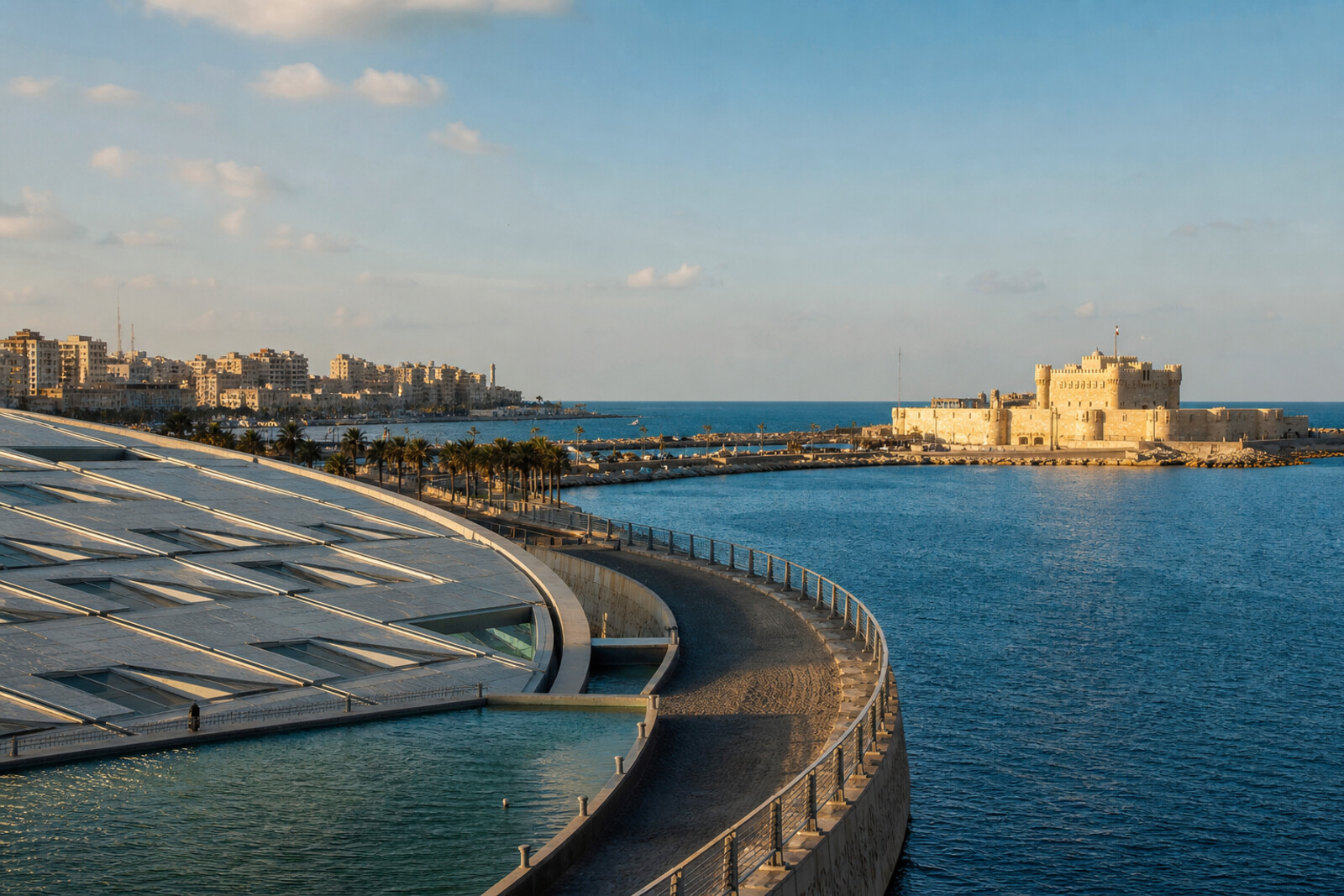
From Bibliotheca Alexandrina to Qaitbay Citadel
Guide On Map on your phone
Open the walk like a regular app
It takes about 10 seconds to install. No app store needed.
The whole path
Route map
About the walk
You will walk along Eastern Harbour—from the new library's disk, past squares, an old hotel, mosques, and the fishing shore, to the citadel at the end of Pharos Island.
At first, the route stays with the open water and the submerged Ptolemaic Royal Quarter. Then you enter a city of squares and balconies, where public speeches altered other people's lives and a hotel owner was left with only a few personal belongings. After the noisy center comes Anfushi: a major shrine, boats, the fish market, and the last stretch of shore before the citadel.
The story follows particular people and objects: a mosaic with a dog, a clock on a minaret, an ink stain, a wooden tray. It separates what is confirmed from what is disputed, without turning Alexandria into scenery for ancient legends.
By the end of the walk, you will understand why this city's most important traces must be sought at once in its squares, at the water's edge, and beneath it.
Why this order
The route follows one curve of Eastern Harbour, gradually changing scale. The modern library first raises the question of restoring a lost Alexandria, while the neighboring waters immediately show the limit of that restoration: the Ptolemaic Royal Quarter remains underwater. Al-Qaed Ibrahim Mosque then takes the story from the ancient harbour into the royal city of the twentieth century, and Saad Zaghloul Square continues the theme of state memory through a public monument. Nearby, Cecil Hotel moves it from the square into the home and business of one family. The next stop, Mansheya Square, broadens the scene again into a square holding many thousands and a national radio broadcast. From there, the route enters Anfushi: first a shrine that grew from a grave by the harbour, then the fishing shore, where a religious district becomes a working port. Qaitbay Citadel completes the line at the harbour entrance: after libraries, squares, prayer, and trade, it becomes clear why this whole shoreline required protection for centuries.
Those who want to walk through Alexandria by the sea without losing the city's history Those interested in the lives of buildings, monuments, and their creators Those who appreciate a calm story without an ancient haze or ceremonial rhetoric
Those looking for a short walk without long city crossings Those who only want accessible ancient ruins Those who prefer quiet lanes to large squares and the waterfront
Before you go
Plan your energy for a long city crossing, and bring protection from sun, wind, and sea spray. Corniche remains a busy traffic artery: use safe crossings and do not step into the roadway for the view. Plan visits to the library, active mosques, and Qaitbay Citadel separately; access inside may depend on institutional hours, prayer, or current work. At mosques, choose clothing that covers you, speak quietly, and ask about photography rules on site. At Anfushi Fishing Harbour, do not enter piers or unloading areas without an invitation. The underwater ruins cannot be seen from shore, so this part of the route calls for imagination rather than a search for stones in the water.
When to go
Allow around 3.5–4 hours for the walk with exterior viewing and short pauses. If you visit the library, accessible mosques, and Qaitbay Citadel, allow 5–7 hours. The walk from Mansheya Square to Anfushi takes a noticeable part of the route—leave roughly half an hour for it, not counting stops.
Backup plan
If the library is inaccessible, begin with the sloping disk, the granite wall, and the view of Eastern Harbour: exterior viewing is enough for the route's logic. A mosque closed for prayer does not cancel the stop either—the architectural idea can be read from the square, and you can return to the mausoleums separately. If you are very tired after Mansheya Square, shorten indoor visits but keep the walk out to Anfushi: that is where the route changes its urban register. If you cannot enter Qaitbay Citadel because of hours or repairs, finish at the fishing harbour and the outer walls, where you can still see the fort's connection to the port and its vulnerability to the sea.
Route conditions
Surface. Paved — 2.1 km (data covers 39% of the route)
Stairs. Flights: 3, 21 m in total
Access. Wheelchair — no; stroller — limited (stairs)
Facilities. Toilets — 3; drinking water — 3
Elevation. Ascent — 69 m; descent — 75 m
OpenStreetMap extract of July 2, 2026: database data, not a check on the ground. Data © OpenStreetMap contributors, ODbL licence
Walk plan
Open in maps ↗- 1
Bibliotheca Alexandrina
Here, the modern project of restoring a great collection will meet the fate of the man who worked to create it. - 2
Eastern Harbour and the Sunken Royal Quarter
The waters make it possible to reconstruct a defeated commander's final attempt to hide from the city and his allies. - 3
Al-Qaed Ibrahim Mosque
This stop will show how a request for a place to pray became the monarchy’s last major memorial project. - 4
Saad Zaghloul Square
Here, the reception of a national leader continues with the story of the sculptor who was not allowed to see the monument installed. - 5
Cecil Hotel
The hotel serves the route as a personal story of a building the family tried to recover after being expelled. - 6
Mansheya Square and the Muhammad Ali Monument
The commercial cityscape becomes the scene of an assassination attempt that the entire country heard live on the radio. - 7
Abu al-Abbas al-Mursi Mosque
Here you will see how a merchant's endowment turned a revered grave into a permanently functioning shrine. - 8
Anfushi Fishing Harbour
A working harbour will show how selling today’s catch pays for a boat’s next trip to sea. - 9
Qaitbay Citadel
The final stop will test whether the sea fortress was able to carry out the task for which it was built.
Route features
Everything you need stays in the browser
Progress, saves and your trip plan are stored on this device.
Add Guide On Map to your home screen so the walk opens outside the browser.
How we handle sources, maps and corrections: our editorial standards