 Guide On Map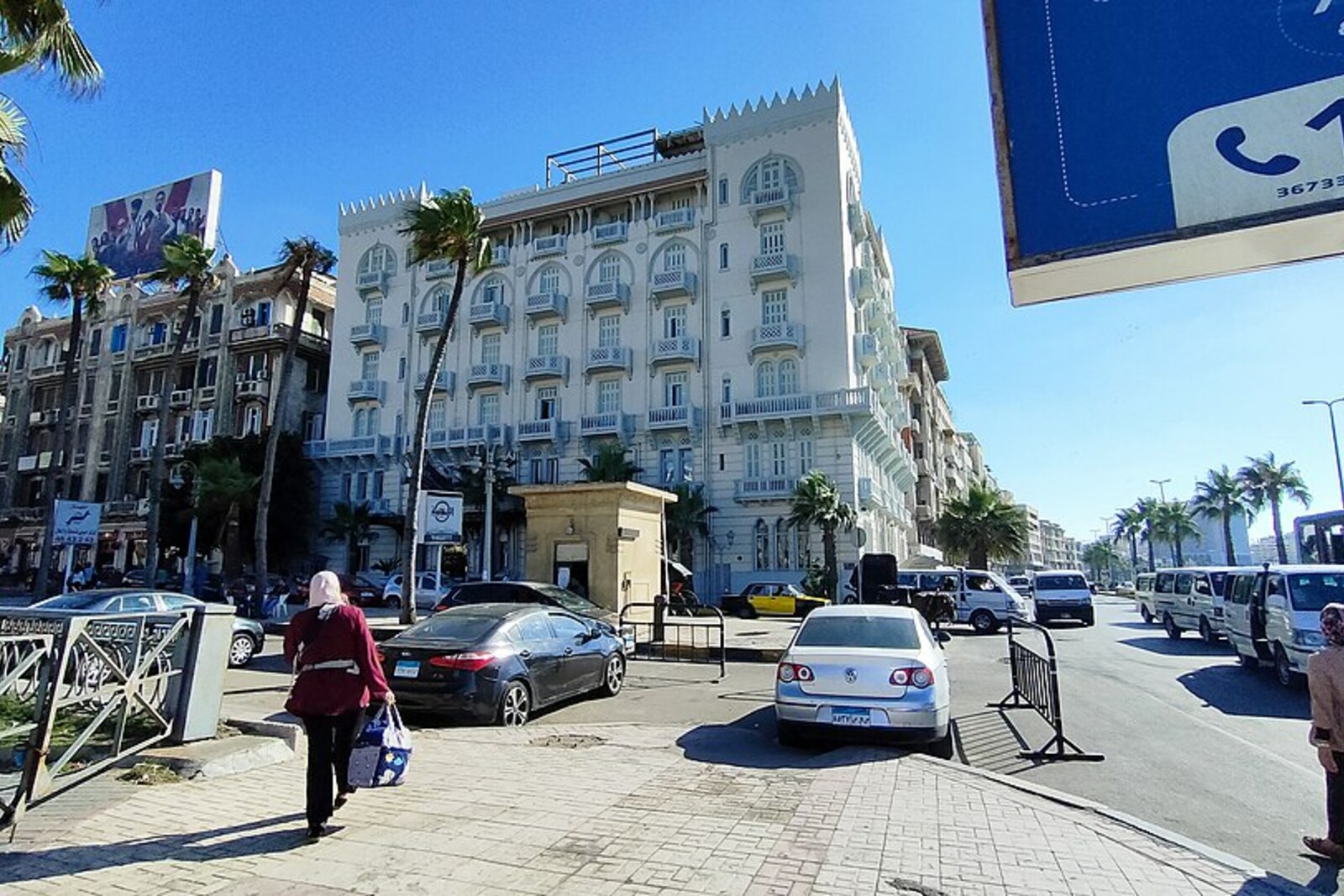
Look around first
What to notice
- The “Cecil” sign
- Main entrance
- Façade balconies
- First-floor windows
The story of the place
Two names appear together on the façade: “Steigenberger” denotes the current hotel brand, while “Cecil” remains from the family that opened the hotel in nineteen twenty-nine. The Metzger family named it after Cecil, the son of the owner Albert Metzger.
For Albert, this building was both a business and a home. He was born in Egypt to a Jewish family that had long ago moved here from France, owned several hotels, and lived in a separate apartment on the first floor of the Cecil Hotel. From there, he oversaw the reception of guests and the work of the staff. The hotel by the harbour brought the family income, and it was also where they held their celebrations: in the mid-nineteen fifties, Albert’s daughter-in-law Patricia Metzger celebrated her engagement at the Cecil Hotel.
In the autumn of nineteen fifty-six, after the Suez Crisis, the Egyptian state began seizing businesses from Jews and foreigners. Albert was given a few days to leave and was allowed to take only clothing in his luggage. He left the hotel, traveled with his family through Libya and Italy, and then moved to England. He was never allowed to return to Alexandria.
Metzger tried to start over in Dar es Salaam: he bought the New Africa Hotel there and once again made his living in the hotel business. In nineteen sixty-four, this property was nationalized as well. Albert died seven years later, never having seen the Cecil Hotel again.
Patricia sought its return—the very woman whose engagement had once been celebrated in this building. After her father-in-law’s death, she and her children spent decades in court over the hotel. In nineteen ninety-six, a court recognized the Metzger family as the owners of the building and the land, but the ruling was not carried out for another eleven years. During trips to Alexandria, Patricia tried to find family belongings: the clock from Albert’s apartment, his books, and a gilded album bearing guests’ signatures.
In nineteen oh seven, the heirs were finally transferred the legal rights to the hotel. That same day, they sold it to an Egyptian state company: Patricia wanted to run the Cecil Hotel herself, but after half a century of legal proceedings, she agreed to a final settlement. Before leaving, the family received Albert’s clock, a pair of his shoes, and several volumes of an encyclopedia.
The hotel continues to receive guests. The Metzger family owned it for only one day after a fifty-year legal battle, but above the entrance still stands the name of their son—“Cecil.”
Useful on site
The façade is visible around the clock. The hotel is operating; access to the lobby and photography inside are determined by the administration.
Checked: date not specified. Check the official source before visiting.The hotel remains in operation and is not an open museum site. View the façade from the street; interior spaces are accessible under the hotel’s conditions.