 Guide On Map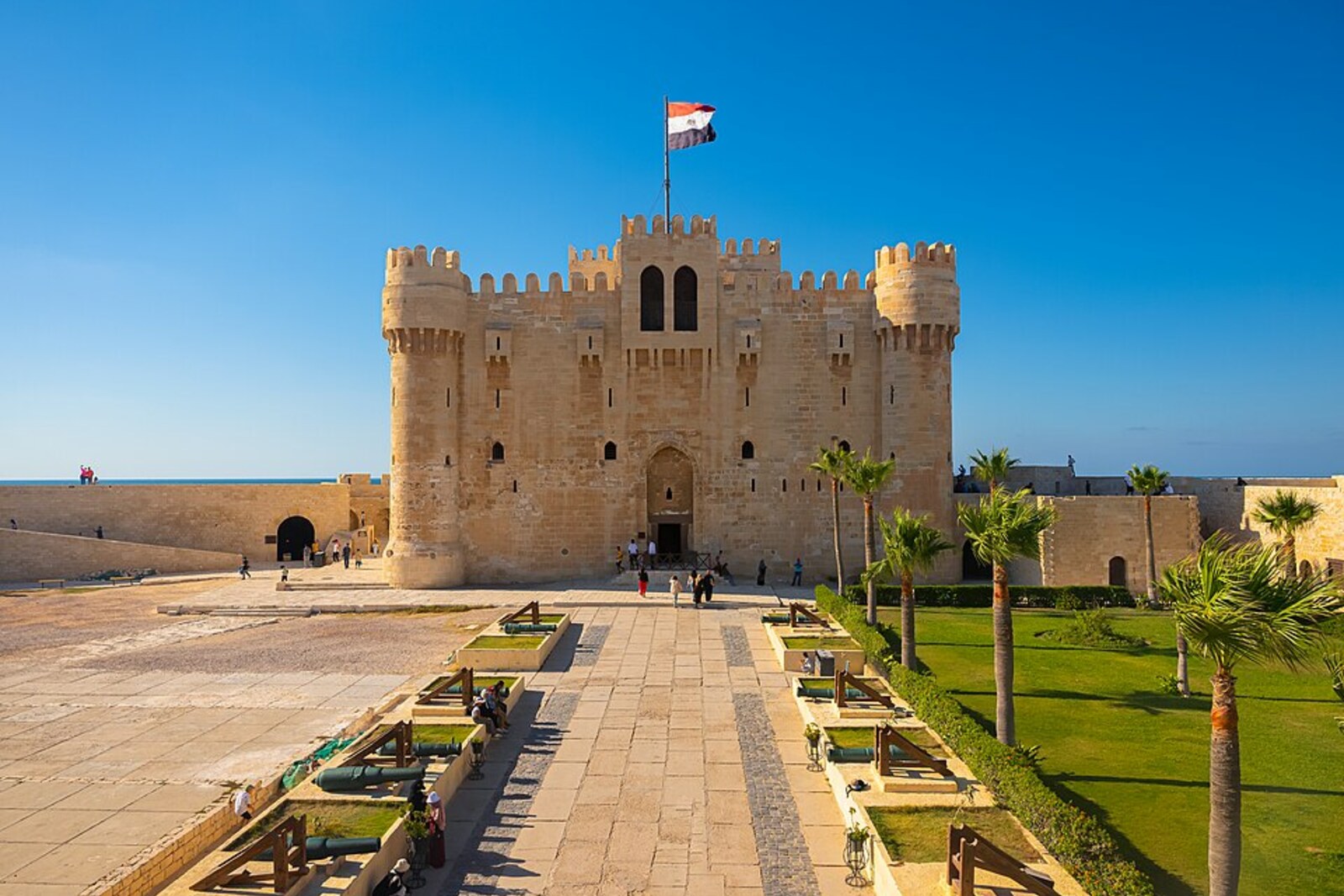
Look around first
What to notice
- Square three-story keep
- Outer walls
- The sultan’s emblem above the entrance
- Marble slab with the order
The story of the place
Qaitbay in the citadel’s name is the name of a Mamluk sultan of Egypt. In June fourteen seventy-seven, he arrived in Alexandria to inspect the walls, towers, and harbour. He was concerned about the open passage from the sea: the Ottomans were expanding their possessions in the Eastern Mediterranean, and the people of Alexandria already knew how weak coastal defenses could end. A century earlier, the troops of the king of Cyprus had captured and plundered the city.
The mouth of Eastern Harbour remained especially vulnerable. It had once been marked by the Lighthouse of Alexandria, but earthquakes destroyed the tower, and by the sultan’s arrival its ruins lay at the tip of ancient Pharos Island. Qaitbay ordered a fortress tower to be built on the old foundations and enclosed by a wall. The site was chosen not in memory of a wonder of the world: from here, the garrison could meet ships before they entered the harbour.
The Mamluk sultan headed a military system in which former slave-warriors became officers and courtiers after training and emancipation. Qaitbay himself followed this path. Within the walls, he stationed people from the same military milieu, with weapons, provisions, and horses. Fresh water was brought here from the city cisterns on pack animals and poured into underground reservoirs. Without these supplies, the defenders on the headland projecting into the sea could not have withstood a siege. A mosque was installed on the ground floor of the main tower, with storerooms and quarters for the garrison above, and at the top a hall from which the sultan or the commander could watch the movement of vessels.
Construction was completed by fourteen seventy-nine. Qaitbay died seventeen years later and did not see the war for which he had prepared the coast. When the Ottoman threat drew closer, the Mamluk sultan Qansuh al-Ghuri strengthened the outer wall and stationed heavy guns here. He ordered an inscription carved in marble: weapons, gunpowder, and equipment were forbidden to be taken out of the citadel, and a violator faced the gallows at its gate. Al-Ghuri then personally observed artillery drills here.
In fifteen sixteen, al-Ghuri died after defeat by the Ottoman army. A year later, the Ottomans conquered Egypt. The citadel did not stop their campaign: they advanced mainly by land. Having taken Alexandria, the victors preserved the fortification and stationed their own garrison here, with infantry, cavalry, and artillery.
Of Qaitbay’s construction, a square three-story keep remains; the surrounding walls were repeatedly rebuilt later. The sultan’s emblem remains above the tower entrance, and inside is the marble slab bearing al-Ghuri’s order. The lighthouse itself no longer stands above the water. Its massive blocks lie directly east of the citadel, at a depth of six to eight meters.
Useful on site
Daily. The ticket operator gives the last entry as 19:00 in summer, 17:00 in winter, and 15:00 during Ramadan; the monument’s official listing separately gives 09:00–20:00. Follow the earlier cutoff and check again on the day of your visit.
Checked: date not specified. Check the official source before visiting.The outer silhouette and the citadel’s connection to the sea can be seen without entering. Plan a separate visit to the inner courtyards and tower; near the water, keep away from waves and protective blocks.