 Guide On Map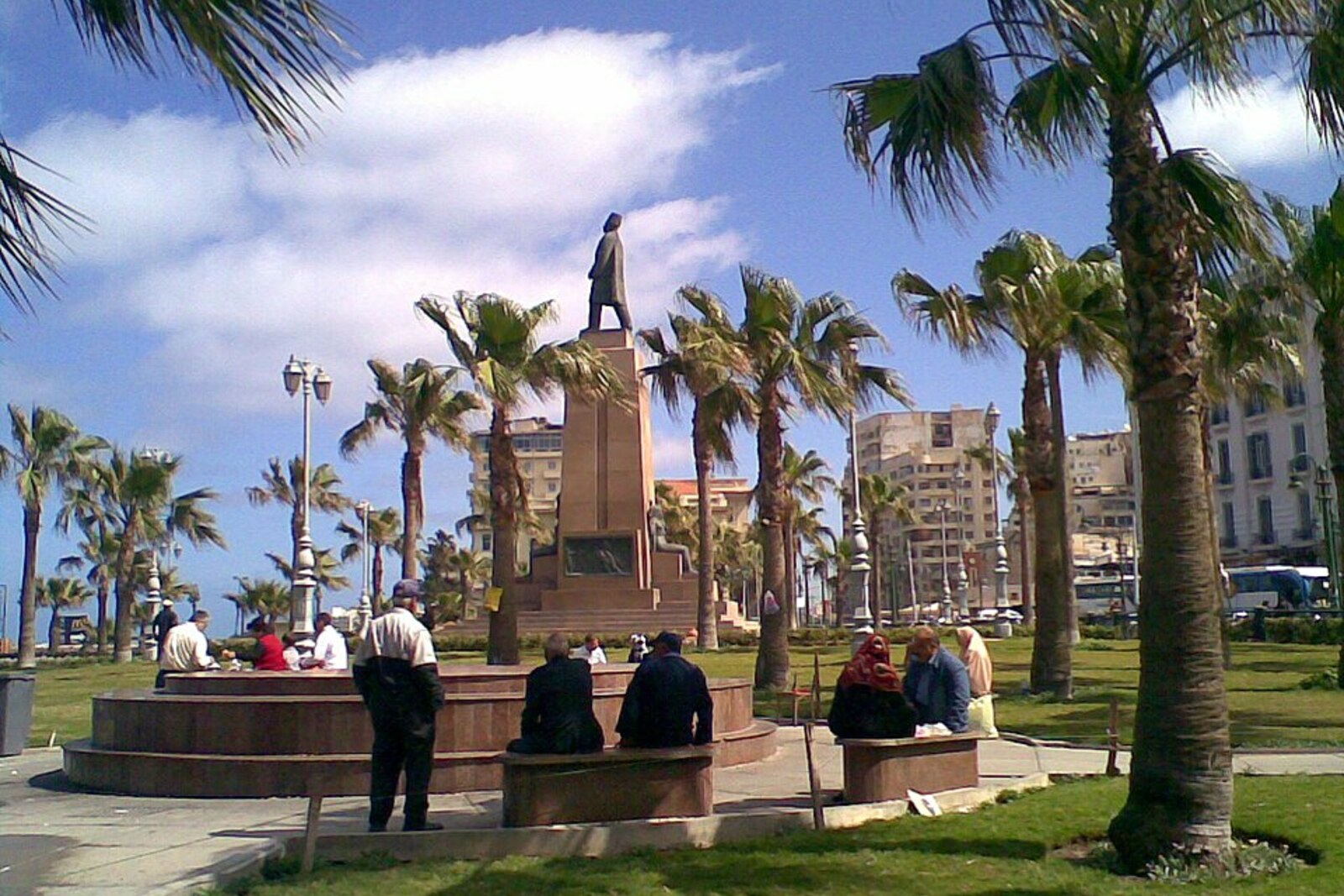
Look around first
What to notice
- Bronze figure in a coat and fez
- Granite pedestal
- Side reliefs
- Tram tracks
The story of the place
By the Eastern Harbour, the broad open space was first called Obelisk Square. The ancient Egyptian monoliths that gave it this name were sent long ago to London and New York; a monument with a bronze figure on a granite base appeared on the cleared site. The reliefs on its sides preserve an entire political story, while the tram tracks recall that the square has remained an urban crossroads between the center and the sea. Its present name is connected with the man above.
Between the Corniche and the Ramla tram junction, people change trams, walk to the Eastern Harbour, and arrange to meet by the tall granite pedestal. The bronze man in a long coat and fez is shown walking toward the sea. This is Saad Zaghloul—an attorney and former minister who, after the First World War, sought Egypt’s independence from British occupation.
On November thirteenth, nineteen eighteen, Zaghloul and two of his associates went to the British high commissioner. They demanded permission for an Egyptian delegation to take part in the Paris Peace Conference. In Arabic, a delegation is a “wafd”; this word would soon be used for Zaghloul’s movement and party. To prove that they represented the country, supporters collected signatures and powers of attorney. The British administration responded with arrests: Zaghloul was exiled to Malta.
The exile of a man who had expected to act as a lawyer and negotiator sparked the uprising of nineteen nineteen. The British had to release the exiles and allow the delegation to go to Europe. Zaghloul did not obtain independence there, but on April fourth, nineteen twenty-one, he returned through Alexandria, already recognized as a national leader.
At that time, this place was called Obelisk Square. The two ancient Egyptian monoliths that had once stood here had by then been taken to London and New York, while the open area between the city and the harbour retained its former name. It was here that Alexandrians welcomed Zaghloul. People from all over Egypt arrived in the city in advance; special trains were scheduled for them, and places on balconies along the procession route were rented out for money. From the harbour, the procession made its way through central Alexandria.
A few months later, the British exiled Zaghloul again, this time to the Seychelles. After his return, his party won the first parliamentary elections under the new constitution, and in nineteen twenty-four he headed the elected government. That is why the monument was given the site where, during his lifetime, the crowd had shown whom it considered its representative.
After Zaghloul’s death, the commission for two monuments—for Cairo and Alexandria—went to the Egyptian sculptor Mahmoud Mokhtar. He prepared models, began work in France, and expected to receive eight thousand Egyptian pounds under the contract. Then Prime Minister Ismail Sidqi abolished the constitution, removed Zaghloul’s supporters, and halted the installation of the monuments. Officials demanded that the pedestals be redesigned; a court dispute over the contract and the money began.
Mokhtar died in nineteen thirty-four, without waiting for the court’s decision and without seeing either statue in its square. The bronze parts were cast in Paris and installed after his death. On August twenty-seventh, nineteen thirty-eight, the eighteen-year-old King Farouk removed the covering from the Alexandria monument.
On the pedestal, Mokhtar preserved the entire chain of events through which the square received its present name. One relief depicts the meeting of November thirteenth: Zaghloul and his companions demand recognition for the Egyptian delegation. Another shows people raising their representative above the crowd. Above them stands the very man whom the government did not want to let leave the country, and then for many years did not allow to be placed in the city center.
Useful on site
Open city square, accessible around the clock.
Checked: date not specified. Check the official source before visiting.The square is crossed by traffic and pedestrian flows. View the monument from a safe point and cross streets only where provided for.