 Guide On Map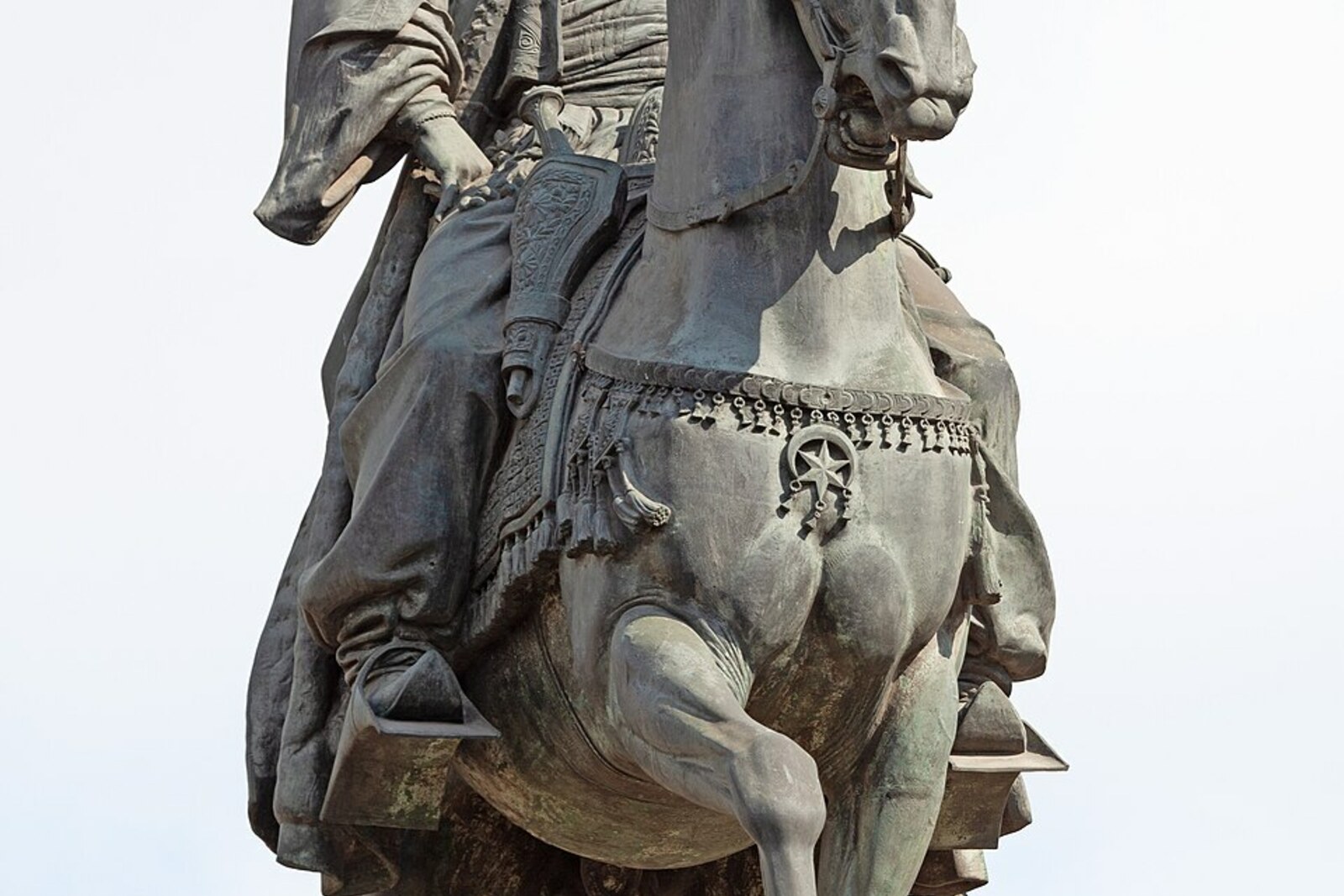
Look around first
What to notice
- Bronze rider
- Stone pedestal
- The square's open rectangle
- Facades of trading houses
The story of the place
The bronze rider at the center of the square is Muhammad Ali, the Ottoman governor who effectively ruled Egypt in the first half of the nineteenth century. He needed Alexandria as a deep-water port and a base for a new fleet. On his orders, the harbour was cleared, an arsenal was built, and the Mahmoudiyya Canal was cut, linking the city to the Nile. Warehouses, trading houses, and consulates grew up around the port—hence this place's former name, Consuls' Square.
After Muhammad Ali's death, his grandson Ismail, Egypt's hereditary ruler, commissioned an equestrian monument to the founder of the dynasty. The bronze figure was cast in France, exhibited in Paris, then transported by sea to Alexandria. In eighteen seventy-two, the rider was installed in the middle of the square and ceremonially unveiled a year later. The square was given Muhammad Ali's name; it is now more often called after the surrounding commercial district—Mansheya.
The spacious rectangle between the stock exchange, banks, and consulates was convenient for another purpose as well: mass rallies of many thousands gathered here. On the eastern side stood the Alexandria Stock Exchange, with a balcony above the square. On October twenty-sixth, nineteen fifty-four, Prime Minister Gamal Abdel Nasser stepped onto that balcony. He wanted to secure support for an agreement under which British troops were to leave Egypt.
Two years earlier, Nasser and the other Free Officers Movement members had overthrown the monarchy. Their former allies in the coup, a mass religious-political movement, expected to take part in shaping the new state. The officers did not allow the organization to exercise independent political leadership, and in January nineteen fifty-four they dissolved it. By autumn, the former allies had become opponents.
In the crowd before the stock exchange stood Mahmoud Abdel Latif, a thirty-two-year-old tinsmith from Cairo and a member of the movement's underground wing. During the speech, he raised a pistol and fired eight times at Nasser. Not one bullet struck the prime minister. A glass lamp shattered above the balcony, and ink from a damaged fountain pen spread across Nasser's uniform—the stain was initially mistaken for blood. People nearby tried to lead the speaker away, but he waved them aside, returned to the microphone, and continued his speech. The entire country had already heard the shots: the speech was being broadcast on the radio.
Abdel Latif was seized in the square. During the investigation, he admitted that he had received instructions from the organization's secret structure; its leaders denied giving that order, and later Nasser's opponents called the assassination attempt a staged event. What remains proven is the shooting during the live broadcast, the arrest of the shooter, and the trial that followed.
The court handed down seven death sentences, one of which was commuted to life imprisonment. Abdel Latif and five other convicts were executed in December of that same year. Thousands of members of the movement were arrested. Huge crowds greeted Nasser on his way to Cairo, and in November President Muhammad Naguib, his last rival among the leaders of the coup, was removed from office and placed under house arrest.
The stock exchange building is gone: after a fire, it was finally demolished in nineteen eighty-two. The balcony from which eight shots made it onto a radio broadcast disappeared. The bronze Muhammad Ali, installed here eighty years before the assassination attempt, remained in the center of the square.
Useful on site
Open city square, accessible around the clock.
Checked: date not specified. Check the official source before visiting.This is a busy business district, not an isolated memorial. Watch the traffic and do not step into the roadway for a closer shot.