 Guide On Map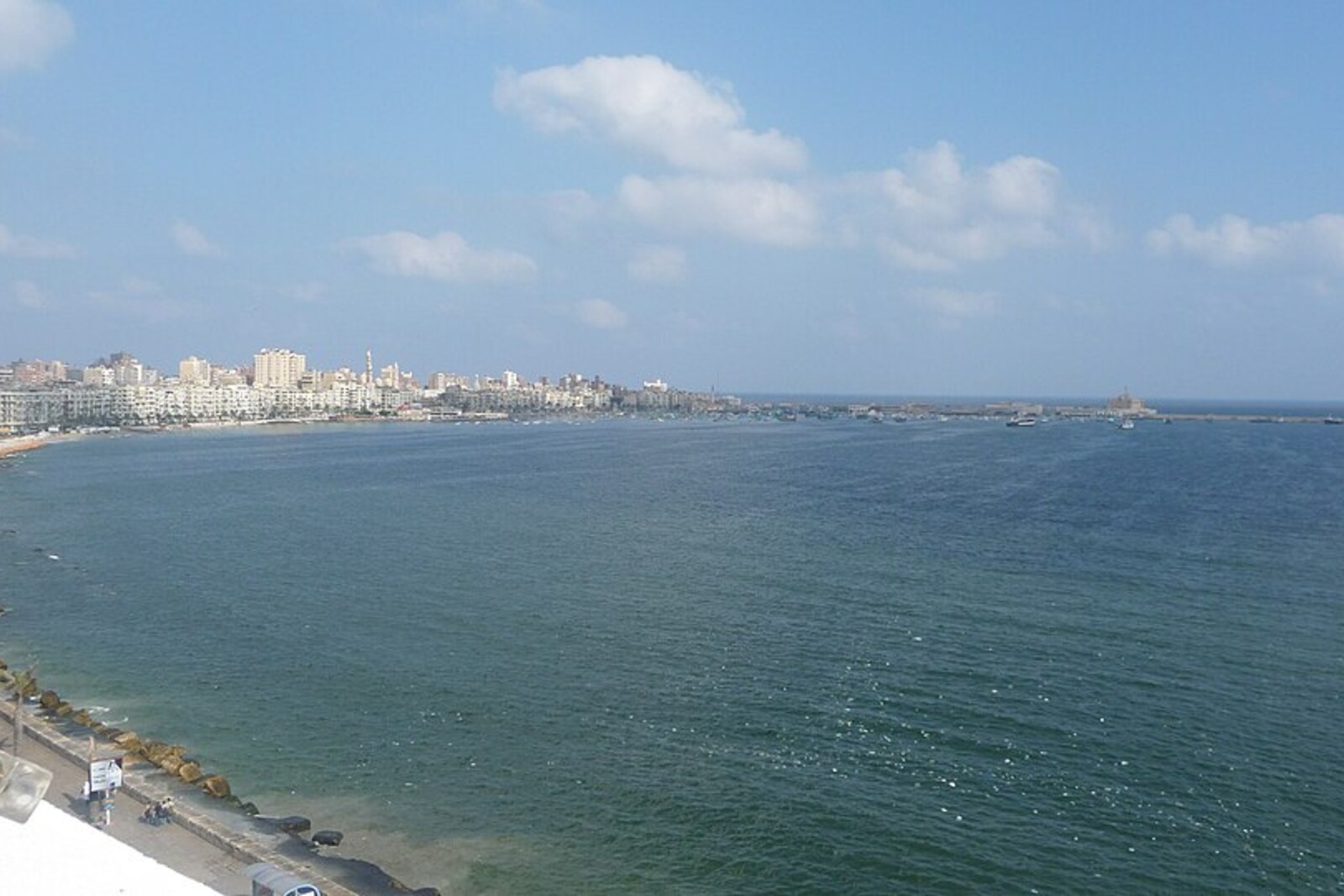
Look around first
What to notice
- The smooth waters of Eastern Harbour
- Stone breakwaters
- Fishing boats
- The line of the Corniche
The story of the place
Here Mark Antony tried to settle literally outside Alexandria—in a house on a mole extending into the waters of the royal harbour.
In thirty-one BCE, this Roman commander and ally of Queen Cleopatra lost the naval battle at Actium to Octavian, his rival in the Roman civil war. Antony returned to Egypt, the last land where he still had ships, soldiers, and Cleopatra's money. Whether he would face Octavian at the head of an army or as a prisoner depended on their loyalty.
The shoreline then lay farther out than it does today. Along it stretched palaces, gardens, a theatre, temples, and shipyards connected by passageways. A separate artificial harbour was reserved for the royal family. In front of it lay Antirhodos Island, an island with a palace and its own small port. Each new king added another residence to this quarter, so it occupied a substantial part of Alexandria's coast.
Antony added a stone mole to the promontory that projected into the harbour and built a royal house at its end. He called it the Timonium, after Timon of Athens, whom ancient comedies portrayed as a man who came to hate society after his friends betrayed him. According to Plutarch, Antony declared that he had been treated the same way and intended to spend the rest of his life here, receiving no one.
The seclusion did not last long. Antony was told that the land army he had left at Actium was lost, that his former allies were going over to Octavian, and that he had no troops left outside Egypt. He then left the house on the mole and returned to Cleopatra in the palace. The following year, Octavian occupied Alexandria. Antony killed himself; soon Cleopatra did the same. Egypt became a Roman province, and Strabo described the Timonium as Antony's last building.
Over the following centuries, this stretch of coast subsided. Rising sea levels, earthquakes, and the tsunamis of three hundred sixty-five gradually sank the royal harbours and palaces beneath the water. Their remains lie at depths of two to eight meters.
Since the early nineteen nineties, archaeologists have been mapping the ancient shoreline, moles, harbour basins, and Antirhodos Island. The functions of individual foundations are still debated, so not every underwater column can confidently be called part of Cleopatra's palace. But the location of the Timonium has been reconstructed: the name of Antony's brief refuge now marks a sunken peninsula on the floor of Eastern Harbour.
Useful on site
The public promenade is accessible around the clock; the underwater archaeological area is not visible from the shore and is not a separate site open to visitors.
Checked: date not specified. Check the official source before visiting.The ruins lie at depth and cannot be distinguished from the promenade. Do not mistake modern embankments or random stones by the shore for ancient structures.