 Guide On Map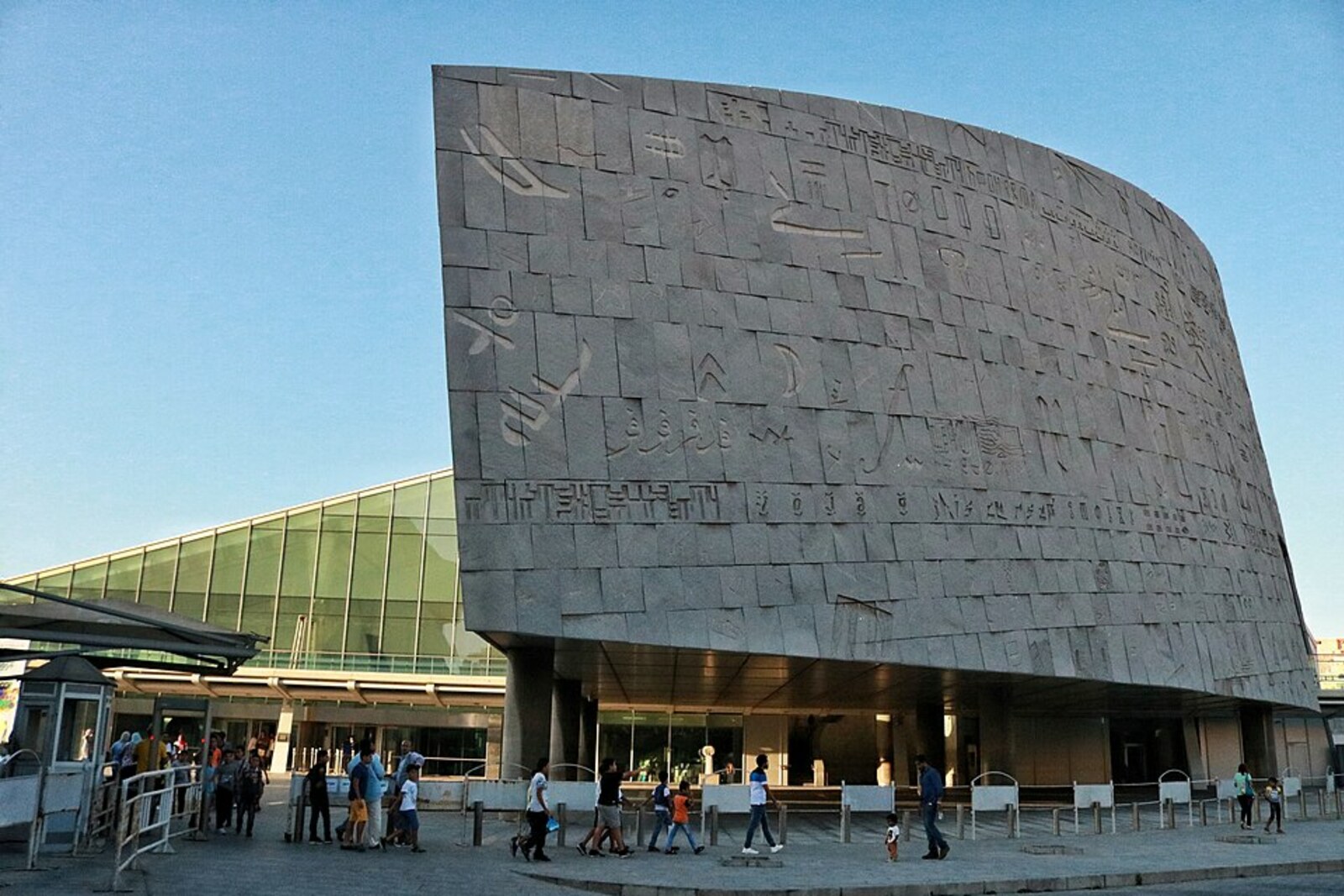
Look around first
What to notice
- The sloping round building
- The terraced reading room
- The mosaic with the spotted dog
- The archaeological museum
The story of the place
The name “Bibliotheca Alexandrina” refers to the ancient Library of Alexandria, but this is a modern institution. The exact location of the ancient library has not been found. All that is known is that it was part of the Ptolemies’ royal quarter, which occupied this part of the city by the harbour. The present building was placed between the sea and Alexandria University—it was the university that first needed a new library.
In the early nineteen seventies, Mostafa El-Abbadi, a professor of Greco-Roman history, ended one of his lectures by reproaching his own university. Scholars readily called themselves heirs to ancient Alexandria, yet they had no decent scholarly library. El-Abbadi lived on a professor’s salary and studied the vanished city: he read papyri, investigated the royal quarter, and tried to establish the fate of the ancient collection. He proposed creating a new universal library here—a research institution able to collect books from around the world.
Chance helped turn the university’s idea into a state project. In nineteen seventy-four, United States President Richard Nixon came to Alexandria. While viewing antiquities, he asked his Egyptian escorts where the famous library had stood and what had happened to it. No convincing answer could be found. That same evening, the rector of Alexandria University called El-Abbadi and demanded that he urgently prepare a memorandum on the library’s history.
The memorandum was read by people on whom the land and funding depended. El-Abbadi persuaded city leaders, Egyptian institutions, and UNESCO that Alexandria needed an international scholarly center. More than ten years passed before the project received global support. In nineteen eighty-eight, the first stone was laid, and in two thousand two, the round building sloping toward the sea was opened. Beneath its roof, they created a vast terraced reading room, specialized libraries, research centers, and storage facilities. Museums, exhibition spaces, a conference hall, and a planetarium appeared alongside it.
During construction, El-Abbadi had to defend not the idea itself, but the land beneath it. He believed that the excavation pit was being dug without a sufficiently thorough archaeological survey. From his nearby apartment, the professor filmed bulldozers and claimed that workers were throwing antiquities lifted from the ground into the sea. After the scandal he raised, work was suspended and archaeologists were allowed to carry out rescue excavations.
In the ground, they found remains of buildings from the royal quarter and several mosaics. The most famous one, made in the second century BC from tiny stone cubes, shows a spotted dog sitting in a red collar, with an overturned Greek vessel beside it. The mosaic is more than three meters long and just as wide. An archaeological museum was created within the library for the finds made directly in the excavation pit. El-Abbadi helped gather exhibits for it, seeking them out in storage facilities and at excavations.
That intervention cost him his place in the culmination of his own project. Heads of state and royal families came to the library’s ceremonial opening, but the professor was not invited. Guests were given his book, “The Life and Fate of the Ancient Library of Alexandria,” while its author spent the day at home, among his books.
He nevertheless continued to add to the new collection. One of his first gifts was a rare sixteenth-century edition of a compilation of Roman law. Before his death, El-Abbadi ordered that about six thousand books and scholarly papers be transferred here—his own and those of his wife, Azza Karara, a professor of English literature.
He was not among the honored guests at the opening. Now his books are kept in the library he created, and the mosaic with the sitting dog is displayed in the museum above the very ground that he made them investigate.
Useful on site
Main library: Mon–Thu 10:00–18:00, Sat–Sun 10:00–14:00, Fri closed. Visits, museums, and planetarium: Mon–Thu 09:30–17:00, Sat–Sun 10:00–14:00.
Checked: date not specified. Check the official source before visiting.The main details can be seen from outside. The museums, reading room, and other spaces require a separate visit under the library’s rules.