 Guide On Map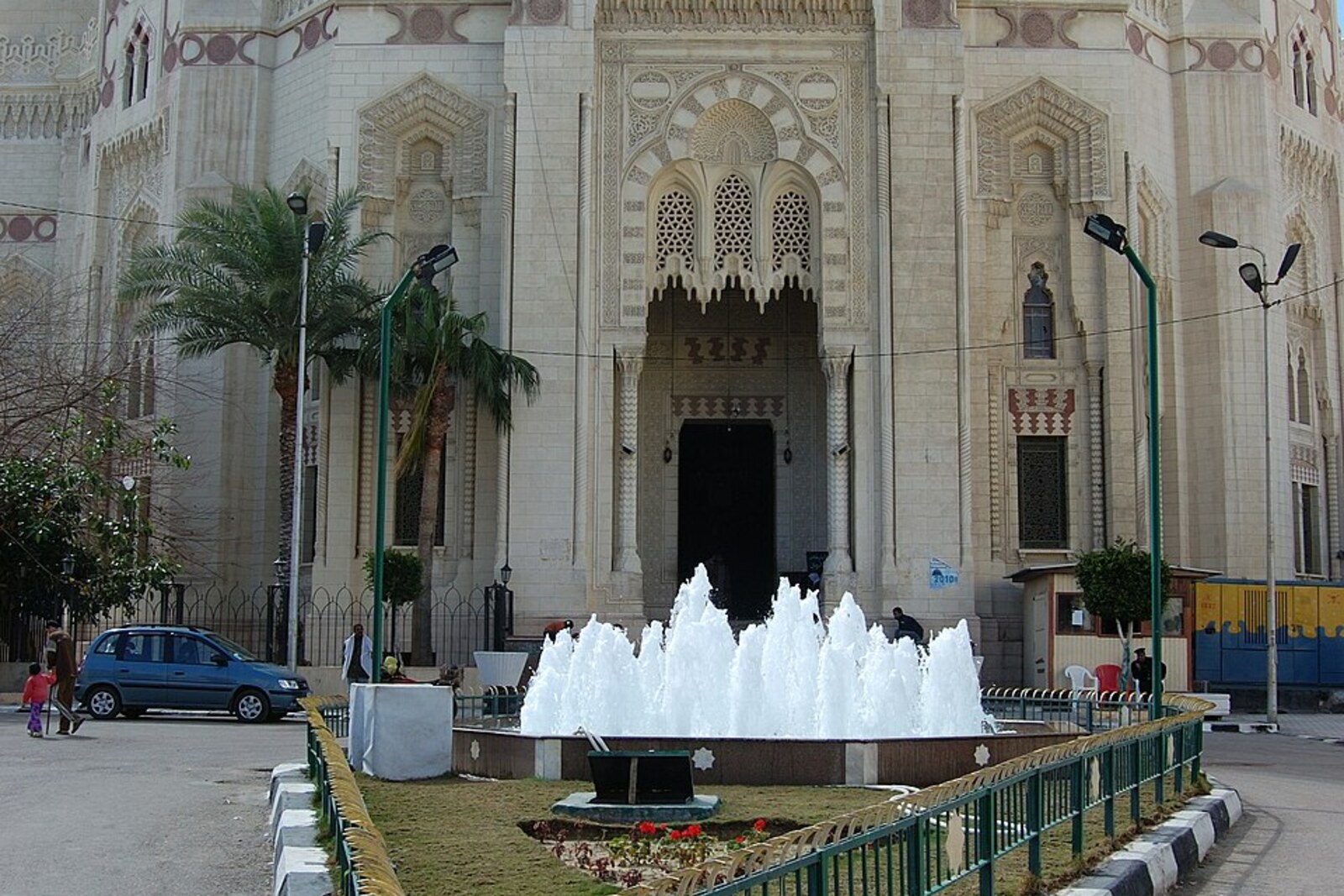
Look around first
What to notice
- Light-colored domes
- Tall minaret
- Arched entrances
- Tombs beneath the western dome
The story of the place
The first mosque here was paid for by Zayn al-Din ibn al-Qattan, the head of Alexandria's merchants. In thirteen oh seven, he came to a grave above which there was still neither a dome nor a prayer hall. The man buried here had died about twenty years earlier, but pilgrims were already coming to his tomb. The merchant decided to give this grave walls, attendants, and a permanent income.
The deceased was named Shihab al-Din Ahmad, but in Alexandria he was known as Abu al-Abbas al-Mursi. Al-Mursi means “man from Murcia”: he was born in the Spanish city of Murcia, into a merchant's family, and from his youth helped his father himself. At the age of twenty-four, the family set out by sea for Mecca. Off the coast of Tunisia, their ship was caught in a storm; Abu al-Abbas's parents died, but he and his brother survived.
The brothers remained in Tunisia. There Abu al-Abbas met Abu al-Hasan al-Shadhili, a Sufi teacher who gathered disciples around him for prayer, remembrance of God, and spiritual instruction. Al-Shadhili accepted the young merchant's son into his circle, gave him his daughter in marriage, and took him with him to Alexandria. After his teacher's death in twelve fifty-eight, Abu al-Abbas led his disciples.
He taught in Alexandria for nearly three decades. Abu al-Abbas wrote no books: his words were recorded by his disciples, above all Ibn Ata Allah al-Iskandari. Thanks to these records, the teachings of the Shadhili Sufi order spread far beyond the city. Ibn Ata Allah himself stated that at his death, his teacher left neither a house, nor a garden, nor a source of permanent income.
When Abu al-Abbas died in twelve eighty-seven, his disciples buried him here, in Bab al-Bahr Cemetery by Eastern Harbour. No mosque existed then. The place lay on the route of people from the Maghreb and Andalusia: they stopped in Alexandria on their way to Mecca and visited the graves of revered scholars. Thus, the tombstone of the man born in Murcia became one of the points on a pilgrimage route that linked the western Islamic world with Egypt and the Hejaz.
Zayn al-Din ibn al-Qattan built a domed mausoleum over the grave, with a small mosque and minaret beside it. He appointed an imam and attendants, and transferred part of his property for their upkeep. After the merchant's death, the payments continued: the grave was maintained, prayers were said in the mosque, and visitors had a place where they could honor the shaykh. A bare grave had become a permanently functioning institution.
A century and a half later, the buildings began to deteriorate. Kijmas al-Ishaqi, the governor of Alexandria, paid for their restoration and arranged for his own tomb beside Abu al-Abbas. After his death, he was buried here. A place beside the Sufi teacher became part of the reward the mosque's patron had prepared for himself.
The present building was erected much later. In the late nineteen twenties, the Ministry of Awqaf commissioned Eugenio Valzania and Mario Rossi to replace the old complex with a large city mosque. The architects enlarged the prayer hall but preserved the original center: beneath the western dome remained the tombs of Abu al-Abbas and his sons.
Today, regular prayers are performed here and the mausoleum is visited. During the annual mawlid, a celebration commemorating the shaykh, Sufi brotherhoods and pilgrims from different parts of Egypt come to the mosque and the square. They read the Quran, hold gatherings for the remembrance of God, and make their way to the grave. The walls around it date from the twentieth century; the burial itself occupies the part of Bab al-Bahr Cemetery that the disciples chose in the thirteenth century.
Useful on site
Active mosque. Exterior viewing is available at all times; tourist entry inside depends on prayers, events, and the attendants' decision.
Checked: date not specified. Check the official source before visiting.The complex functions as a religious space. Be mindful of prayer times, dress respectfully, and ask permission to enter the mausoleum areas and to take photographs.