 Guide On Map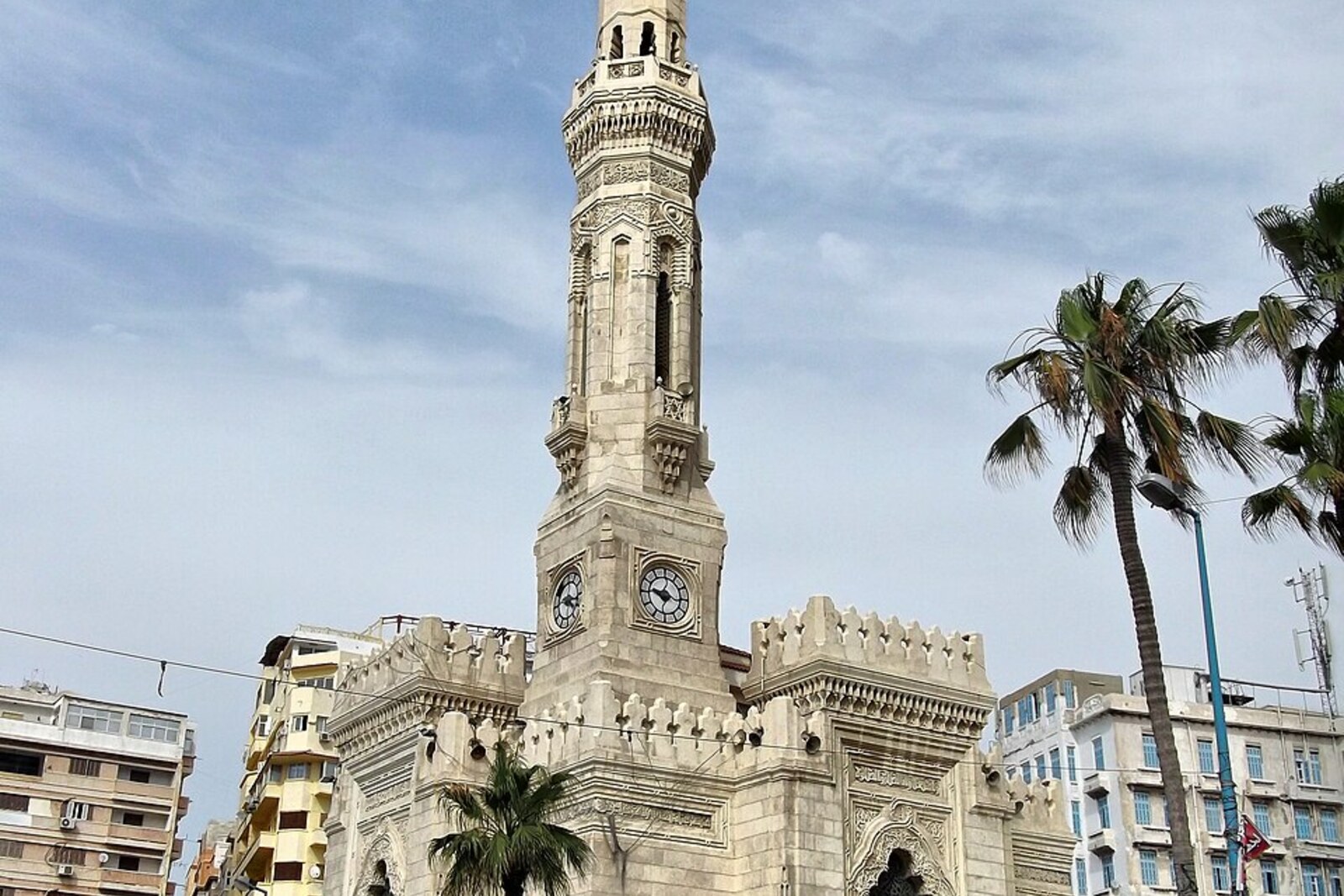
Look around first
What to notice
- Minaret with a clock
- Andalusian arches
- Upper tiers of the minaret
- Large chandelier
The story of the place
Wedged between tall buildings, the mosque rises above the street with its elongated minaret and clock: the architect Mario Rossi ensured that its silhouette would not be lost among the dense development. Its appearance combines arches reminiscent of Andalusian ones with upper tiers of the minaret that are Mamluk in character; inside hangs a chandelier purchased with the king’s personal funds. The building was completed in nineteen fifty-one, but it remains an active mosque: during Ramadan, worshippers fill not only the hall but also the square and neighboring streets.
In nineteen thirty-six, the young King Farouk came to Alexandria and saw city residents spreading prayer rugs directly on the square by Raml Station. There was not enough mosque space in this part of the city center, and residents asked for one to be built nearby. Farouk instructed the Ministry of Awqaf to find a site. By nineteen forty-one, officials had prepared a design for a mosque on Eastern Harbour, but the chosen site proved too cramped, the owners of neighboring shops objected, and the world war that had begun finally brought the project to a halt.
Farouk returned to the idea seven years later, now under a different name. Nineteen forty-eight marked one hundred years since the death of his great-grandfather Ibrahim Pasha, the son of Muhammad Ali and commander of the Egyptian army. In the eighteen thirties, Ibrahim led troops through Syria into Anatolia, defeated several armies of the Ottoman sultan, and came almost as far as Istanbul. The European powers intervened and forced the Egyptians to withdraw, but in the memory of the ruling family, he remained its foremost commander. The word “Al-Qaed” in the mosque’s name means “commander.” Ibrahim’s grave is not here: Farouk gave the mosque under construction his ancestor’s name when Egypt itself entered the war and the king needed to recall his family’s former victories.
The project was entrusted to Mario Rossi, an Italian who had previously served as chief architect of the Ministry of Awqaf and then worked as its external consultant. The site was surrounded by tall buildings, so Rossi raised the structure and lengthened the minaret so that the mosque would not be lost among the façades. He set a clock into the minaret; he made the arches resemble Andalusian ones and the upper tiers Mamluk in character. Farouk paid for the chandelier inside out of his own funds.
Construction was completed in nineteen fifty-one. By then, the war had ended without the victory for which the king had invoked his great-grandfather’s name. Farouk himself did not come to the opening and sent a minister. Sacrificial animals were slaughtered in the courtyard, the meat was distributed to the poor, workers were given money—and the mosque opened without a grand royal celebration.
The following year, Farouk was forced to abdicate and leave Egypt. His six-month-old son, Fuad II, formally became king; a year later, the monarchy was abolished. The mosque continued to operate, and during Ramadan, prayer rows again began to extend from the hall onto the square and neighboring streets—construction had once begun with exactly such a lack of space.
On April seventeenth, two thousand twenty-six, Fuad II came here with his children and grandchildren for Friday prayers. Farouk did not attend the opening of his mosque; seventy-five years later, his son prayed in it.
Useful on site
An active mosque. Exterior viewing is available at all times; tourist entry inside has no stable published schedule and depends on prayers and the attendants’ decision.
Checked: date not specified. Check the official source before visiting.This is an active mosque: do not disturb prayers or gatherings, comply with clothing requirements, and ask about entry and photography.