 Guide On Map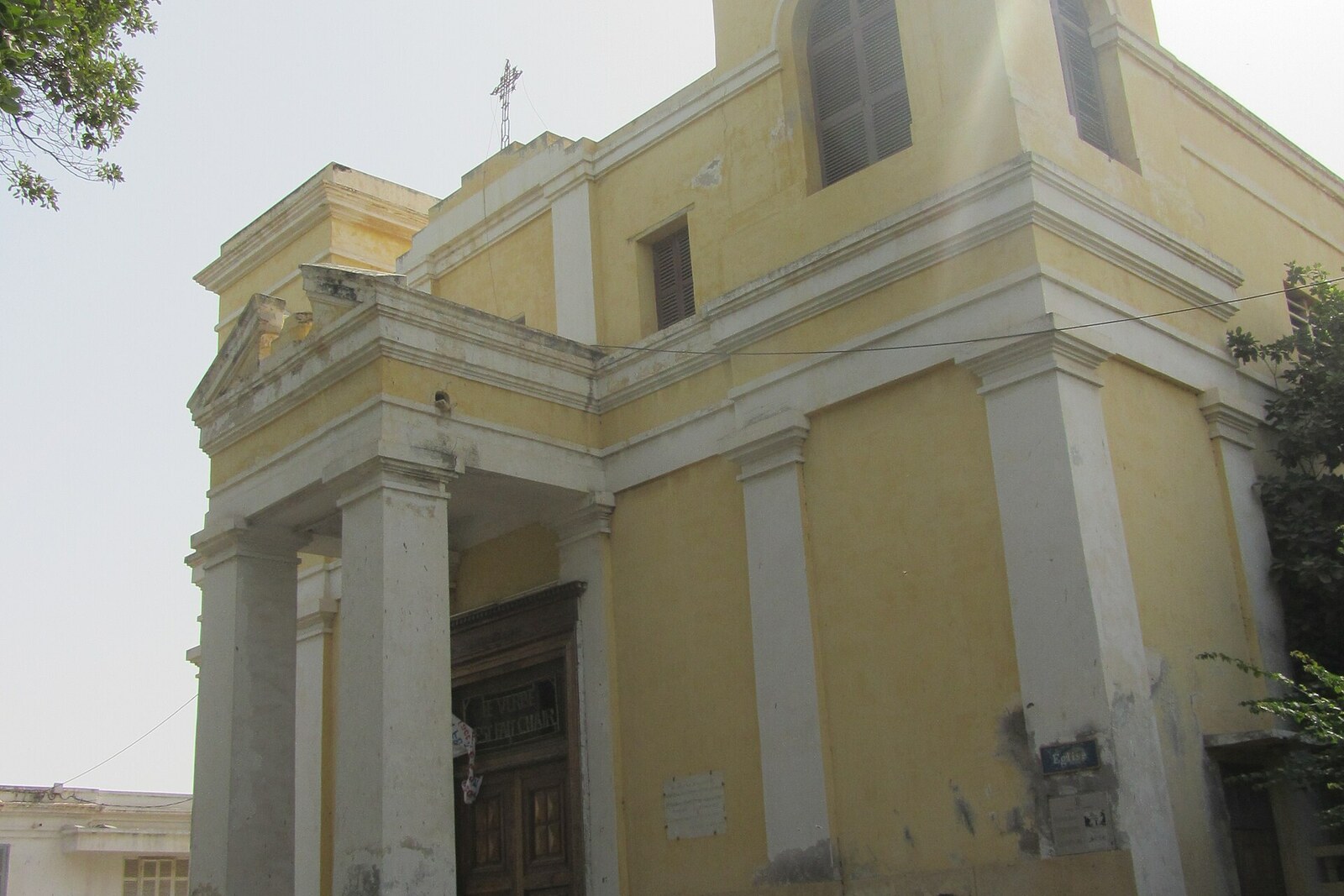
Look around first
What to notice
- Portico
- Figure of the sainted king
- Brick walls
The story of the place
The southern part of the island was once called Kertian, the Christian quarter: most of Saint-Louis’s Catholics lived here, and the present site was formerly occupied by a house that served as a hospital ward. Beside the hospital and the homes of this community, the island’s only Catholic church appeared; much later, it received cathedral status. The brick walls and the portico with a figure of the sainted king above the entrance recall to whom both the cathedral and the city itself are dedicated.
In eighteen twenty, Henri Baradère, the priest who led the Catholic Mission of Senegal, began raising funds for a proper church in Saint-Louis. Before that, services were held in the fort, in rooms of the military hospital, and in private homes. The thirty thousand francs promised by the French ministry did not reach the construction project, and Baradère proposed that parishioners pay for it themselves. He promised to have the donors’ names carved on a marble plaque in the choir of the future church.
Women from Senegalese-European families brought money and cloth. Masons and carpenters gave working days—that is, the very time by which they earned their living. But military engineers estimated the construction at seventy-five thousand francs, while the administration agreed to provide bricks and lime worth only twelve thousand. In March eighteen twenty-two, Baradère left Saint-Louis without having begun the church.
Shortly before his departure, Anne-Marie Javouhey, founder of the Sisters of Saint Joseph of Cluny, arrived on the island. Her nuns were already treating patients in the hospital and teaching girls; Javouhey wanted to establish their mission through a permanent church. She demanded that it be built and secured the support of Governor Jacques-François Roger.
The site was chosen where a house that had served as a hospital ward once stood. The southern part of the island was called Kertian—the Christian quarter: most of Saint-Louis’s Catholics lived here. This meant that parishioners no longer had to go to the fort or ask for a room for a service; the church was being built beside the hospital and the homes of the community for which it had been collected.
Javouhey herself returned to France in eighteen twenty-four and never saw Senegal again. Three years later, Roger laid the first stone. On November fourth, eighteen twenty-eight, the new head of the mission, Abbot Girardon, consecrated the building in the presence of European and Senegalese Christians. In the act, he called it the first and only church built on the island and dedicated it to Louis, King of France.
This was Louis IX of France—the medieval king whom the Catholic Church declared a saint. Both the church and Saint-Louis itself are named after him; the city’s name referred at once to the saintly ancestor and flattered Louis XIV of France, who ruled during the French settlement of the island. Only in nineteen sixty-six, when the separate Diocese of Saint-Louis was established, was this church called a cathedral.
Choosing a low-lying island site had one further consequence. Salt-laden moisture rose through the brick walls and damaged the load-bearing masonry. In nineteen oh five, the cathedral was closed; during a later restoration, builders dried the walls and applied plaster able to withstand salts and sea air. In nineteen twenty, the doors reopened for worship. Above the present portico stands a figure of the sainted king, and behind it the cathedral that Anne-Marie Javouhey secured, but never saw, remains in operation.
Useful on site
outside at any time; interior access depends on services and the parish schedule
Checked: June 24, 2026. Check the official source before visiting.The main account works from outside; if the doors are open, enter only with regard for worship and the community’s rules.