 Guide On Map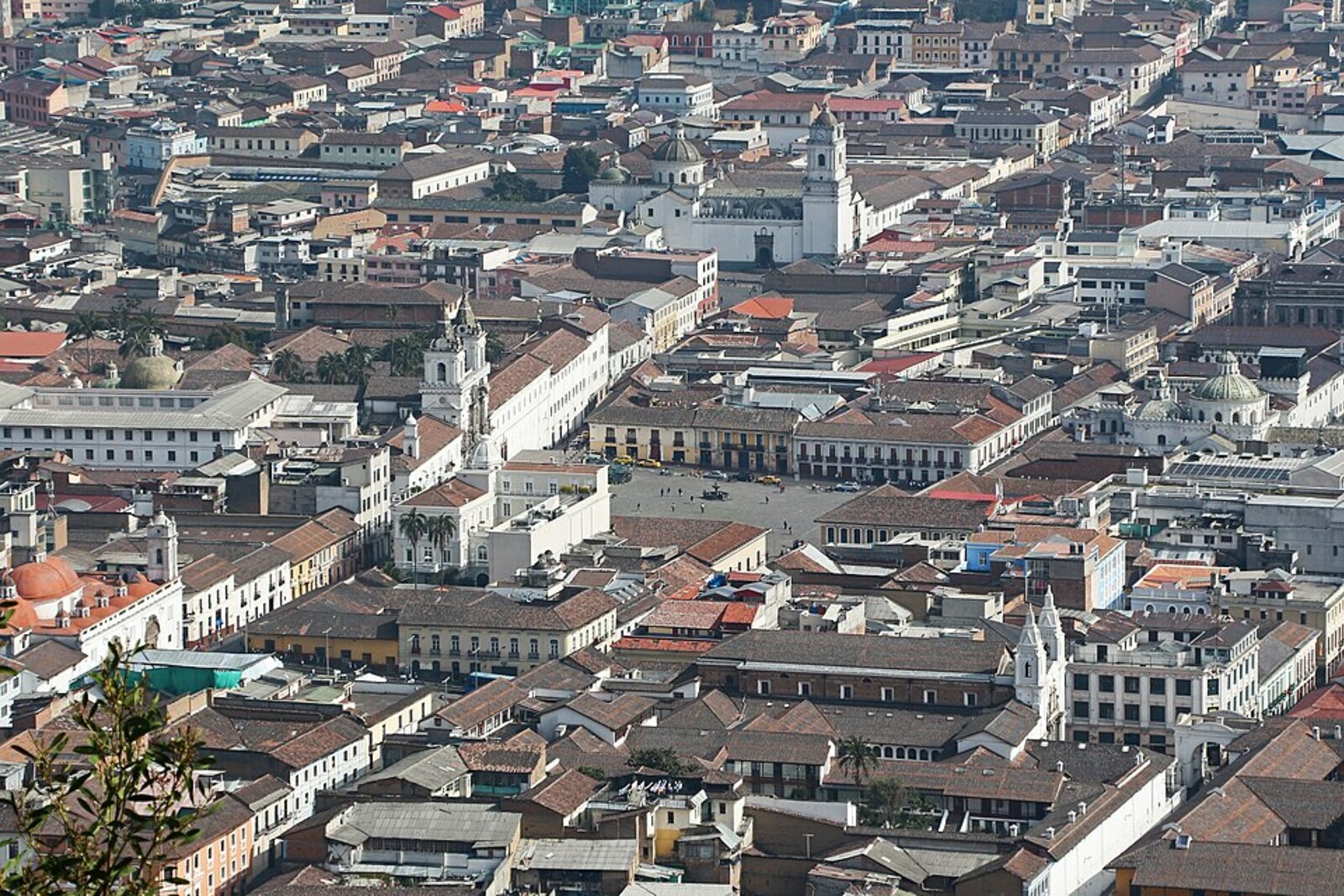
Look around first
What to notice
- Cantuña Chapel
- Stone staircase
- Raised atrium
- Fountain on the lower level
The story of the place
At the southern edge of the long monastery facade, a small chapel adjoins the church, and beside it a stone staircase rises to the high courtyard in front of the church. It was once administered by a religious brotherhood of Quito’s Indigenous people: lay members paid for services and arranged burials for their members here. Its original dedication was to Our Lady of Sorrows, but over time the city came to call it Cantuña Chapel.
The square is divided into two levels. For centuries, the lower rectangle remained part of the city: people traded here, drew water from the fountain, and gathered for celebrations. A metro station now lies beneath it, while the open space is still used for fairs and religious ceremonies. A stone staircase leads up to the raised atrium—the platform in front of the church where the monastery grounds began. The church and square received the name San Francisco from the Franciscans, followers of the Italian preacher Francesco d'Assisi.
At the southern, left-hand end of the monastery facade, there is a separate chapel. It was originally administered by a religious brotherhood of Quito’s Indigenous people: lay members jointly paid for services and arranged burials for their members. The chapel was dedicated to Our Lady of Sorrows, but it is now known as Cantuña Chapel.
Francisco Cantuña was an Indigenous man from Sangolquí who earned his living as a blacksmith and locksmith. The city council repeatedly appointed him master craftsman and overseer of the blacksmiths’ guild: he inspected the work of other craftsmen. Cantuña acquired houses and workshops, but the office alone did not secure his family a place beside the monastery altar. He obtained that through a separate agreement with the brotherhood.
In sixteen sixty-eight, Cantuña undertook to make door hinges, a lock, and keys for the chapel, and to pay for the decoration of the altar and two statues. The metal fittings alone were valued at nearly two hundred pesos. In addition, the master was to maintain a solemn Mass every year. In return, the brotherhood recognized him as the chapel’s lifelong patron, passed that right to his legitimate children, and assigned a family burial place.
Cantuña was indeed buried by the altar. In his will, he left money for an annual service for his soul and required it to be held until the end of time. The agreement had its effect even without eternity: residents gradually stopped calling the chapel by its former name and linked it to the blacksmith who paid for the altar, the doors, and the family tomb.
Later storytellers moved his agreement from the chapel to the vast atrium in front of the church. According to the best-known legend, the Franciscans ordered Cantuña to finish the stone platform by an impossible deadline. He promised the devil his soul if the final block was laid before dawn. Demons worked at night, but Cantuña hid one stone. By morning, the construction formally remained unfinished, the devil did not receive what had been promised, and the master kept his life and soul.
This is precisely a legend. Documents identify Cantuña as a blacksmith and patron of the chapel, not as the builder of the atrium; there is no reliably documented “missing block” here. At the southern edge of the facade survives the result of the agreement he actually made: the chapel bears his name, and the master himself lies by its altar.
Useful on site
The square is open as an urban public space. According to a Pichincha tourism source, the San Francisco Museum is open Monday through Saturday 09:00–17:30 and Sunday 09:00–13:00; before integration, it is best to check the museum’s official channel again.
Checked: July 1, 2026. Check the official source before visiting.After rain, take care on the smooth paving stones and steps. The museum spaces and the church are visited under their own rules, independently of the open square.